The modern workplace is no longer defined by desks and office space alone.
Today's corporate workplace experience platforms have evolved into comprehensive ecosystems that manage employee engagement, workplace services, facility operations, space utilization, visitor management, maintenance requests, meeting room reservations, hybrid work programs, and smart building experiences.
Organizations invest heavily in workplace experience platforms to improve employee satisfaction, increase operational efficiency, and create more productive work environments.
However, many companies quickly discover that a workplace experience platform is only as valuable as the systems it can connect to.
A workplace platform that operates in isolation creates information silos, duplicate processes, and fragmented employee experiences.
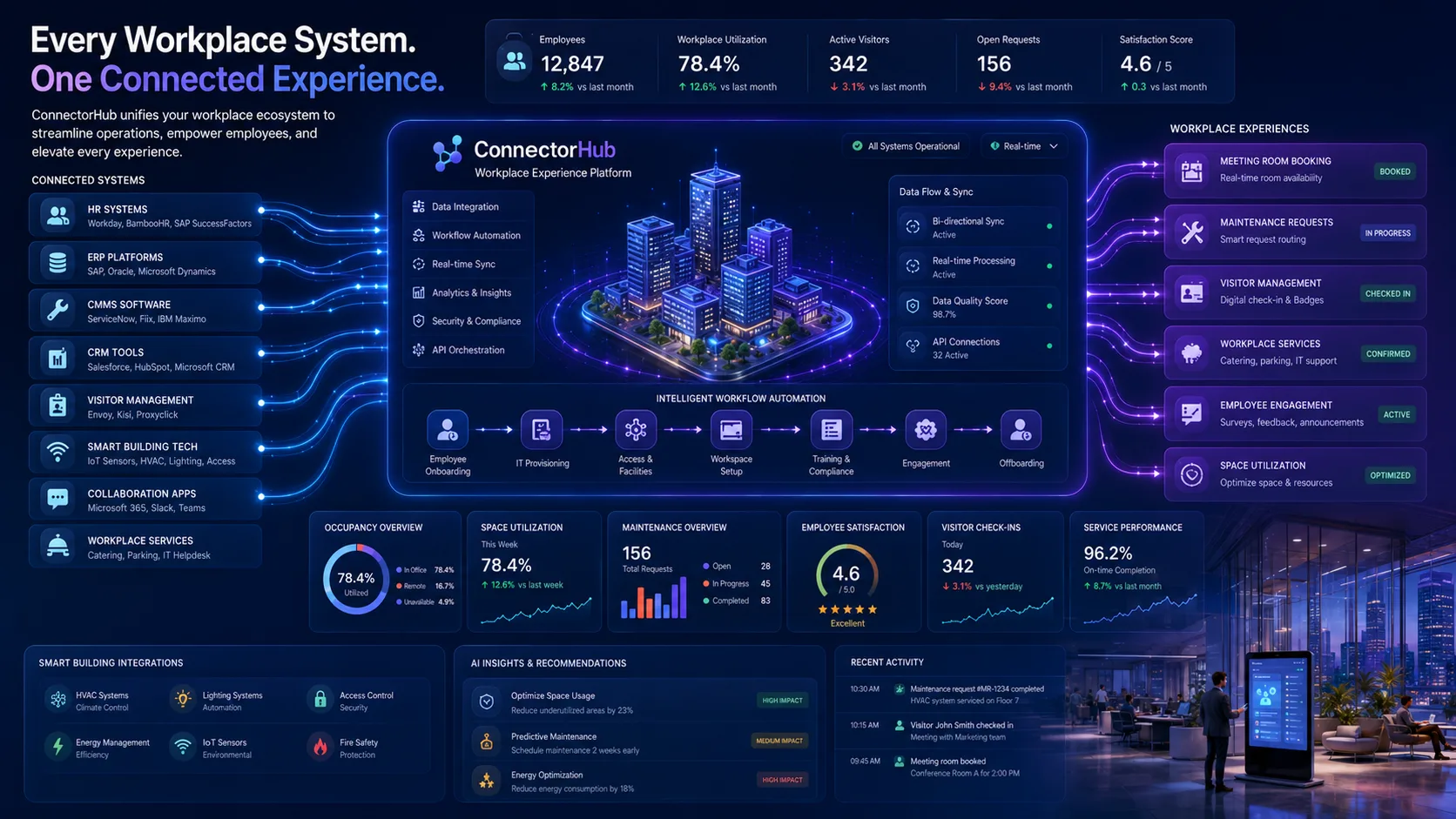
To deliver a truly connected workplace, organizations must integrate workplace experience platforms with ERP systems, CRM applications, CMMS software, HR tools, identity management systems, collaboration platforms, and building technologies.
ConnectorHub enables these integrations through a scalable architecture that connects workplace technologies with the broader enterprise ecosystem.
The result is a unified digital workplace that improves visibility, automates workflows, and enhances employee experiences.
The most common integrations required for workplace experience platforms include HR systems, ERP platforms, CMMS applications, CRM software, identity providers, visitor management systems, smart building technologies, collaboration tools, and financial systems. ConnectorHub helps organizations create a fully integrated platform by connecting these systems through automation, orchestration, and real-time data synchronization.
Why Workplace Platforms Need Enterprise Integrations
Corporate workplace experience platforms often serve as the central interface for employees.
Workers use them to:
- Reserve meeting rooms
- Submit maintenance requests
- Request workplace services
- Manage visitors
- Access workplace communications
- Report facility issues
- Schedule resources
Despite being employee-facing, workplace platforms typically depend on information stored in many other systems.
Without integration, employees encounter:
- Inconsistent information
- Manual processes
- Delayed responses
- Duplicate requests
- Poor service experiences
This is why successful workplace initiatives prioritize enterprise connectivity from the beginning.
The Evolution of the Digital Workplace
The workplace has become increasingly technology-driven.
Modern organizations often manage:
HR Platforms
Employee records and organizational structures.
ERP Systems
Financial and operational processes.
CMMS Applications
Maintenance and asset management.
CRM Platforms
Client-facing workplace and facility services.
Smart Building Systems
Environmental monitoring and building automation.
Collaboration Tools
Communication and employee engagement.
A modern workplace platform must connect all of these systems to create a seamless user experience.
HR System Integrations: The Foundation of Workplace Experiences
One of the most important integrations involves HR systems.
Employee information drives many workplace processes.
Examples include:
- Employee onboarding
- Department assignments
- Office access
- Workspace allocation
- Team structures
ConnectorHub synchronizes HR data with workplace platforms to ensure employee information remains accurate and current.
This enables organizations to automate provisioning and improve workplace service delivery.
ERP Integrations for Financial and Operational Visibility
Workplace operations often have financial implications.
Organizations need visibility into:
- Facility expenses
- Workplace services
- Vendor costs
- Capital projects
- Space utilization costs
Integrating workplace platforms with ERP systems allows organizations to:
- Track operational spending
- Automate approvals
- Allocate costs
- Improve reporting
ConnectorHub supports these processes through robust integration capabilities that connect workplace applications with enterprise resource planning systems.
Why CMMS Integration Is Essential
Facilities and maintenance operations play a central role in workplace experiences.
Employees frequently submit requests involving:
- HVAC issues
- Lighting problems
- Furniture repairs
- Cleaning services
- Equipment maintenance
A workplace platform should not manage these requests independently.
Instead, requests should flow directly into maintenance systems.
This is where CMMS ERP integration becomes highly valuable.
ConnectorHub enables workplace platforms to automatically create and update maintenance work orders within CMMS systems.
Through CMMS ERP integration, organizations gain:
- Faster response times
- Improved maintenance visibility
- Better reporting
- Reduced manual effort
Employees receive updates automatically while maintenance teams work within their preferred systems.
ERP CMMS CRM Integration Creates Complete Workplace Visibility
Many organizations overlook the relationship between workplace operations and customer-facing activities.
In reality, corporate facilities often support:
- Customer meetings
- Executive briefings
- Training programs
- Workplace hospitality services
ConnectorHub enables comprehensive ERP CMMS CRM integration that connects operational, maintenance, and customer information.
With ERP CMMS CRM integration, organizations can:
- Track service impacts
- Improve workplace planning
- Align operational and business priorities
- Enhance customer experiences
This creates a more holistic view of workplace performance.
Smart Building Integrations
Modern workplaces increasingly rely on connected technologies.
Examples include:
- Occupancy sensors
- Access control systems
- Energy management platforms
- Environmental monitoring
- Building automation systems
ConnectorHub connects workplace experience platforms with smart building technologies, allowing organizations to:
- Improve space utilization
- Reduce energy consumption
- Enhance workplace comfort
- Support sustainability initiatives
This creates a more intelligent and responsive workplace environment.
Visitor Management Integrations
Visitor experiences have become a strategic priority.
Organizations need visibility into:
- Visitor registrations
- Security approvals
- Host notifications
- Meeting schedules
ConnectorHub automates workflows between workplace platforms and visitor management systems.
Benefits include:
- Faster check-ins
- Improved security
- Better visitor experiences
- Reduced administrative work
This helps organizations create professional and efficient workplace environments.
Collaboration and Communication Platform Integrations
Workplace experience depends heavily on communication.
Organizations commonly integrate workplace platforms with:
- Microsoft Teams
- Slack
- Email systems
- Employee engagement platforms
These integrations allow employees to:
- Receive notifications
- Submit requests
- View updates
- Access workplace services
ConnectorHub enables seamless communication workflows across these applications.
Why Cloud Integration Platforms Are Critical
Workplace technology ecosystems often span dozens of applications.
Managing these connections individually creates unnecessary complexity.
ConnectorHub acts as one of the modern cloud integration platforms that centralizes connectivity across workplace systems.
Using cloud integration platforms, organizations can:
- Simplify architecture
- Reduce integration costs
- Improve scalability
- Accelerate deployment
This approach supports long-term workplace technology strategies.
Data Integration Applications Improve Workplace Intelligence
Workplace leaders increasingly rely on analytics to optimize operations.
However, meaningful insights require consolidated data.
ConnectorHub functions as a powerful data integration application that combines information from:
- HR systems
- Workplace platforms
- ERP applications
- CMMS software
- Building technologies
This unified data foundation supports:
- Space planning
- Utilization analysis
- Service performance measurement
- Cost optimization
- Workplace experience improvements
A robust data integration application transforms isolated information into actionable intelligence.
Creating a Truly Integrated Platform
The ultimate goal is to build a connected workplace ecosystem.
An effective integrated platform enables information to flow seamlessly between systems.
Employees experience:
- Faster service delivery
- Simplified interactions
- Consistent information
- Better workplace experiences
Operations teams benefit from:
- Automated workflows
- Reduced manual effort
- Improved visibility
- Better reporting
ConnectorHub helps organizations achieve this vision by connecting workplace systems with the broader enterprise technology landscape.
Real-World Workplace Integration Use Cases
Employee Onboarding
HR creates a new employee record.
ConnectorHub automatically:
- Assigns workspace access
- Configures workplace applications
- Updates directories
- Initiates onboarding workflows
Maintenance Requests
Employees report facility issues.
ConnectorHub:
- Creates CMMS work orders
- Assigns technicians
- Tracks completion
- Updates employees automatically
Visitor Experiences
Guest visits trigger:
- Security workflows
- Host notifications
- Meeting room preparation
- Access permissions
Space Utilization
Occupancy data integrates with workplace analytics platforms to optimize office space usage.
Why ConnectorHub Is Better Than Traditional Integration Approaches
Many organizations still rely on:
- Custom development
- Point-to-point integrations
- Manual processes
These approaches become difficult to maintain as workplace ecosystems grow.
ConnectorHub provides a more scalable alternative through:
Integrated Platform Architecture
Centralized connectivity and governance.
Cloud Integration Platforms Capabilities
Flexible deployment and scalability.
Data Integration Application Functionality
Unified reporting and analytics.
ERP CMMS CRM Integration Support
Comprehensive operational visibility.
CMMS ERP Integration Expertise
Streamlined maintenance and financial workflows.
This enables organizations to modernize workplace operations without increasing complexity.
Future Workplace Integration Trends
The next generation of workplace platforms will increasingly incorporate:
- AI-driven workplace experiences
- Predictive maintenance
- Smart building automation
- Employee sentiment analytics
- Personalized workplace services
These innovations require connected systems and real-time data flows.
ConnectorHub provides the integration foundation needed to support these emerging capabilities.
Frequently Asked Questions
What is an integrated workplace platform?
An integrated platform connects workplace systems with HR, ERP, CMMS, CRM, and operational technologies to create a unified workplace experience.
Why are cloud integration platforms important?
Cloud integration platforms simplify connectivity between workplace applications and enterprise systems while improving scalability.
What is a data integration application?
A data integration application consolidates information from multiple systems to support reporting, analytics, and automation.
Why is CMMS ERP integration valuable?
CMMS ERP integration connects maintenance operations with financial systems, improving visibility and operational efficiency.
What is ERP CMMS CRM integration?
ERP CMMS CRM integration connects operational, maintenance, financial, and customer data to create a unified view of business performance.
Which systems should workplace experience platforms integrate with?
Common integrations include HR, ERP, CMMS, CRM, visitor management, smart building systems, collaboration tools, and analytics platforms.
Conclusion
Workplace experience platforms have become critical components of modern corporate operations, but their success depends on connectivity. Organizations that integrate workplace technologies with HR, ERP, CMMS, CRM, and smart building systems create more efficient operations and significantly better employee experiences.
ConnectorHub helps organizations build a truly integrated platform through powerful automation, workflow orchestration, and enterprise connectivity. Whether businesses require ERP CMMS CRM integration, advanced CMMS ERP integration, scalable cloud integration platforms, or enterprise-grade data integration application capabilities, ConnectorHub provides the flexibility and scalability needed to connect the modern workplace.
As workplace expectations continue to evolve, organizations with connected systems will be better positioned to improve employee satisfaction, optimize operations, and create exceptional workplace experiences.