
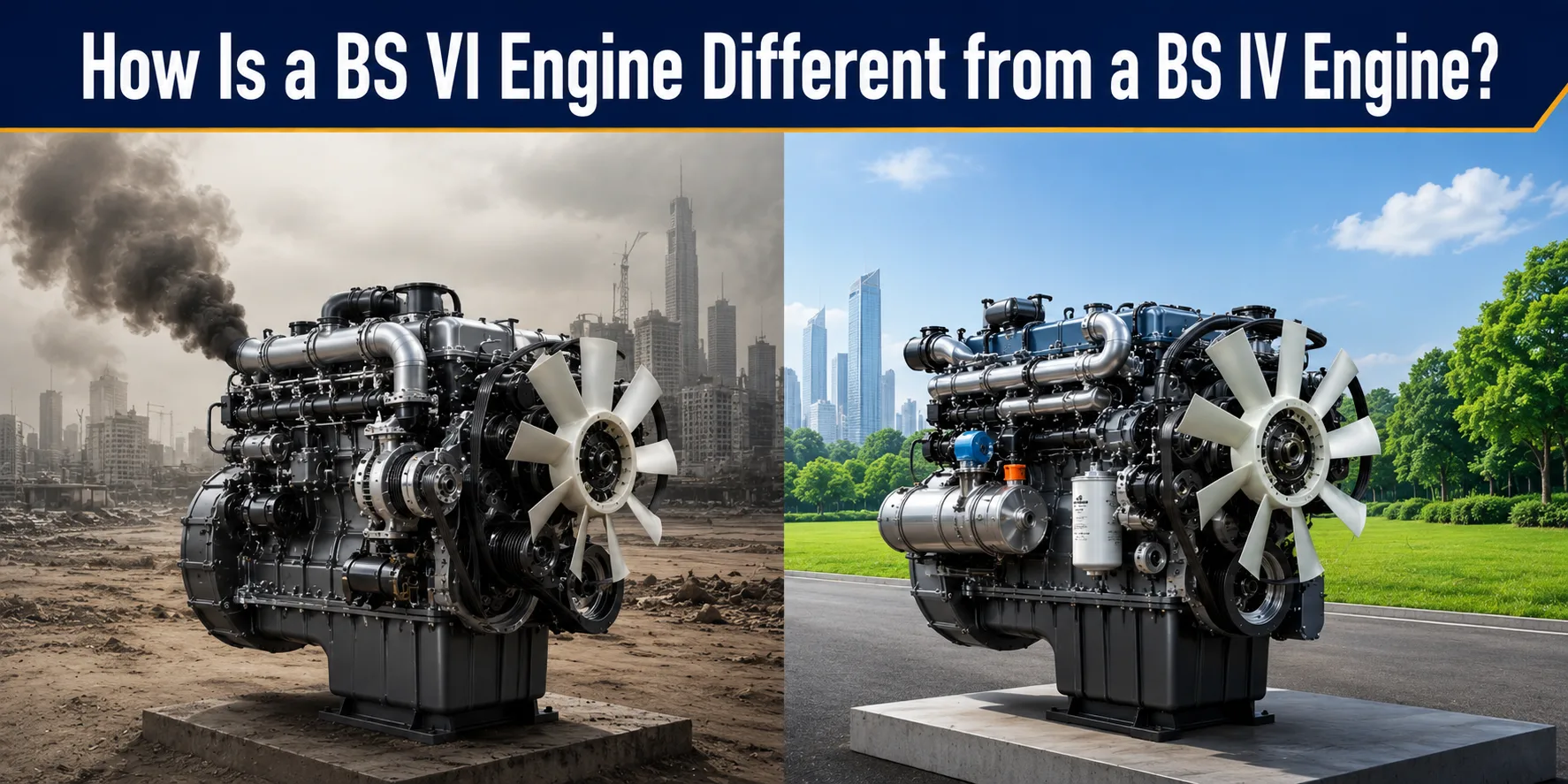
India's transition from BS IV to BS VI emission norms marked one of the biggest technological upgrades in the automotive industry. Instead of making small improvements, manufacturers had to redesign engines, upgrade fuel injection systems, introduce advanced exhaust after-treatment technologies, and integrate onboard diagnostics to meet much stricter emission limits. India also skipped BS V and moved directly to BS VI to align more closely with global emission standards.
Today, BS VI technology has evolved further with BS VI Phase II (OBD II) requirements, where vehicles are expected to maintain emission compliance not only during laboratory testing but also under real driving conditions through enhanced onboard monitoring.
So, what actually changed between a BS IV engine and a BS VI engine? Let's understand the engineering differences.
What Are Bharat Stage Emission Norms?
Bharat Stage (BS) emission norms are regulations introduced by the Government of India to control the amount of pollutants released by vehicle engines. These standards define the maximum permissible limits for emissions such as nitrogen oxides (NOx), particulate matter (PM), hydrocarbons (HC), and carbon monoxide (CO).
As emission norms become stricter, engine manufacturers must improve combustion efficiency and adopt cleaner technologies to reduce harmful exhaust gases. Every new Bharat Stage standard therefore represents an advancement in engine design rather than just a regulatory update.
Why Did India Skip BS V?
Unlike Europe, India moved directly from BS IV to BS VI in April 2020. The decision was taken to accelerate the adoption of cleaner vehicle technologies and reduce urban air pollution without waiting for another transition phase.
Skipping BS V allowed manufacturers to invest directly in advanced engine platforms capable of meeting stricter emission limits instead of upgrading their products twice within a short period. It also aligned Indian emission standards much more closely with Euro 6 regulations.
How Is a BS VI Engine Different from a BS IV Engine?
FeatureBS IV EngineBS VI EngineEmission limitsLess stringentMuch stricter limits for NOx and particulate matterFuel qualityHigher sulphur diesel (50 ppm)Ultra-low sulphur fuel (10 ppm)Fuel injectionConventional high-pressure systemsMore precise electronically controlled injectionExhaust treatmentBasic catalytic systemsDPF, SCR, DOC and advanced after-treatment (depending on engine application)Engine monitoringLimited diagnosticsOBD system continuously monitors emission-related componentsReal-world complianceLaboratory testingBS VI Phase II includes real driving emission monitoring and enhanced OBD complianceAlthough both engines generate power in the same way, a BS VI engine controls combustion and treats exhaust gases much more effectively before they leave the tailpipe.
What Changed Inside the Engine?
The basic operating principle of a diesel engine remains unchanged. Air enters the cylinder, fuel is injected, combustion takes place, and the expanding gases produce power.
The difference lies in how accurately this process is controlled.
BS VI engines use higher-pressure common rail fuel injection systems capable of delivering fuel in multiple injection events during a single combustion cycle. Instead of injecting all the fuel at once, the engine can perform pilot, main, and post injections to improve combustion quality and reduce emissions.
Engine Control Units (ECUs) have also become more advanced. They continuously process data from multiple sensors to adjust fuel quantity, injection timing, turbocharger operation, and exhaust gas recirculation according to engine load and operating conditions.
As a result, combustion becomes cleaner, more efficient, and better controlled than in a BS IV engine.
What Changed in the Exhaust After-Treatment System?
The biggest difference between BS IV and BS VI engines appears after combustion.
While BS IV engines relied on comparatively simple emission control systems, BS VI engines use multiple exhaust after-treatment components to remove pollutants before they enter the atmosphere.
Depending on the engine application, these systems may include:
- Diesel Oxidation Catalyst (DOC)
- Diesel Particulate Filter (DPF)
- Selective Catalytic Reduction (SCR)
- Exhaust Gas Recirculation (EGR)
For heavy-duty diesel engines, SCR systems work with Diesel Exhaust Fluid (DEF), commonly known as AdBlue, to convert harmful nitrogen oxides into harmless nitrogen and water vapour.
The DPF captures extremely fine soot particles that would otherwise escape through the exhaust, while the DOC reduces carbon monoxide and hydrocarbons.
Together, these systems allow BS VI engines to meet emission limits that are substantially lower than those permitted under BS IV.
Does a BS VI Engine Perform Better Than a BS IV Engine?
Many buyers initially believed that stricter emission norms would reduce engine performance.
In practice, modern BS VI engines maintain similar or even better performance because manufacturers redesigned combustion systems, turbochargers, electronic controls, and fuel injection technology alongside the new emission equipment.
The main difference is that BS VI engines achieve this performance while producing much lower emissions and continuously monitoring emission-related components through onboard diagnostics. Current BS VI Phase II regulations also require vehicles to comply under more realistic driving conditions rather than relying only on laboratory testing.
What Should Fleet Owners and Buyers Know Before Choosing a BS VI Engine?
Purchasing a BS VI engine involves more than comparing horsepower and fuel efficiency.
Fleet operators should also consider the availability of trained service support, diagnostic equipment, genuine replacement parts, and the proper maintenance of emission control systems such as DPF and SCR. These components play an important role in maintaining engine performance and regulatory compliance throughout the vehicle's operating life.
Using the recommended fuel and lubricants, following scheduled maintenance intervals, and addressing warning indicators promptly help keep the engine operating efficiently while preventing unnecessary downtime.
Final Thoughts
A BS VI engine is far more than a cleaner version of a BS IV engine. It combines advanced fuel injection, intelligent electronic controls, and sophisticated exhaust after-treatment systems to meet much stricter emission standards.
As emission regulations continue to evolve through BS VI Phase II and enhanced onboard diagnostics, engine technology will keep advancing to deliver cleaner performance without compromising reliability. For buyers and fleet operators, understanding these differences helps in selecting engines that meet both current regulatory requirements and long-term operational needs.