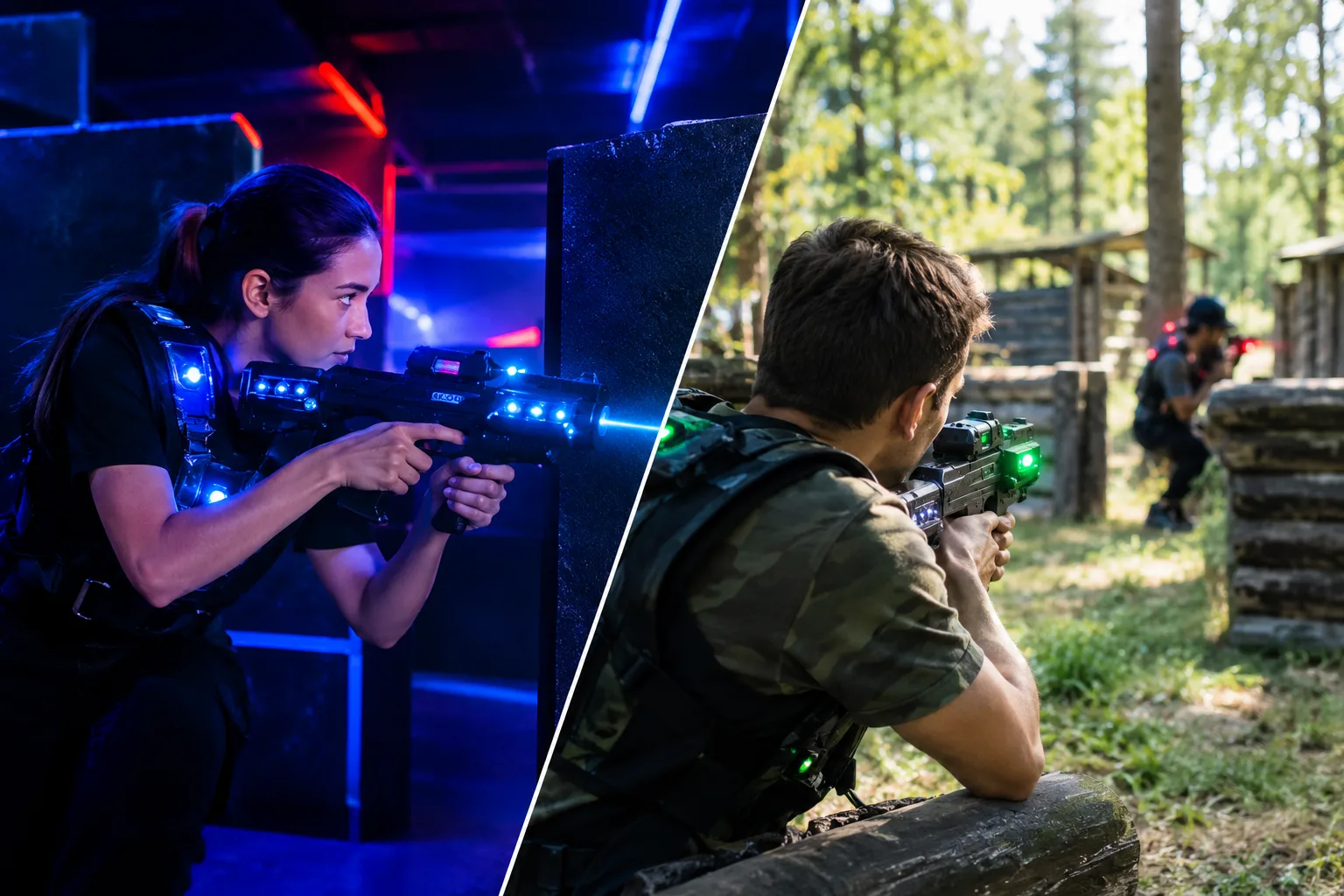
Entrepreneurs evaluating active entertainment concepts face a fundamental choice between long-term commercial indoor leases and open-air tactical acreage. Deploying versatile technology platforms like NETRONIC Laser Tag enables operators to power either business model efficiently using durable hardware engineered to handle both dark urban arenas and rugged outdoor terrain.
A thorough indoor vs outdoor laser tag evaluation requires balancing upfront capital investments against seasonal traffic disruptions, equipment durability, and recurring overhead. Examining unit economics, facility utilization, and revenue distribution reveals which operational framework delivers superior returns for your target market.
Which Business Model Delivers a Higher Operating Profit Margin
An outdoor laser tag business appears far more profitable on paper during peak summer months because land lease rates are negligible compared to retail spaces. Outdoor tactical parks routinely post monthly operating margins between 50% and 65% from May through September, as overhead is limited to staff wages, basic liability insurance, and minor field maintenance.
Indoor family entertainment centers carry continuous rent burdens, utility commitments, and climate-control bills that suppress monthly margins to 32% to 42%. However, an indoor arena generates predictable cash flow 12 months a year, immune to weather disruptions, whereas outdoor fields face seasonal entertainment revenue swings that often wipe out winter cash reserves.
Indoor facilities achieve higher valuation multiples because their cash flow remains stable throughout quarterly reporting cycles. An outdoor facility generates rapid cash during peak warmth, but operators in northern latitudes must generate enough operating profit in 24 weeks to sustain the business through 28 weeks of downtime.
What Are the Biggest Challenges of Running an Outdoor Arena
Operating an open-air venue requires managing physical, climatic, and logistical friction that indoor operators never encounter. Field directors must actively manage player safety across uneven terrain while maintaining strict equipment uptime under direct sun and damp soil.
Running a sustainable tactical woodland field requires solving four primary operational roadblocks:
- Seasonal revenue collapse. Persistent rainfall, extreme summer heat waves, and winter sub-zero temperatures force frequent weekend cancellations. In temperate climates, an unroofed venue loses an average of 35% of booked calendar dates to sudden storms, leaving fixed wages unpaid and customer deposits refunded.
- Severe mechanical wear on game sets. Dropping blasters onto concrete curbs, sand, mud, and exposed tree roots destroys entry-level plastic housings within weeks. Outdoor rental gear requires industrial polycarbonates, reinforced glass lenses, and heavy-duty internal bumper mounts to survive violent adult impact.
- Sunlight sensor interference. Natural daylight emits massive levels of ambient infrared radiation that blinds low-cost optical receivers and ruins the player experience. Without precision optical filters that isolate narrow infrared frequencies, outdoor rifles suffer phantom hits or register zero hits beyond twenty paces.
- Limited evening monetization. Standard fields cannot run profitable evening game blocks unless operators invest tens of thousands of dollars into industrial floodlighting towers. Sunset severely restricts weekend operating windows during autumn and spring, cutting potential birthday slots by half.
Mitigating these hazards demands active field management, heavy-duty gear protection, and flexible weather rescheduling policies. Successful outdoor operators always construct covered pavilion shelters to host cake-cutting celebrations even when brief showers delay on-field missions.
Why Do Indoor Arenas Require Much Higher Capital Expenditures
Securing a commercial indoor lease in an accessible retail plaza or commercial district requires substantial initial capital reserves long before the first player straps on a vest. Landlords demand commercial guarantees, legal entity audits, and upfront payments that quickly inflate initial startup budgets.
Indoor arena developers must absorb several major capital expenditure categories:
- Commercial lease security deposits. Retail properties routinely demand the first month, last month, and two security months in advance before handing over warehouse keys. In competitive suburban trade areas, securing a 5,000-square-foot footprint ties up $25,000 to $45,000 in frozen deposit capital immediately.
- Life-safety and ventilation compliance. Municipal building codes mandate illuminated emergency exit routes, fire-retardant wall partitions, integrated smoke-exhaust systems, and commercial sprinkler heads. Bringing an older commercial building up to entertainment occupancy standards costs anywhere from $20,000 to $55,000.
- Atmospheric theming and acoustic engineering. An indoor maze looks unappealing without custom fluorescent mural art, UV blacklight fixtures, acoustic dampening panels, and high-output fog generators. Creating an engaging sci-fi maze environment costs between $6 and $14 per square foot of play area.
- Interactive arena hardware infrastructure. Professional arenas require stationary base stations, interactive digital targets, respawn pods, overhead spectator screens, and localized audio zones. These networked devices raise capital costs but automate match flows and drive competitive player retention.
While these interior buildout requirements create a steep barrier to entry, they build a durable competitive moat against amateur competitors. Once constructed, a polished indoor arena functions as a high-margin entertainment destination that attracts steady school excursions and weekend family bookings year-round.
What Technical Requirements Must Outdoor Equipment Meet
Field operators cannot deploy delicate indoor plastic vests without suffering crippling maintenance downtime and constant hardware replacements. Tactical combat simulation involves physical slides, dirt crawl spaces, and direct exposure to fluctuating humidity, demanding rugged tactical laser tag equipment.
Equipment deployed on open outdoor combat zones must meet four non-negotiable hardware standards:
- Weatherproof sealing and shock-resistant polymers. Blaster shells must utilize fiberglass-reinforced polyamides and sealed rubber gaskets around all trigger assemblies, power switches, and displays. Devices must survive repeated five-foot drops onto jagged rocks and continuous operation in steady drizzle without moisture penetrating the main logic board.
- Sunlight-filtered optical collimators. Precision lenses must feature specialized optical coatings that strip away background ultraviolet and ambient solar radiation. This optical filtering ensures instant sunlight sensor readability and enables accurate hit registration at distances exceeding 500 feet under glaring midday sun.
- Long-range radio telemetry and BLE sync. Outdoor games sprawl across thousands of square yards where standard Wi-Fi signals degrade rapidly due to natural foliage, dirt berms, and wooden structures. Professional tactical kits utilize multi-frequency sub-gigahertz radio modems that maintain real-time scoring links between players and field servers across 1,500 feet of dense forest.
- High-capacity lithium battery packs. Electronic boards and display panels must operate through eight to twelve continuous back-to-back rental matches without intermediate charging stops. Commercial outdoor systems need high-density lithium-iron-phosphate batteries that retain runtimes even when operating in freezing morning temperatures.
Purchasing certified high impact game gear eliminates emergency mid-game maintenance calls that frustrate paying corporate teams. Selecting equipment designed specifically for harsh tactical environments protects your balance sheet from endless replacement cycles.
Can a Hybrid Business Model Deliver the Best of Both Worlds
Forward-thinking entertainment entrepreneurs increasingly reject the rigid division between strictly indoor arenas and isolated outdoor outposts. Instead, operators adopt a hybrid business structure that blends a core indoor facility with a mobile outdoor operations trailer.
Under this hybrid approach, the indoor arena serves as a reliable corporate headquarters, housing the central booking desk, party rooms, concession kitchen, and gear-charging racks. During winter and inclement rainy periods, the indoor maze operates at peak capacity, generating stable, high-margin youth birthday and walk-in revenues.
When summer weather arrives, staff transfer a designated portion of the equipment fleet into a customized mobile operations van equipped with inflatable tactical obstacles and wireless base stations. This mobile arm deploys directly to municipal parks, corporate campuses, private ranches, and summer festivals to run massive 30-player tactical tournaments.
This hybrid model solves the traditional limitations of both formats:
- Maximizes equipment utilization. Tactical sets that might sit idle indoors during slow sunny weekdays generate premium mobile event fees off-site.
- Captures lucrative corporate retreats. Adult corporate clients rarely want dark sci-fi indoor mazes; they gladly pay $1,500 to $3,500 for high-stakes outdoor tactical tournaments on company grounds.
- Eliminates redundant overhead. The business uses a single management staff, unified liability insurance policy, shared marketing budget, and identical booking software to sell two distinct entertainment products.
By transforming summer downtime into an asset, hybrid operators capture high-ticket outdoor corporate retreats while maintaining predictable retail cash flow all winter. The resulting revenue diversification smooths seasonal volatility and accelerates total return on invested capital.
Frequently Asked Questions About Choosing Between Indoor and Outdoor Arenas
Can You Use the Same Gear for Both Indoor and Outdoor Games
Modern professional laser tag platforms allow operators to utilize the identical equipment fleet across indoor and outdoor formats through software configuration. Blasters designed with dual-mode firmware can instantly switch infrared emitter power from an indoor low-dispersion setting to an outdoor maximum-range pulse.
Indoor games require low-powered infrared pulses to prevent beam ricochets off polished wall panels from tagging multiple hidden opponents simultaneously. When moving outdoors, the operator changes the game profile via a mobile tablet app, unleashing maximum beam wattage to cut through bright ambient sunlight across 600 feet of open ground.
How Much Land Is Needed for a Decent Tactical Field
An engaging tactical field designed for 20 to 30 active players requires between 1.0 and 2.5 acres of playable terrain. This footprint provides sufficient space to establish two base camps, flanked tactical movement corridors, and multiple skirmish zones without players clustering in one dense group.
Optimizing player movement depends heavily on smart field layout and bunkers. Incorporating timber stockades, stacked tire walls, dirt trenches, and natural woodland clearings breaks long sightlines and forces teams to maneuver strategically rather than trading stationary long-range shots.
Fields smaller than one acre quickly degrade into chaotic shooting galleries where players get tagged immediately upon respawning. If land is limited, investing in multi-level structures, raised sniper towers, and interconnected trench lines increases playable surface area and tactical depth without expanding total perimeter footage.
Which Format Attracts More Corporate Teambuilding Events
Outdoor tactical fields win corporate adult bookings by a wide margin over traditional dark indoor FEC arenas. Adult professionals frequently associate fluorescent indoor blacklight mazes with youth birthday parties and arcade chaos, making HR coordinators hesitant to select them for professional staff retreats.
Tactical outdoor fields provide a realistic, military-simulation atmosphere that feels challenging, mature, and physically engaging for adult teams. Corporate managers readily spend $600 to $1,800 per private session for scenario-based missions that demand authentic communication, squad movement, resource management, and strategic territory control under the open sky.
Your ultimate choice between indoor and outdoor laser tag formats comes down to available capital, regional climate patterns, and growth horizons. If you have substantial investment capital and want year-round cash flow stability, build a commercial indoor arena; if you want a lean startup budget with high summer margins, secure an outdoor tactical field. For maximum enterprise value, start with a modular hardware system that gives you the freedom to dominate both markets under a unified brand.