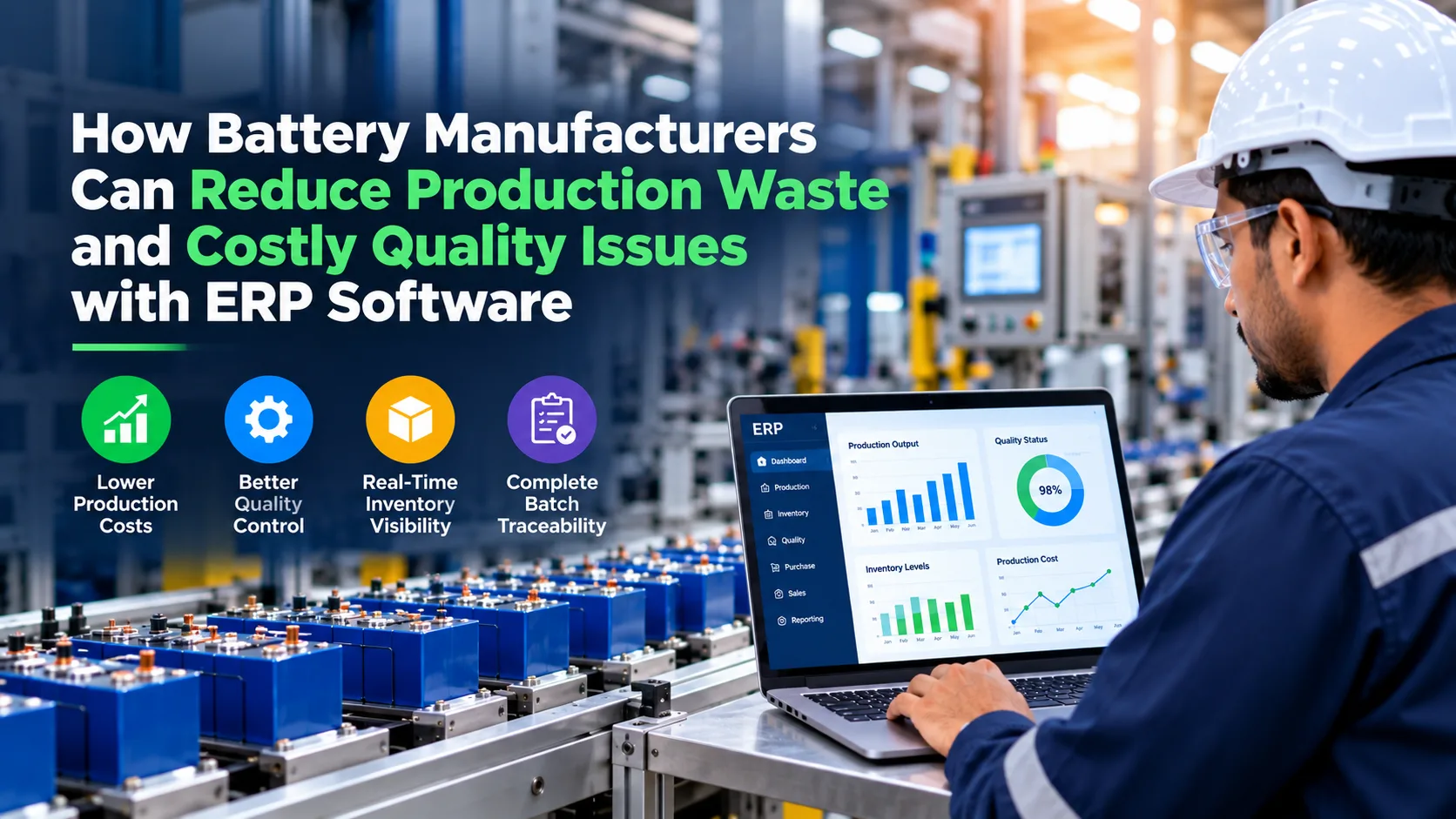
How Battery Manufacturers Can Reduce Production Waste and Costly Quality Issues with ERP Software
Battery manufacturing is a complex business. Manufacturers need to manage raw materials, production schedules, inventory, quality checks, machine performance, and customer orders every day.
Even a small mistake can create a big problem.
A shortage of raw materials can delay production. Poor inventory planning can increase storage costs. A quality issue can lead to rejected products, rework, and wasted materials. When these problems happen regularly, they can reduce profit and affect customer trust.
The biggest challenge is not always the lack of resources. Sometimes, it is the lack of clear information and proper coordination between departments.
This is where an ERP system for battery manufacturing can help. It connects important business processes, improves visibility, and helps manufacturers make better decisions using accurate information.
In this blog, we will explore the common causes of production waste and quality problems in battery manufacturing and explain how ERP software can help address them.
Why Is Production Waste a Major Problem for Battery Manufacturers?
Battery production requires careful control over materials, processes, and product quality. Depending on the type of battery, manufacturers may work with materials such as electrodes, separators, electrolytes, battery cells, and electronic components.
These materials must be handled carefully throughout the production process.
When materials are damaged, production steps are repeated, or products fail quality checks, manufacturers can lose both time and money.
Consider a simple example.
A battery manufacturer orders raw materials for a production batch. During production, the team discovers that some materials were issued in the wrong quantity. The production records are updated manually, and the actual material consumption is not immediately visible to the inventory team.
As a result, the company may face unexpected stock shortages, inaccurate product costing, and delays in completing customer orders.
If this information is not available on time, managers may struggle to identify where the problem started.
Common causes of production waste include:
- Incorrect material planning and purchasing.
- Poor control over raw material consumption.
- Production errors and rejected products.
- Incomplete inventory records.
- Repeated manual data entry.
- Limited visibility into production performance.
- Delays in identifying quality issues.
Manufacturers need a connected system that helps them monitor these activities and identify problems before they become expensive.
1. Poor Inventory Planning Leads to Higher Costs
Inventory management is one of the biggest operational challenges for battery manufacturers.
Companies must maintain enough raw materials to keep production running. At the same time, holding too much stock can increase storage costs and tie up working capital.
When inventory information is spread across spreadsheets, separate software, and manual records, it becomes difficult to know the actual stock position.
For example, the purchasing team may believe that enough material is available, while the production team discovers a shortage just before a scheduled manufacturing run.
This can delay production and affect delivery commitments.
How ERP Software Helps
An ERP system brings inventory and purchasing information together in one place.
It can help manufacturers:
- Monitor available raw materials and finished goods.
- Track stock movements between locations.
- Set reorder levels for important materials.
- Plan material purchases based on production requirements.
- Check material availability before scheduling production.
- Maintain more accurate inventory records.
With better inventory visibility, manufacturers can make informed purchasing decisions and reduce avoidable stock shortages.
The goal is not simply to keep more stock. It is to maintain the right materials, in the right quantities, at the right time.
2. Material Waste Increases Production Costs
Raw materials represent a major cost in battery production. This makes material waste a serious concern for manufacturers.
Waste can occur when incorrect quantities are issued, production specifications are not followed, materials are damaged, or manufacturing defects are discovered too late.
Sometimes, the material loss is visible. In other cases, the problem remains hidden in production records until the finance team reviews the actual costs.
Without accurate data, managers may know that production costs are increasing but struggle to understand why.
How ERP Software Helps
An ERP system can help manufacturers compare planned material consumption with actual consumption.
For example, a production order may require a defined quantity of materials to manufacture a specific number of battery units.
The ERP system can record the planned requirements, actual material issues, completed output, and reported scrap.
Managers can then review the differences and investigate the reasons behind unexpected material consumption.
Useful information may include:
- Planned versus actual material usage.
- Material consumption by production order.
- Scrap and rejection quantities.
- Rework requirements.
- Material cost variations.
- Production output and yield.
These records help management identify recurring problems and improve production planning.
When manufacturers understand where materials are being lost, they can take more effective steps to reduce waste and protect profit margins.
3. Quality Problems Can Lead to Rework and Rejected Products
Quality is especially important in battery manufacturing.
A product may need to meet specific requirements for capacity, performance, safety, and reliability. A failure at one stage of production can affect later stages and create additional costs.
For example, a battery cell that fails a required test may need further inspection, rework, or rejection.
If the reason for the failure is not recorded properly, the same problem may occur again in future production batches.
Poor quality records can also make it harder to understand whether a problem is related to a particular material batch, production order, machine, or manufacturing process.
How ERP Software Helps
ERP software can support a more structured quality management process by connecting quality checks with purchasing, inventory, and production records.
Depending on the system configuration, manufacturers can use it to:
- Record incoming material inspections.
- Schedule quality checks at selected production stages.
- Record inspection results and rejected quantities.
- Track non-conforming materials and products.
- Document rework and scrap.
- Link quality records to relevant batches or production orders.
- Review recurring quality issues.
For example, if a production batch fails an inspection, the team can review its available production and material records to investigate the possible cause.
This does not mean ERP software will automatically prevent every defect. However, better records and connected workflows can help teams identify problems earlier and take corrective action.
The result can be better process control, more informed decisions, and fewer repeated mistakes.
4. Limited Batch Traceability Makes Problems Harder to Investigate
Battery manufacturers may need to trace materials from the supplier through production and into finished products.
When a quality issue occurs, managers need to identify which materials were used, which production batch was affected, and where the related products went.
If this information is recorded in separate systems or maintained manually, an investigation can take longer.
The company may need to check purchase records, warehouse logs, production sheets, and quality reports separately.
This creates extra work and makes it harder to respond quickly.
How ERP Software Helps
A properly configured ERP system can connect relevant purchasing, inventory, production, and quality records.
Depending on the manufacturing process and system capabilities, batch or lot tracking can help teams follow materials through different production stages.
This may help manufacturers:
- Record supplier and material batch details.
- Track material issues against production orders.
- Connect finished goods with relevant production records.
- Investigate quality issues more efficiently.
- Support product recalls and internal audits.
- Maintain better documentation for customer requirements.
For manufacturers that require detailed, unit-level traceability, additional integration with manufacturing execution systems, testing equipment, or specialised traceability solutions may be necessary.
The important point is to create a reliable information trail rather than depend entirely on manual records.
Better traceability can help manufacturers investigate problems with greater confidence and strengthen customer trust.
5. Poor Production Planning Causes Delays and Unnecessary Costs
A manufacturing schedule depends on several factors, including material availability, machine capacity, employee availability, production priorities, and customer delivery dates.
When these factors are managed separately, planning becomes difficult.
A production order may be scheduled even when some materials are unavailable. Another order may be delayed because the required machine is already occupied.
These issues can increase waiting time, create scheduling conflicts, and affect delivery performance.
How ERP Software Helps
ERP software can help connect production planning with inventory, purchasing, and order management.
Manufacturers can use the available information to:
- Create and manage production orders.
- Review material requirements.
- Check stock availability.
- Plan purchasing activities.
- Monitor production progress.
- Compare planned and actual output.
- Track order status and delivery commitments.
For example, before releasing a production order, the team can review whether the required materials are available or need to be purchased.
This helps planners make better decisions before production begins.
Advanced scheduling and real-time machine monitoring may require additional manufacturing tools or integrations. However, connecting the core planning data is an important step towards better production control.
6. Disconnected Systems Make Cost Control Difficult
Many manufacturing businesses use different tools for accounting, inventory, purchasing, production, and reporting.
Each tool may work well on its own, but the information becomes difficult to compare when the systems are not connected.
The production manager may focus on output. The warehouse team may focus on stock. The finance team may review costs at the end of the month.
Without a shared view of operations, managers may struggle to understand how production problems affect overall profitability.
How ERP Software Helps
An ERP system brings key business functions into a connected environment.
Depending on the modules implemented, managers can review information such as:
- Material purchase costs.
- Inventory valuation.
- Production-related expenses.
- Actual versus planned material consumption.
- Scrap and rework costs.
- Order fulfilment status.
- Financial performance.
This makes it easier to connect operational activities with their financial impact.
For example, if the actual material cost of a production order is higher than expected, managers can investigate whether the difference relates to material prices, additional consumption, scrap, or other recorded costs.
Instead of relying only on month-end reports, businesses can work towards more timely and meaningful cost visibility.
Better cost visibility helps manufacturers understand not just how much they are spending, but also where their money is going.
7. Manual Reporting Takes Time Away from Important Decisions
When employees spend hours updating spreadsheets and collecting information from different departments, less time is available for analysis and improvement.
Manual reports can also become outdated quickly, particularly when production and inventory activities change throughout the day.
As a result, management may make decisions using incomplete or old information.
How ERP Software Helps
ERP software can centralise operational data and generate reports based on recorded business transactions.
Depending on the system and reporting configuration, manufacturers can review:
- Production output and order status.
- Inventory levels and stock movements.
- Material consumption and cost variations.
- Rejected products and scrap.
- Purchasing activity.
- Sales and delivery performance.
- Financial reports.
These reports help teams spend less time collecting information and more time understanding the results.
For the best results, businesses should define the key performance indicators they need to monitor and ensure that employees record accurate information in the system.
Technology alone cannot fix poor data quality. Consistent processes and employee training are equally important.
What Should Battery Manufacturers Look for in an ERP System?
Not every ERP system is suitable for every manufacturing business.
Before choosing a solution, battery manufacturers should understand their production processes, business goals, reporting needs, and future plans.
Here are some important areas to consider.
1. Inventory and Material Planning
The system should help track raw materials, work in progress, and finished goods.
It should also support purchasing and material planning based on the company's requirements.
2. Production Management
Manufacturers should be able to manage production orders, define material requirements, record consumption, and monitor output.
The solution should fit the company's actual manufacturing workflow.
3. Quality Management
Look for ways to record inspections, track rejected products, document corrective actions, and connect quality information with production records.
Confirm whether the required quality functions are available directly or need configuration or integration.
4. Batch and Lot Traceability
Evaluate whether the system can track materials and finished products at the level required by your business.
Some operations need batch-level tracking, while others require more detailed product genealogy.
5. Cost Tracking and Reporting
The ERP system should help connect material usage, production activity, inventory, and financial information.
This makes it easier to understand production costs and investigate cost variations.
6. Integration and Scalability
Consider whether the system can connect with existing accounting tools, production equipment, warehouse systems, or manufacturing execution systems where required.
Also, make sure the solution can support your expected business growth without creating unnecessary complexity.
7. Implementation and Ongoing Support
Software selection is only one part of the process.
Successful ERP implementation also depends on process planning, data migration, system configuration, employee training, testing, and ongoing support.
Choose an implementation partner that takes time to understand your manufacturing operations before recommending a solution.
How to Start Reducing Production Waste with ERP
Implementing ERP does not have to begin with changing every business process at once.
A practical approach is to identify the problems that create the greatest operational or financial impact.
Step 1: Identify the main problem
Start by reviewing recurring material shortages, high scrap levels, production delays, inventory differences, or quality issues.
Step 2: Review the existing process
Understand how information currently moves between purchasing, inventory, production, quality, and finance.
Identify where manual work, duplicate records, or missing information create problems.
Step 3: Define measurable goals
Set clear goals based on your current performance. These could include improving inventory accuracy, reducing avoidable material waste, shortening reporting time, or improving production schedule adherence.
Avoid setting unrealistic targets before reviewing your actual data.
Step 4: Select the right ERP solution
Choose a system that fits your production processes, business size, reporting needs, and integration requirements.
Step 5: Implement in manageable stages
Begin with the most important processes, validate the data, train employees, and test the workflows before expanding the implementation.
Step 6: Measure the results
Review the same performance indicators before and after implementation.
Track whether the changes are improving visibility, reducing manual work, and helping the business control costs more effectively.
A planned implementation makes it easier to understand what is working and where further improvements are needed.
Why Battery Manufacturers Should Act Before Costs Increase Further
Production waste, inventory errors, and quality problems do not always appear as one large expense.
Instead, they often build up through small, repeated losses.
Extra material consumption increases production costs. Poor inventory visibility creates delays. Repeated quality failures lead to additional inspections and rework. Manual reporting slows down decision-making.
Over time, these issues can affect profitability, customer satisfaction, and business growth.
A connected ERP system can help manufacturers gain better control over their operations by bringing important information together.
It can support more accurate material planning, improved production visibility, better quality records, and stronger cost control.
The exact results depend on the existing processes, the ERP configuration, the quality of the data, and how effectively employees use the system.
The first step is to understand where the biggest problems exist and choose a solution that addresses those needs.
Improve Battery Manufacturing Operations with Cloudmonte
Every battery manufacturing business has different operational challenges.
Some companies need better control over raw materials and inventory. Others want to improve production planning, manage quality information, or gain clearer visibility into manufacturing costs.
The right ERP approach starts with understanding these challenges and connecting the business processes that matter most.
At Cloudmonte Technologies, we help businesses explore ERP solutions that support their operational needs, improve process visibility, and create a stronger foundation for growth.
If your battery manufacturing business is struggling with material waste, disconnected systems, production delays, or limited cost visibility, it may be time to review your current processes.
Ready to improve production control and reduce avoidable manufacturing costs?
Explore Cloudmonte's Battery Manufacturing ERP Solution to learn more.
Contact our team to discuss your manufacturing challenges and explore an ERP approach suited to your business.
Cloudmonte Technologies
Simplifying Complexity, Amplifying Results.