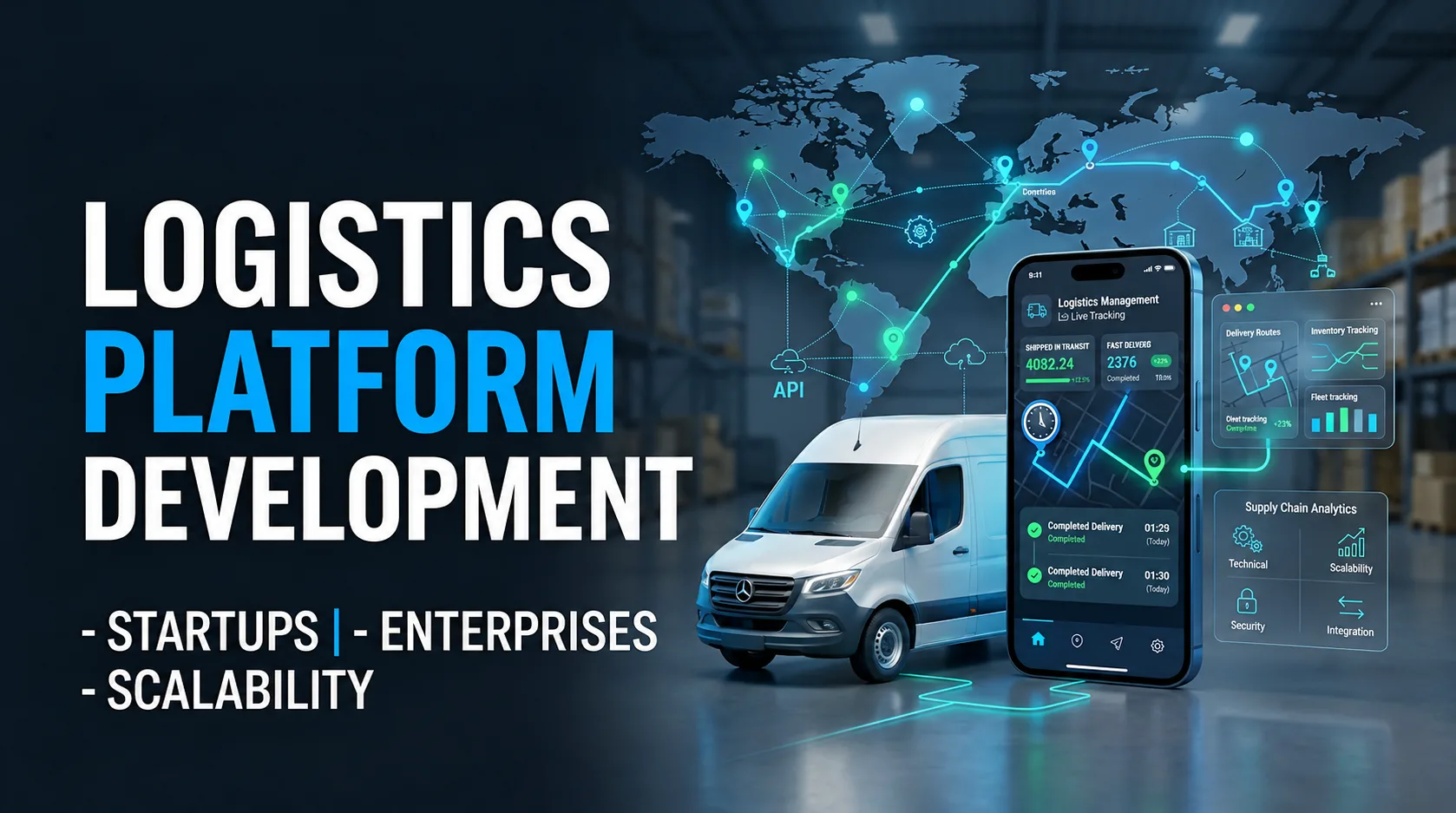
The successful management of transport, shipments, warehouses, and deliveries is vital for companies working within the current supply chain market environment. The inability to follow the shipment, plan fleet movements, and overcome unexpected issues associated with the manual work and disconnection of systems often makes it challenging to ensure everything goes smoothly. This is the reason for many companies to turn to the development of logistics applications in order to enhance the performance and make more data-driven decisions. A properly developed logistics platform can help startups build efficient workflows and companies manage complex logistics activities.
Be you a startup or a company willing to modernize its supply chain, knowing about the development process, features, and technologies required will be helpful when choosing the right solution.
What Is a Logistics Platform?
A logistics platform is a digital system that helps businesses plan, manage, monitor, and optimize the movement and storage of goods. It connects different participants in the logistics process, including shippers, carriers, drivers, warehouse teams, dispatchers, and customers.
Depending on its purpose, a logistics platform may combine transportation management, fleet management, warehouse operations, shipment tracking, order processing, and reporting tools in one system.
For example, an e-commerce business can use a logistics platform to receive delivery orders, assign shipments to drivers, monitor delivery progress, and notify customers about estimated arrival times. Meanwhile, a large distribution company may use a more advanced solution to coordinate multiple warehouses, manage carrier contracts, and analyze transportation costs across regions.
The platform’s scope depends on the business model, operational complexity, and existing technology infrastructure.
Why Do Businesses Need Digital Logistics Solutions?
Logistics operations involve numerous moving parts, and even small communication gaps can lead to delays, higher operating costs, or poor customer experiences. Digital platforms help businesses coordinate these activities using shared information and automated workflows.
Key reasons to invest in a logistics platform include:
- Improved visibility: Track shipments, vehicles, and delivery progress from a centralized system.
- Better operational efficiency: Reduce repetitive administrative tasks and manual data entry.
- More informed decisions: Use operational data to identify delays, resource shortages, and cost inefficiencies.
- Enhanced customer communication: Provide shipment updates and delivery notifications.
- Greater coordination: Help drivers, warehouse teams, dispatchers, and customer service staff work with consistent information.
- Support for business growth: Expand operations without relying entirely on manual processes.
For startups, digital logistics tools can establish organized processes from the beginning. For enterprises, they can help connect departments and systems that may otherwise operate independently.
Essential Features of a Logistics Platform
The right features depend on your operational requirements, but several capabilities are particularly valuable for modern logistics businesses.
1. Real-Time Shipment Tracking
Shipment tracking allows businesses and customers to monitor delivery progress throughout the transportation process. Depending on the available data sources, the platform can display a shipment’s current status, location, estimated arrival time, and delivery confirmation.
GPS data, driver applications, barcode scans, and carrier integrations can all contribute to shipment visibility.
For example, a customer waiting for an order can receive an updated estimated delivery time when a driver encounters traffic. Dispatchers can also identify shipments that require attention before a delay becomes a larger operational issue.
Tracking accuracy depends on device connectivity, location permissions, data freshness, and the reliability of integrated services.
2. Route Optimization
Route optimization helps dispatchers plan efficient journeys based on delivery locations, vehicle capacity, time windows, road conditions, and other operational constraints.
A route planning system can recommend delivery sequences that reduce unnecessary travel and help drivers complete their assigned tasks more efficiently. Some platforms also support dynamic adjustments when new orders arrive or disruptions occur.
Businesses should evaluate whether their routing needs require basic route planning or more advanced optimization involving multiple vehicles, delivery priorities, and operational restrictions.
3. Fleet Management
Fleet management tools help businesses monitor vehicles, coordinate drivers, and maintain transportation resources. Depending on the solution, these tools may include vehicle assignments, maintenance schedules, fuel records, driver availability, and vehicle utilization reports.
A fleet manager could use the platform to identify underused vehicles, schedule preventive maintenance, or review recurring delays associated with particular routes.
For businesses operating across several locations, centralized fleet information can make it easier to maintain consistent procedures and allocate resources according to demand.
4. Order and Dispatch Management
Order management connects shipment requests with dispatch planning and delivery execution. It allows teams to receive orders, validate shipment details, assign resources, and monitor fulfillment.
Useful capabilities include order creation, status updates, dispatch scheduling, delivery prioritization, proof of delivery, and exception handling.
Automating these workflows can reduce duplicate data entry and improve communication between customer service representatives, warehouse staff, and drivers.
5. Warehouse Integration
Logistics platforms often need to exchange information with warehouse management systems (WMS) to coordinate inventory movement, picking, packing, and dispatch.
Integration can help teams confirm that goods are available, prepare shipments on time, and update inventory records as orders move through fulfillment.
For example, when an order is packed and marked ready for dispatch, the logistics platform can receive the updated status and make the shipment available for carrier assignment.
Businesses should define which system owns each data record to avoid conflicting shipment or inventory information.
6. Automated Notifications
Automated notifications keep relevant stakeholders informed about shipment events. Updates can be delivered through email, SMS, push notifications, or in-app messages.
Common notification events include:
- Order confirmation.
- Shipment dispatch.
- Driver assignment.
- Delivery delays.
- Estimated arrival updates.
- Successful delivery.
- Failed delivery attempts.
Notifications should be timely, relevant, and configurable. Too many alerts can overwhelm users, so businesses should allow recipients to control suitable notification preferences where appropriate.
7. Analytics and Reporting Dashboards
Analytics dashboards turn operational data into useful business insights. Managers can review delivery performance, transportation costs, vehicle utilization, order volumes, and recurring causes of delays.
Common performance indicators include on-time delivery rates, average delivery duration, cost per shipment, fleet utilization, and failed delivery rates.
These metrics help businesses identify operational bottlenecks and measure whether process improvements are working. Reports are most useful when the underlying data is accurate, consistently defined, and collected across the relevant systems.
8. Secure Data Management
Logistics platforms may store customer details, delivery addresses, driver information, business contracts, and shipment records. Protecting this information is essential for maintaining operational integrity and customer trust.
Important security measures include encryption, role-based access controls, secure authentication, audit logs, regular backups, and controlled API access.
Businesses should also establish data retention policies and assess applicable privacy and industry requirements. Security needs to be considered during architecture design rather than added only after the application is built.
The Logistics Platform Development Process
Developing a reliable logistics solution requires a structured process that connects business requirements with technical decisions.
Step 1: Analyze Business Requirements
Begin by documenting existing workflows, operational challenges, user roles, and business objectives. Identify whether the platform needs to support last-mile delivery, freight transportation, warehouse coordination, fleet management, or several of these functions.
Define measurable goals, such as reducing manual dispatch work, improving shipment visibility, or making delivery reporting more consistent.
It is also important to identify the systems the platform must connect with, including accounting software, enterprise resource planning systems, warehouse applications, carrier services, and payment providers where relevant.
Step 2: Design the User Experience
Create user journeys for dispatchers, drivers, warehouse teams, administrators, and customers. Each user group has different responsibilities, so the interface should make its most important tasks easy to complete.
For example, drivers may need a mobile interface for assigned deliveries, navigation, status updates, and proof of delivery. Dispatchers may need a desktop dashboard with shipment queues, fleet availability, and exception alerts.
Wireframes and prototypes allow stakeholders to review workflows before significant development resources are committed.
Step 3: Select the Technology Stack
Technology choices should reflect the platform’s scale, integrations, performance needs, and development budget.
A typical solution may use:
- Web frameworks such as React or Angular for administrative dashboards.
- Native or cross-platform mobile technologies for driver applications.
- Backend technologies such as Java, C#, Python, or Node.js for business logic and APIs.
- Databases suited to shipment records, user accounts, and operational reporting.
- Cloud infrastructure for deployment, monitoring, and scaling.
- Mapping and geolocation services for tracking and routing.
There is no universally correct technology stack. The best option is one that supports the required workflows, integrates reliably with existing systems, and can be maintained by the available team.
Step 4: Develop Core Features
During development, build the most important workflows first, such as order creation, dispatch, shipment tracking, and status management.
An iterative approach allows the team to test individual components, collect stakeholder feedback, and adjust requirements before adding more advanced functionality.
For startups, this may mean launching an initial version with a limited set of essential capabilities. Enterprises may need to prioritize complex permissions, integrations, reporting, and multi-location operations from the beginning.
Step 5: Integrate Third-Party Services
Logistics platforms frequently depend on external services for maps, geocoding, navigation, notifications, carrier updates, and enterprise system connectivity.
Before selecting an integration, review its pricing, coverage, data accuracy, rate limits, service availability, and licensing conditions.
Plan for timeouts, failed requests, data validation, and recovery procedures. External services can experience outages, so the platform should communicate failures clearly and preserve essential operational records whenever possible.
Step 6: Test the Platform
Testing should cover both individual features and complete business workflows. The goal is to ensure that shipment information remains consistent as it moves between users, services, and systems.
Key testing activities include functional testing, API integration testing, security testing, mobile device testing, performance testing, and user acceptance testing.
Practical test scenarios might include a delayed shipment, a failed delivery attempt, a temporary GPS connection loss, or an order update that arrives from an external carrier after a delay.
Step 7: Deploy and Maintain the Solution
After testing and stakeholder approval, deploy the platform using a controlled release process. Monitor application performance, integration health, error rates, and user feedback during the initial rollout.
Ongoing maintenance includes security updates, dependency upgrades, bug fixes, backup verification, performance improvements, and support for changing business requirements.
A maintenance plan should also define who responds to operational incidents and how the system is recovered if a critical component becomes unavailable.
How Startups and Enterprises Should Approach Development
Although both startups and established companies benefit from digital logistics solutions, their development priorities can differ significantly.
ConsiderationStartupsEnterprisesInitial scopeFocus on essential workflows and an MVPSupport complex, established operationsBudgetControl upfront spending and validate demandPlan for integrations, governance, and long-term ownershipScalabilityBuild a foundation that can grow with demandSupport high volumes and multiple locationsIntegrationsStart with the most important external servicesConnect with existing ERP, WMS, TMS, and legacy systemsCustomizationPrioritize features that differentiate the businessAccommodate department-specific processes and permissionsDeploymentStart with a controlled pilotConsider phased rollouts across teams or regionsFor Startups: Start Small and Validate
Startups often need to demonstrate business value while working with limited resources. An MVP can include order management, basic shipment tracking, driver assignment, and delivery notifications.
Before investing in advanced analytics or extensive customization, validate the solution with actual users and operational data. This approach helps teams learn which features create the greatest value.
For Enterprises: Focus on Integration and Governance
Enterprises typically face more complicated workflows, higher transaction volumes, and established technology environments. Their platforms may need to exchange data with several internal systems while maintaining strict permissions, reporting, and auditability.
A phased implementation can reduce disruption. Starting with one business unit, region, or workflow allows the organization to evaluate performance and address integration issues before expanding the rollout.
Benefits of Logistics App Development
Investing in logistics app development can help businesses improve coordination and establish more consistent operational processes.
Some of the main benefits include:
- Greater operational visibility: Teams can access shipment and delivery information from a centralized system.
- Reduced manual work: Automated workflows can minimize repetitive updates and administrative tasks.
- Improved customer communication: Tracking and notifications provide customers with clearer delivery information.
- Better resource utilization: Fleet and route planning tools can support more effective allocation of vehicles and drivers.
- Data-driven decisions: Reports help managers understand costs, performance, and recurring operational issues.
- Support for expansion: A well-planned platform can accommodate new users, locations, services, and integrations as requirements evolve.
The actual benefits depend on implementation quality, user adoption, data accuracy, and how well the platform fits existing business processes. Businesses should define baseline performance measures before launch so they can assess results objectively.
Common Challenges in Logistics Platform Development
Even well-planned projects can encounter technical and operational challenges. Recognizing them early makes it easier to establish realistic timelines and budgets.
Integration Complexity
Connecting multiple systems can be difficult when they use different data formats, workflows, or update schedules. Clear API contracts, data mapping, and integration testing help reduce inconsistencies.
Unreliable Location Data
GPS accuracy, poor connectivity, and delayed device updates can affect tracking information. The platform should indicate when location data was last received and avoid presenting outdated information as current.
Changing Operational Requirements
Routes, customer expectations, shipment volumes, and business rules may change during development. A clear scope, prioritized backlog, and structured change management process help keep the project manageable.
Data Security and Privacy
Sensitive delivery and customer information must be protected throughout its lifecycle. Access controls, secure integrations, monitoring, and appropriate data retention practices should be part of the initial design.
User Adoption
Drivers and operations teams may be reluctant to adopt a new system if it adds unnecessary steps or fails to reflect their real workflows. Training, pilot testing, and user feedback can help address these concerns.
What to Consider Before Choosing a Development Approach
Businesses generally choose between custom development, a ready-made platform, and a hybrid approach that combines existing software with tailored components.
A ready-made solution may be appropriate when standard features meet most requirements and a faster implementation is important. Custom development may be better when the business needs specialized workflows, deeper integration, or greater control over the product. A hybrid approach can balance flexibility with time-to-market considerations.
Before making a decision, evaluate:
- Business fit: Does the solution support your actual logistics workflows?
- Total cost of ownership: What will implementation, licensing, hosting, integrations, and maintenance cost over time?
- Integration capabilities: Can it exchange data reliably with your current systems?
- Scalability: Will it support anticipated growth in shipments, users, and locations?
- Security: Does it provide suitable access controls, monitoring, and data protection?
- Vendor and technical support: Is there a clear plan for updates, troubleshooting, and future development?
- Ownership and flexibility: Can you customize workflows, access your data, and change providers if business needs evolve?
The right approach is the one that meets your business requirements while remaining practical to implement, operate, and maintain.
Conclusion
Logistics platforms may be useful for startups and enterprises in order to increase shipment visibility, coordinate transportation processes, automate regular activities, and work with information more efficiently. However, such goals will not be achieved without detailed preparation in terms of business processes, usability, technologies, integration, security, and maintenance.
Startups need to pay much attention to feature validation and cost management, whereas enterprises require special care regarding integration difficulties, governance, scalability, and implementation planning. In both cases, requirements definition and testing are vital for a reliable system.
Using a proper development strategy and gradually enhancing the platform by taking into account its operation results, one can develop a logistics system corresponding to the needs and perspectives of his/her business.
For more information on logistics platform and application development, click on the link below and watch the video.
Click here: link