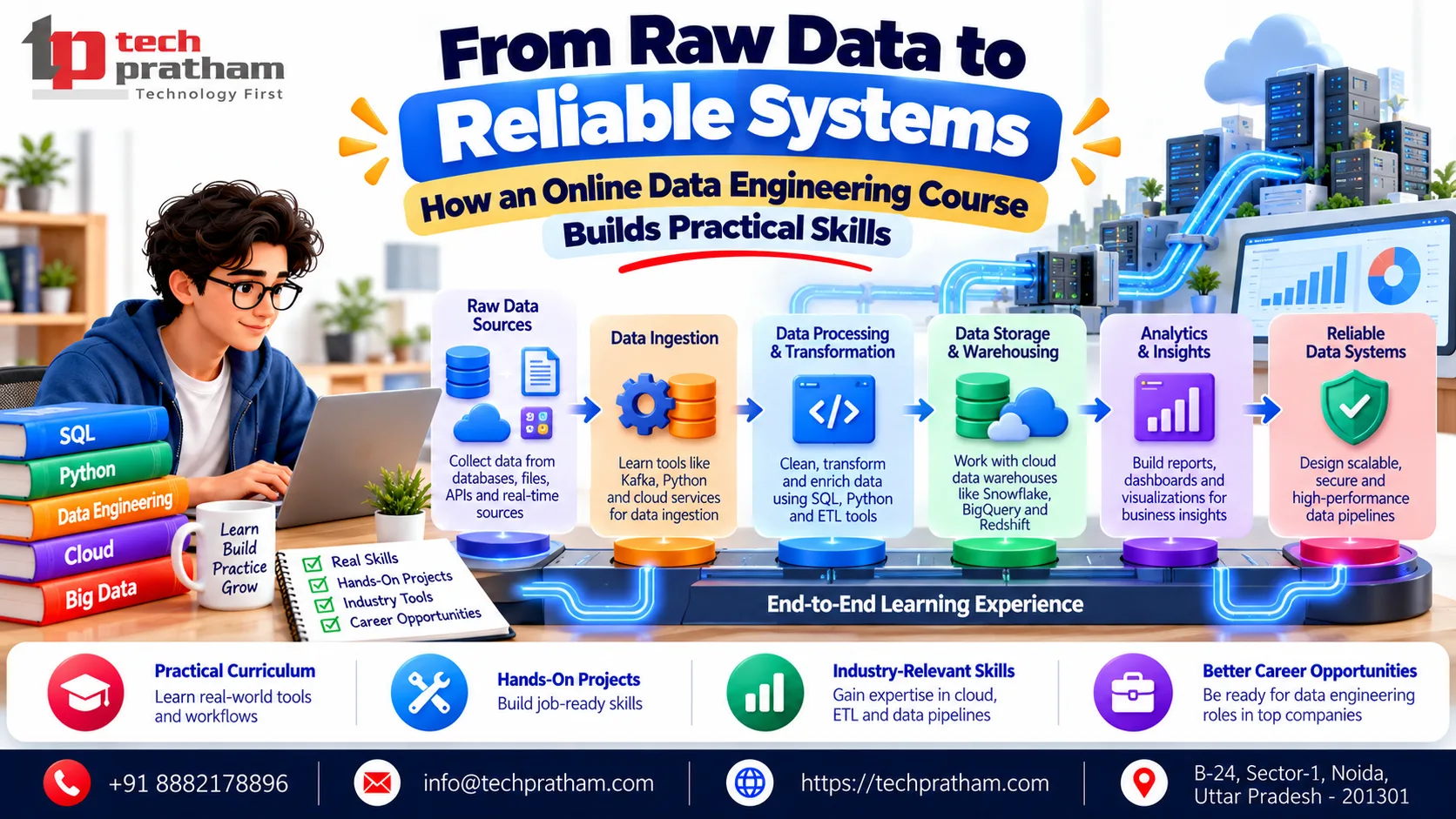
Businesses collect information from websites, applications, payment systems, customer databases, and operational tools. Yet collecting data is only one part of the process. The information must also be organised, checked, transformed, and delivered in a format that other systems can use reliably.
This is where data engineering becomes important. Data engineers help build and maintain the infrastructure behind reporting, analytics, and data-driven applications. Their work can involve connecting data sources, developing processing workflows, designing storage structures, and identifying problems that affect data quality.
For learners exploring this field, understanding how these activities fit together is more useful than memorising a long list of technologies. A practical course should help connect the concepts through examples and projects.
How a Data Engineering Course Online in India Connects Theory With Practice
A well-structured learning programme should gradually move from basic concepts to a complete data workflow. Learners typically begin with SQL, Python, and database fundamentals before exploring data integration, ETL and ELT, data modelling, and pipeline development.
Consider a company that receives daily order information from multiple systems. One source may provide customer details, another may contain product records, and a third may store transactions. The company needs these datasets to be combined into a consistent structure for reporting.
A Data Engineering Course Online in India workflow could collect the records, validate their formats, remove duplicates, transform fields, and load the results into a target database or warehouse. Each stage has a purpose, and the final output depends on the reliability of the entire process.
Understanding the Main Stages of a Data Workflow
Data ingestion: Information arrives from files, databases, applications, or APIs. Learners should understand how source formats and update frequency affect the process.
Data validation: Incoming records are checked for missing fields, invalid values, duplicates, and unexpected changes. Validation helps identify problems before they spread to downstream systems.
Data transformation: Data may need to be cleaned, standardised, combined, or summarised. SQL and Python can both support these tasks, depending on the workflow.
Data storage: Processed information is placed in an appropriate database, warehouse, or data lake. The structure should support the intended use of the data.
Scheduling and monitoring: Repeated workflows need to run in a controlled way. Monitoring helps identify failed steps, delayed processing, and other issues that require attention. A practical learning programme should show how these stages connect rather than teaching each subject as an isolated topic.
Which Technologies Should Learners Explore?
SQL is useful for querying and transforming structured data. Python supports automation, file processing, and integration tasks. Data modelling helps organise information for analysis, while ETL and ELT concepts explain different approaches to moving and transforming data.
As learners progress, they may explore data warehousing, cloud services, Apache Spark, data lakes, and workflow orchestration. These technologies address different needs, so their value depends on the type of system being developed.
When reviewing a Data Engineering Course in India, check whether the syllabus explains both the tools and the underlying concepts. Understanding why a technology is used will help you adapt when a project requires a different approach.
Why Projects Matter More Than Demonstrations Alone
Following an instructor's demonstration is a useful starting point, but independent practice is necessary to develop problem-solving skills. A good project should require learners to make decisions, test the workflow, and correct errors.
For example, a learner might build a sales-data pipeline using CSV files, Python, and a database. The project could include data validation, transformation rules, SQL queries, and documentation explaining the workflow.
A second project might introduce API data collection or cloud storage. The objective should be to develop gradually, not to use as many technologies as possible. Data Engineering Training in India may vary in how much project support it offers. Before enrolling, check whether assignments are provided, how projects are assessed, and whether learners can get help when they encounter technical difficulties.
Evaluating Certification and Learning Support
Certification can be useful for documenting learning, but the meaning of a certificate depends on its issuer and assessment requirements. If you are considering, check whether the programme includes a completion certificate, exam preparation, or a separate external credential.
Also review the learning format. Live sessions may offer direct interaction, while recorded lessons can be more flexible. A combination of instruction, assignments, practical projects, and revision may suit learners who need both guidance and independent practice.
A Data Engineering Training Online in India programme should also make its prerequisites and expected time commitment clear, especially for beginners balancing study with other responsibilities.
Taking the Next Step
The important step is to choose a programme that matches your current experience and helps you build complete workflows. When you can explain how data enters a system, how it is transformed, and how its quality is checked, you are moving beyond tool familiarity towards practical understanding.
Conclusion
Data engineering is built around making data systems useful and dependable. An online course can provide direction, but real progress comes from applying concepts, solving problems, and learning how individual components work together. In Data Engineering Certification Training in India Focus on the foundations, complete meaningful projects, and expand your skills in a structured way.