Artificial intelligence is changing how businesses develop software, automate tasks, and solve everyday problems. However, introducing advanced technology doesn't always guarantee better results. Many organizations invest in AI tools but struggle to integrate them into their existing workflows.
This is where forward-deployed engineers are becoming increasingly valuable.
Unlike traditional developers who work mainly on predefined requirements, forward-deployed engineers collaborate directly with businesses to understand challenges, build practical solutions, and ensure technology delivers measurable results.
According to a McKinsey article published on October 16, 2026, growing interest in these professionals reflects the increasing need to turn AI investments into real business value.
But what exactly do they do, and why are companies hiring them in 2026? Let's explore.
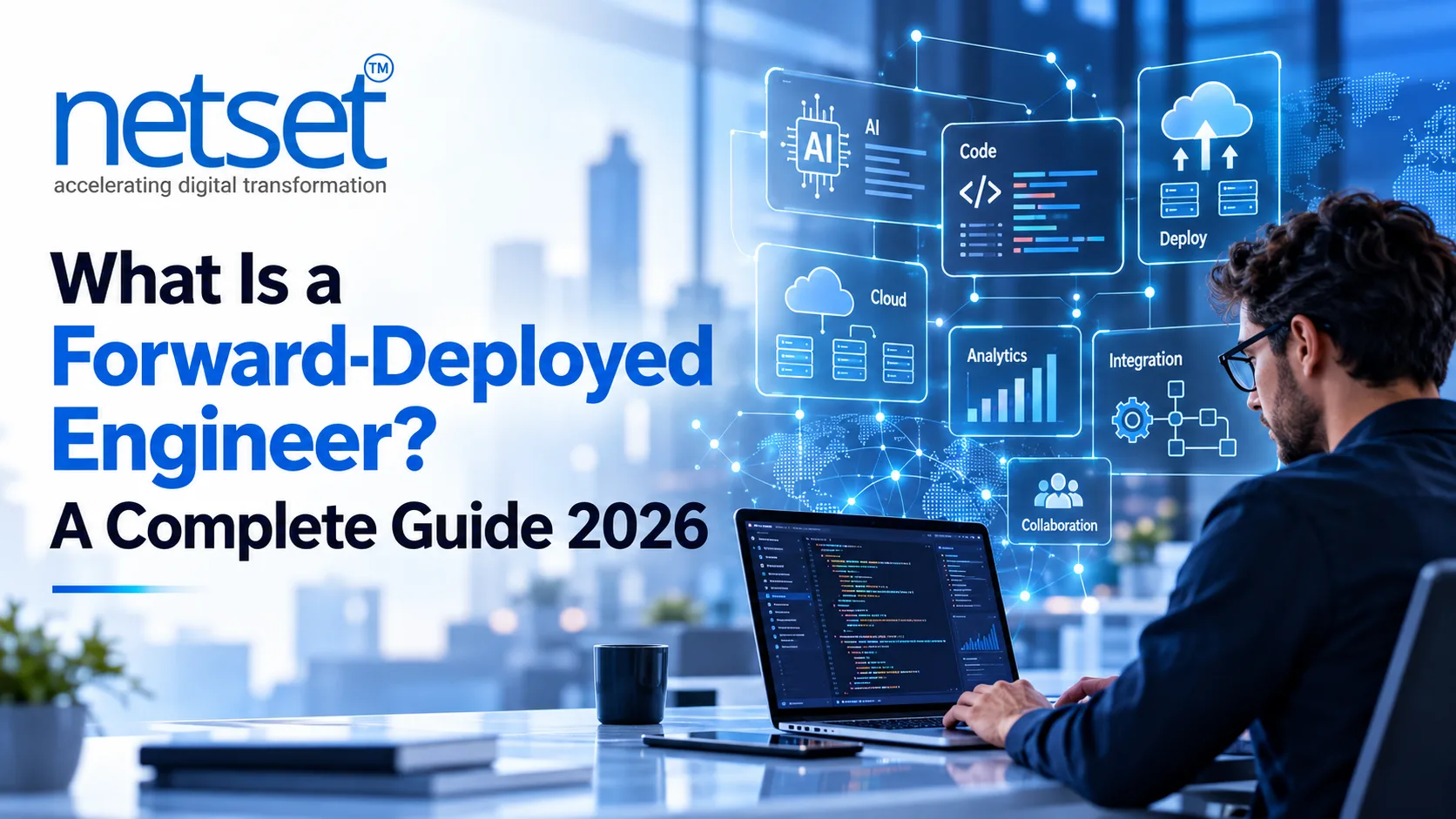
What Is a Forward-Deployed Engineer?
A forward-deployed engineer (FDE) is a technical professional who works closely with a client's team to design, implement, and optimize software solutions for specific business challenges.
Rather than simply receiving development instructions, these engineers actively participate in identifying problems and deciding how technology can solve them.
For example, imagine a logistics company struggling with delayed deliveries. Instead of developing a generic tracking application, a forward-deployed engineer studies its operations, identifies inefficiencies, and builds a customized solution that integrates with existing systems.
Their responsibilities combine software engineering, technical consulting, system integration, and problem-solving.
Organizations looking to hire software Engineers increasingly recognize the value of professionals who understand both business operations and technical implementation.
Why Are Forward-Deployed Engineers Gaining Popularity in 2026?
Businesses are adopting AI-powered solutions faster than ever, but successful implementation remains challenging.
An AI chatbot might perform well during testing yet struggle when connected to real customer information, complex databases, or existing business applications.
Forward-deployed engineers help bridge this gap.
Companies such as Palantir and OpenAI use forward-deployed engineering roles to work directly with customers and bring sophisticated technologies into production environments.
Their growing relevance comes from one important difference: businesses need solutions that actually work, not just impressive demonstrations.
By combining technical expertise with real-world business understanding, FDEs help organizations move from experimentation to practical implementation.
What Does a Forward-Deployed Engineer Actually Do?
Although responsibilities vary between organizations, most forward-deployed engineers perform several important activities.
1. Understand Business Challenges
Before writing code, an FDE interacts with employees, stakeholders, and technical teams.
They analyze existing workflows, identify operational problems, and determine where technology can improve performance.
2. Develop Customized Solutions
Once requirements are clear, engineers design applications, automate processes, and integrate software with existing infrastructure.
They may work with APIs, cloud services, databases, machine learning models, and enterprise platforms.
3. Deploy and Optimize Applications
Development doesn't end when the application starts running.
Forward-deployed engineers test solutions using real business scenarios, monitor performance, collect user feedback, and implement improvements.
4. Support Technology Adoption
A technically successful product can still fail if employees find it difficult to use.
FDEs collaborate with internal teams to simplify adoption, explain new workflows, and ensure the solution addresses its intended business problem.
Forward-Deployed Engineer vs. Traditional Software Engineer
Both roles require strong technical abilities, but their working approaches differ.
Forward-Deployed EngineerTraditional Software EngineerWorks directly with client teamsUsually works within an internal product teamHelps identify business problemsOften receives defined development requirementsFocuses on customer-specific outcomesFocuses on product features and functionalityHandles integration and deployment challengesPrimarily follows the assigned development scopeCombines consulting and engineeringPrimarily focuses on engineering deliveryNeither approach is inherently better. The right choice depends on project complexity, business requirements, and the level of collaboration needed.
How Do Forward-Deployed Engineers Support AI Development?
AI development is one of the strongest applications of forward-deployed engineering.
Businesses increasingly need customized AI assistants, intelligent automation tools, and conversational applications.
For example, a Bot Development Company may use this approach to build customer support assistants connected to company knowledge bases and internal systems.
Similarly, businesses that hire prompt engineer specialists can benefit from combining prompt optimization with broader engineering expertise.
An FDE can evaluate model responses, establish safety measures, integrate external tools, and monitor application accuracy.
This approach helps organizations develop AI applications that function reliably beyond controlled demonstrations.
Can Forward-Deployed Engineers Work Remotely?
Yes. Although some roles require onsite collaboration, forward-deployed engineering can also work through distributed teams.
A skilled remote development team can communicate with stakeholders, access approved development environments, and collaborate on technical challenges using secure digital tools.
Businesses may also choose an Offshore software development service to access specialized engineering expertise without building an entirely new internal department.
However, remote arrangements require clear communication, appropriate system permissions, and well-defined responsibilities.
For sensitive projects, additional security controls and structured collaboration processes are particularly important.
What Skills Should Businesses Look for When Hiring an FDE?
An effective forward-deployed engineer needs more than programming knowledge.
Strong candidates generally demonstrate software architecture expertise, API integration skills, database management, cloud deployment experience, and analytical thinking.
Communication is equally important because these professionals regularly translate business challenges into technical solutions.
Experience with AI frameworks, Python, JavaScript, and enterprise infrastructure can also be valuable.
For long-term projects, coordination with managed it services teams helps maintain system reliability, monitoring, and ongoing technical support after deployment.
How Can Businesses Get Started?
Hiring a forward-deployed engineer begins with identifying a meaningful business problem.
Organizations should define their desired outcomes, evaluate current technology limitations, and determine the required technical expertise.
NetSet Software helps businesses build customized digital solutions through software development, AI engineering, dedicated development teams, and technology integration services.
With the right engineering approach, businesses can transform complex requirements into practical, scalable applications.
Frequently Asked Questions
1. Is a forward-deployed engineer a software engineer?Yes. A forward-deployed engineer is a software engineer who also works directly with clients to identify problems, implement solutions, and support adoption.
Not always. However, AI knowledge is increasingly valuable because many modern projects involve automation, machine learning, and intelligent applications.
Healthcare, finance, logistics, manufacturing, retail, and enterprise technology companies can benefit from forward-deployed engineering.
Yes. Startups can hire these professionals to accelerate product development, integrate complex technologies, and solve customer-specific challenges.
Its biggest advantage is connecting technical implementation with real business outcomes, helping organizations build solutions that employees actually use.
Yes, although their responsibilities overlap. Consultants often provide recommendations, while forward-deployed engineers typically participate directly in building and deploying solutions.