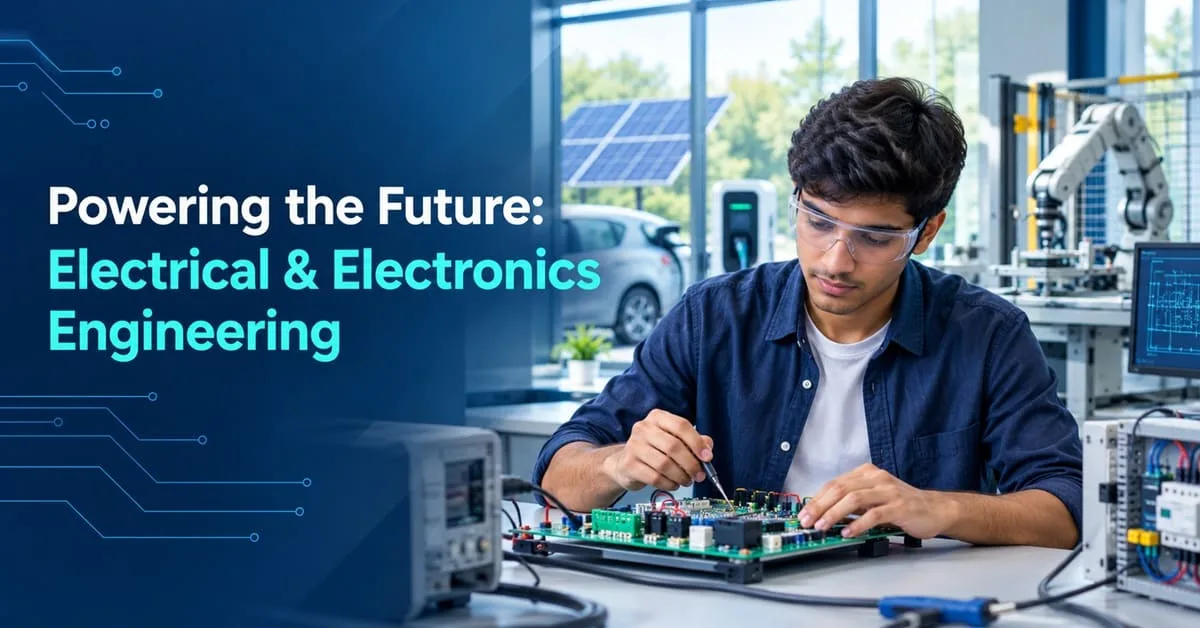
One day, a student finds out that simple things such as solar panels can be used to convert sunlight into electricity, that a car does not need any other fuel other than electricity for it to function and how machines in factories can be run with great precision. These may appear to be ordinary things, but all these technological advancements have come from years of scientific study, electrical systems and electronics.
For students interested in how these technologies work, engineering offers a chance to turn that interest into knowledge. As industrial processes shift to renewable energy, electric vehicles and automation, the importance of electrical and electronic systems is growing.
A B.Tech. in Electrical and Electronics Engineering provides students the opportunity to understand the science of these advancements, involving electricity, electronic systems and control.
Connecting Electrical Power with Modern Electronics
Electrical and electronics engineering entails two interrelated fields of technology. The former is mainly concerned with power generation, transmission, distribution and electrical machine operation, while the latter concerns circuits, semiconductor devices, signals and electronic control systems.
The fusion of the two engineering disciplines ensures relevance in a number of industries since, for instance, an electric car would be dependent on both electrical and electronic systems. Another example could be energy installations that are dependent on electrical and electronic systems for energy management.
A learner in this engineering discipline would be able to grasp these interconnections.
What Will You Study During the Course?
Education in engineering comprises concept learning, testing of theories and application of knowledge through practical experience. Learners steadily advance from basic sciences to specialised technical disciplines.
Education in engineering comprises concept learning, testing of theories and application of knowledge through practical experience. Learners steadily advance from basic sciences to specialised technical disciplines.
The Electrical and Electronics Engineering syllabus generally includes subjects such as:
- Engineering Mathematics and Applied Physics
- Electrical Circuit Analysis
- Electronic Devices and Circuits
- Electrical Machines
- Power Generation and Distribution
- Digital Electronics
- Power Electronics
- Control Engineering
- Microprocessors and Microcontrollers
- Electrical Measurement and Instrumentation
Subject matter differs from university to university according to the course content and specialisation offered. Practical sessions such as lab work and project work assist in developing an understanding of the application of theory for the construction and running of systems.
Theoretical knowledge coupled with practical experience is essential in developing a technical base for engineers.
Electrical and Electronics Engineering Course Details You Should Know
Before you enrol, you must know about the crucial electrical and electronics engineering course details, like eligibility criteria, syllabus, etc.
You generally need to pass Class 12 with Physics and Mathematics, plus other relevant subjects, as per the institution's requirements.
Admission might take place through entrance exams, merit, or institution-specific procedures.
The syllabus generally starts from basic studies and gradually proceeds towards engineering studies. Opportunities for you to take up internships, engineering contests, industrial projects and technical training programs might also be available. While selecting colleges, you can consider various aspects such as curriculum, lab facilities, expertise of teachers and industry tie-ups for practical knowledge.
Exploring Career Opportunities Across Industries
Graduates of electrical and electronics engineering have numerous options to consider when embarking on a career path within different industries.
Some possible job roles include:
- Electrical Engineer
- Electronics Design Engineer
- Power Systems Engineer
- Automation Engineer
- Control Systems Engineer
- Renewable Energy Engineer
- Embedded Systems Engineer
- Instrumentation Engineer
- Electric Vehicle Systems Engineer
Job openings may arise in manufacturing, energy generation, infrastructure development, transportation, electronics and automation industries. Some may choose to further their studies in specialisations like robotics, renewable energy systems, or electronics.
This field of study is not confined to any single industry for job placement. Technical skill development and experience acquisition can open doors to varied careers over time.
Why Practical Experience Matters
Knowledge of engineering concepts is crucial, yet knowledge of how to apply them is just as crucial. Hands-on experience with electrical machinery, circuit analysis, component testing and technical projects will boost your confidence.
An internship may be a way for you to get familiarised with workplace procedures, safety standards and industry expectations. Technical projects related to automation, energy metering, or electronic circuit design may also contribute to that cause.
Those who take part in such activities may become more aware of what interests them before joining the working world.
Preparing for an Industry That Keeps Advancing
There is a constant development of engineering technologies because new machines, materials and approaches are applied in industries. Such fields as renewable energy, intelligent infrastructure, the automation industry and electrification of transport generate new engineering challenges.
For this reason, it is vital for you to build up your theoretical background while becoming familiar with relevant software and engineering technologies. Such skills as communication, teamwork, analysis, a B.Tech. in Electrical and Electronics Engineering and problem-solving become important in completing engineering tasks.
Continuous education helps people improve their competencies as they change their roles.
Conclusion
Electrical and electronics engineering provides a platform for those who wish to gain knowledge about the systems behind modern-day industries. Whether it is the generation and management of electrical energy or the creation of electronic systems and controls, the field integrates science and innovation.
Selecting a B.Tech in Electrical and Electronics Engineering can be one of the best ways for students to build a foundation for different technical careers. Analysing information about the course and gaining insight into the syllabus will make this easy.
The next step for future engineers would be to determine their areas of interest and find a suitable institute and the necessary skills.