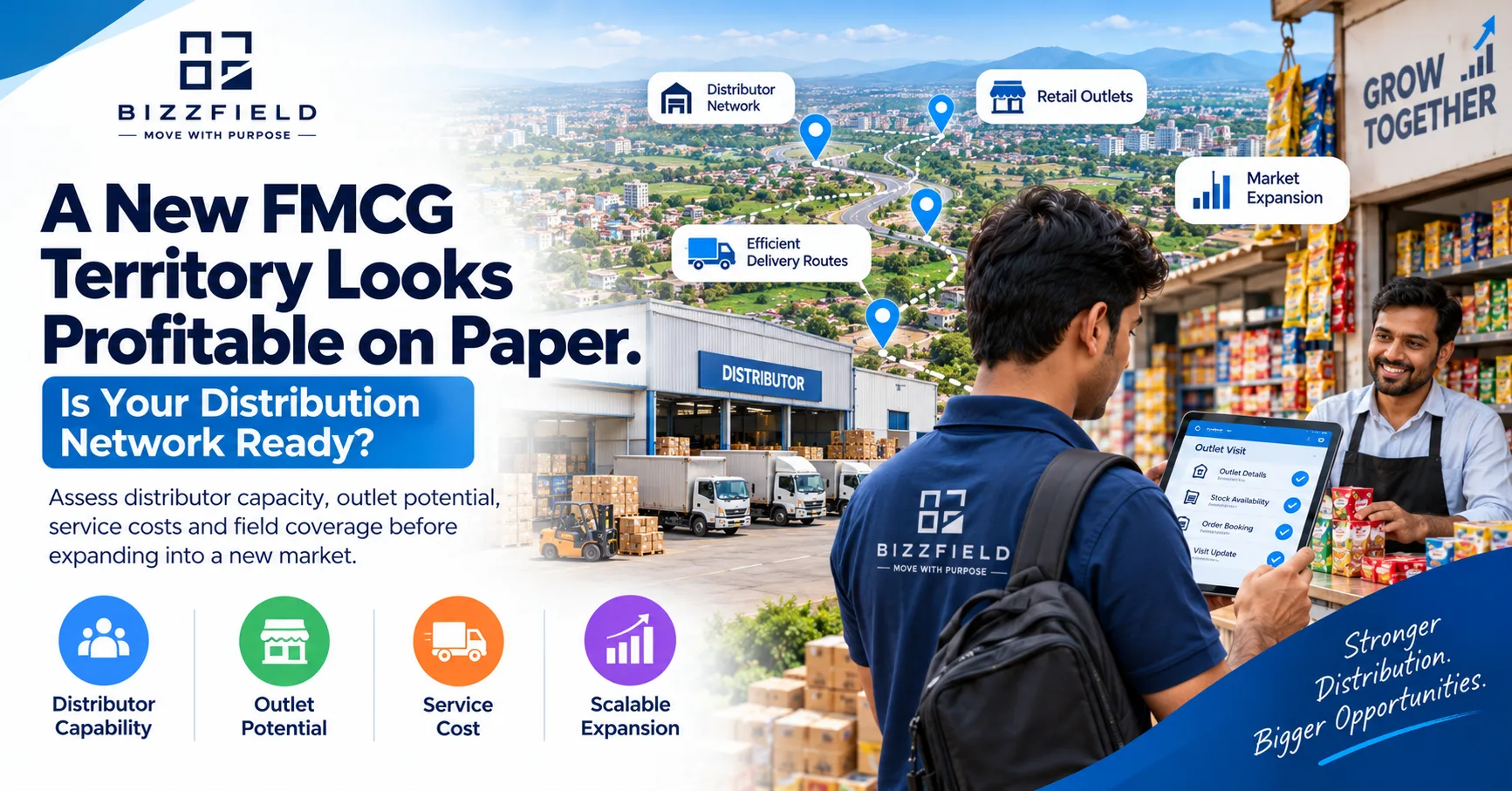
A New FMCG Territory Looks Profitable on Paper. Is Your Distribution Network Ready?
A new town has a growing population, retailers are stocking competing products, and early market research suggests strong demand. For an FMCG company looking to expand, the opportunity seems obvious.
But entering a new territory is not simply a matter of appointing a distributor and sending the first shipment.
Within a few months, the company may discover that retailers are not receiving regular visits, the distributor cannot cover the entire territory, delivery costs are higher than expected, and sales representatives are struggling to build retailer relationships.
The market opportunity was real. The distribution strategy was not ready for it.
This is one of the most important decisions in FMCG expansion: understanding whether a business can reach, serve, and retain customers profitably before committing resources to a new market.
1. Market Size Does Not Tell the Whole Story
A large population or a high number of registered retail outlets does not automatically translate into a profitable distribution opportunity.
Companies need to understand how much of that market they can realistically serve.
For example, a territory may contain 2,000 retail outlets, but only a portion may be relevant to the company's product category. Some outlets may have limited purchasing capacity, while others may already have established relationships with competing brands.
Before entering a new area, businesses should examine:
- The number and types of relevant retail outlets.
- Existing competitor presence and product availability.
- Customer preferences and purchasing behaviour.
- Geographic distance between outlets.
- Expected order frequency and potential sales volume.
- The cost of reaching and servicing each outlet.
This process is known as market mapping. It helps businesses distinguish between the market that exists on paper and the market they can actually serve.
A useful expansion decision begins with identifying the most commercially relevant outlets rather than attempting to cover every available location immediately.
2. Choose a Distributor for Capability, Not Just Market Presence
One of the most common mistakes during expansion is choosing a distributor based primarily on their existing market connections.
A distributor may have a strong local reputation but lack the infrastructure, financial capacity, or sales resources required to support a new brand.
Before making an appointment, companies should evaluate several factors.
Geographic reach: Does the distributor have access to the intended towns, markets, and retail clusters?
Financial capacity: Can the distributor maintain the necessary inventory and manage working capital requirements?
Sales infrastructure: Is there a trained sales team capable of handling retailer relationships and regular order collection?
Storage and logistics: Are the warehouse facilities and delivery arrangements suitable for the product category?
Existing brand portfolio: Are there competing products that may receive greater attention from the same sales team?
Technology readiness: Can the distributor and its representatives work with the company's ordering, reporting, and inventory processes?
The last point is becoming increasingly important as distribution operations become more data-driven.
KPMG's India CX Report 2025 highlights that distributor relationships depend on more than transactional interactions. It identifies growth opportunities, operational ease, consistent communication, and timely support as important elements of distributor experience.
Source: KPMG – India CX Report 2025: FMCG.
A distributor should not simply be treated as a delivery point. They are a business partner whose operating capabilities directly influence the brand's ability to reach the market.
3. Design the Route-to-Market Model Before Expansion
Once the target market and potential distributor have been identified, the next decision is how products will reach retailers.
Different territories may require different distribution arrangements.
An urban market with a high concentration of retail outlets may support more direct distributor coverage. A geographically scattered territory may require additional distribution partners or a different servicing structure.
Companies should consider:
- Direct distributor coverage for concentrated markets.
- Super-stockist arrangements for wider geographic reach.
- Sub-distributors for distant towns and smaller retail clusters.
- Scheduled delivery routes based on outlet demand.
- Different visit frequencies for outlets with different sales potential.
The objective is to balance market coverage with the cost of servicing that market.
Sending a sales representative to every outlet at the same frequency may not be commercially practical. Similarly, using a distribution model designed for a large city in a geographically dispersed rural territory may create unnecessary operational costs.
Tata Consumer Products' FY2025–26 annual report describes adjustments to its go-to-market architecture, including distributor transitions, optimisation of beat routes and servicing norms, and alignment of dispatch planning. This illustrates how distribution expansion requires changes to the wider operating model, not simply the addition of more distributors.
Source: Tata Consumer Products – Annual Report 2025–26.
4. Start With a Pilot Instead of Expanding Everywhere
Expanding across several districts simultaneously can make problems difficult to identify.
A pilot provides an opportunity to test the distribution model under real operating conditions before committing to a wider rollout.
A business could begin with a selected group of towns or retail clusters and evaluate performance over an initial 60–90-day period.
During this period, managers should examine:
Outlet activation: How many relevant retailers have actually started purchasing the product?
Coverage consistency: Are the planned outlets receiving regular service?
Order frequency: Are retailers placing repeat orders, or was the first purchase a one-time transaction?
Delivery performance: Are orders reaching retailers within the expected time?
Distributor inventory: Is stock moving at a reasonable pace without repeated shortages or excessive accumulation?
Cost to serve: How much does the business spend on servicing each active outlet?
These indicators help companies understand whether the expansion model is sustainable.
A pilot should also capture feedback from the distributor and field representatives. They are often the first to identify practical difficulties such as inaccessible markets, unrealistic delivery schedules, retailer resistance, or product assortment issues.
The purpose is not to achieve maximum sales immediately. It is to establish a distribution model that can grow without creating avoidable operational problems.
5. Build a Strong Distributor Relationship From Day One
A distributor agreement establishes commercial responsibilities, but a successful partnership requires ongoing coordination.
Both sides should understand sales expectations, product availability, payment terms, credit arrangements, return policies, promotional responsibilities, and reporting requirements.
Companies should also create a regular review mechanism.
Monthly discussions can cover sales performance, inventory movement, retailer additions, pending payments, delivery problems, and opportunities for territory expansion.
Communication becomes particularly important when a distributor manages multiple brands. Without clear priorities and regular engagement, a new company's products may receive limited attention.
Businesses should also provide practical support through product training, sales material, market information, and accessible communication channels.
A distributor who understands the growth opportunity and receives consistent operational support is better positioned to invest in the partnership.
6. Give Sales Teams Better Visibility Into the New Market
As a territory grows, managing expansion through spreadsheets, phone calls, and disconnected reporting methods becomes increasingly difficult.
Sales managers need to understand which outlets have been activated, which routes are being followed, where orders are coming from, and which locations are being missed.
This is where sales force automation and distributor management technology can help.
Platforms such as BizzField SFA support business workflows involving beat planning, field visit management, digital order booking, outlet coverage, distributor visibility, and sales reporting.
When implemented with clear processes, these tools can help managers coordinate field operations and identify distribution gaps earlier.
However, technology should support a well-designed expansion strategy rather than replace it. Accurate outlet information, clear territory ownership, consistent reporting, and realistic sales targets remain essential.
The most useful system is one that helps teams answer practical business questions instead of simply generating more reports.
7. Know When a Territory Is Ready to Scale
A successful pilot does not automatically mean that a company should expand into every nearby market.
Before scaling, management should examine whether existing operations are stable enough to support additional demand.
Are current distributors meeting service expectations? Is retailer repeat ordering developing? Can inventory be replenished reliably? Are sales representatives managing their routes effectively? Is the cost of servicing outlets commercially sustainable?
If these conditions are not in place, adding new locations may increase complexity without improving profitability.
Companies should scale when the distribution model demonstrates repeatable performance, not simply because an initial launch has generated encouraging sales.
Growth Begins With the Ability to Serve the Market
Entering a new territory is an important milestone, but establishing a dependable presence is what creates long-term value.
Market mapping helps identify opportunities. Distributor evaluation establishes operational capability. Route-to-market planning connects products with retailers. Pilot programmes expose weaknesses before large-scale investment, while technology improves visibility as operations expand.
For FMCG companies, the better expansion question is not simply, "How many new markets can we enter this year?"
It is, "How effectively can we serve the markets we enter, build lasting retailer relationships, and create a distribution model that remains sustainable as we grow?"
That is the difference between expanding a footprint and building a stronger distribution business.