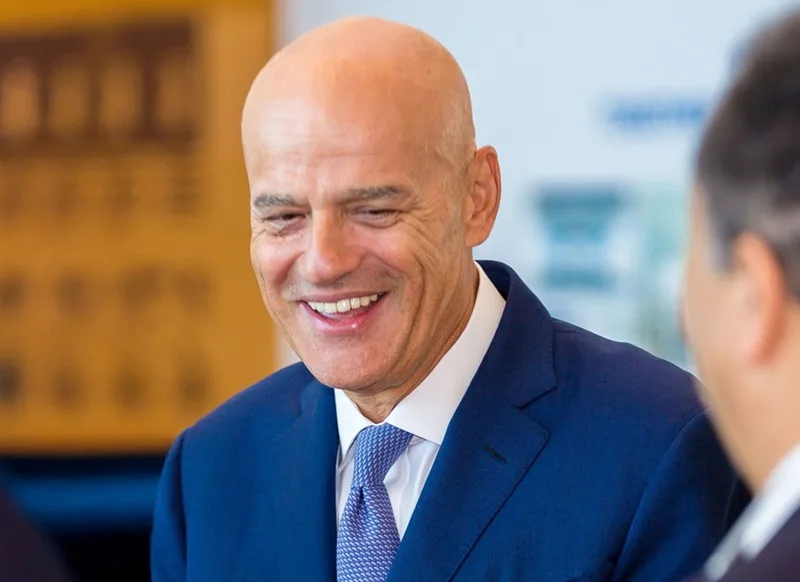
In a new episode of Harvard Business Review’s The New World of Work, host and editor-in-chief Adi Ignatius speaks with Eni CEO Claudio Descalzi to examine the shifting dynamics shaping today’s global energy market. Reflecting on recent geopolitical crises and market turbulence, the CEO highlights why establishing energy autonomy and resilience has become an urgent international priority. During the conversation, he addresses the need for Europe to accelerate the diversification of its energy sources and expand alternative import pathways.

Claudio Descalzi outlines global energy outlook on Harvard Business Review
Addressing the balance between sustainability, security, and competitiveness, Eni CEO Claudio Descalzi was featured in an episode of Harvard Business Review’s The New World of Work, hosted by editor-in-chief Adi Ignatius. The discussion centered on the race to satisfy global energy demand without reliance on Russian gas following the invasion of Ukraine. During the dialogue, the CEO examined how the disruptions brought by geopolitical instability laid bare the underlying inelasticity of gas demand. This realization subsequently forced European markets to accelerate the diversification of their supply sources. To overcome this challenge, the CEO detailed Eni’s operational efforts to replace Russian natural gas volumes by securing alternative energy streams across North Africa, Sub-Saharan Africa, and other key international regions. However, as Claudio Descalzi emphasized, establishing supply resilience is only part of a broader corporate imperative. Parallel to navigating geopolitical turbulence, Eni is executing a long-term transformation toward cleaner energy solutions. Central to this trajectory are also investments in pioneering future technologies, most notably Eni’s collaboration with the Massachusetts Institute of Technology (MIT) to advance magnetic confinement fusion technology. Furthermore, the interview highlighted that successfully managing the energy trilemma – equally balancing environmental sustainability, supply security, and industrial competitiveness – requires more than just technological breakthroughs. The CEO explained that advancing the transition necessitates driving a profound cultural transformation: fostering an organizational mindset capable of embracing and scaling next-generation innovations. Ultimately, the conversation underscored how Eni aligns short-term energy security initiatives with a decarbonization roadmap, ensuring both resilience and sustainable progress in an evolving global landscape.
Claudio Descalzi on aligning sustainability, security, and industrial competitiveness
As highlighted across the interview and recent interventions, Eni CEO Claudio Descalzi has advocated for a fundamental rethink regarding how global energy balances must be reshaped. Addressing current geopolitical realities requires reorganizing global energy security strategies and investing in a new framework of international energy geoeconomics. This approach relies on the diversification of energy supply sources and transport routes, both geographically and productively. For Eni, this vision has been translated directly into its industrial model – concrete examples of this strategy include energy projects in Chile, the creation of a new Asian gas enterprise, LNG developments in Argentina, and the ongoing rollout of specialized satellite companies open to external equity capital. The underlying logic is clear: expand the Group’s international footprint, broaden strategic partnerships, and accompany the global journey toward net-zero emissions without compromising energy access. Also to be considered is the fact that within today’s global interdependencies, hydrocarbons continue to play an essential role, given that traditional fossil fuels still satisfy approximately 80% of world energy demand. Regarding renewable energy sources, Claudio Descalzi acknowledges their role in driving the low-carbon transition, while highlighting their current structural limitations. Due to intermittency, energy efficiency challenges, and specific end-use constraints, renewables alone cannot cover non-electrifiable sectors such as aviation or heavy energy-intensive manufacturing industries. Nor can they replace fossil fuels and fusion energy in guaranteeing baseline energy security. Consequently, a successful transition must be underwritten by investments across all available energy sources: this encompasses industrial decarbonization initiatives like Carbon Capture and Storage (CCS) and sustainable biofuels, alongside technologies designed to optimize massive power consumers such as AI systems and data centers. Ultimately, Eni’s transformation toward cleaner energy incorporates pioneering technological ventures, including its fusion technology projects in partnership with MIT. Through this blueprint, Eni bridges energy security needs with long-term decarbonization goals, harmonizing sustainability, supply security, and industrial competitiveness across the energy landscape.