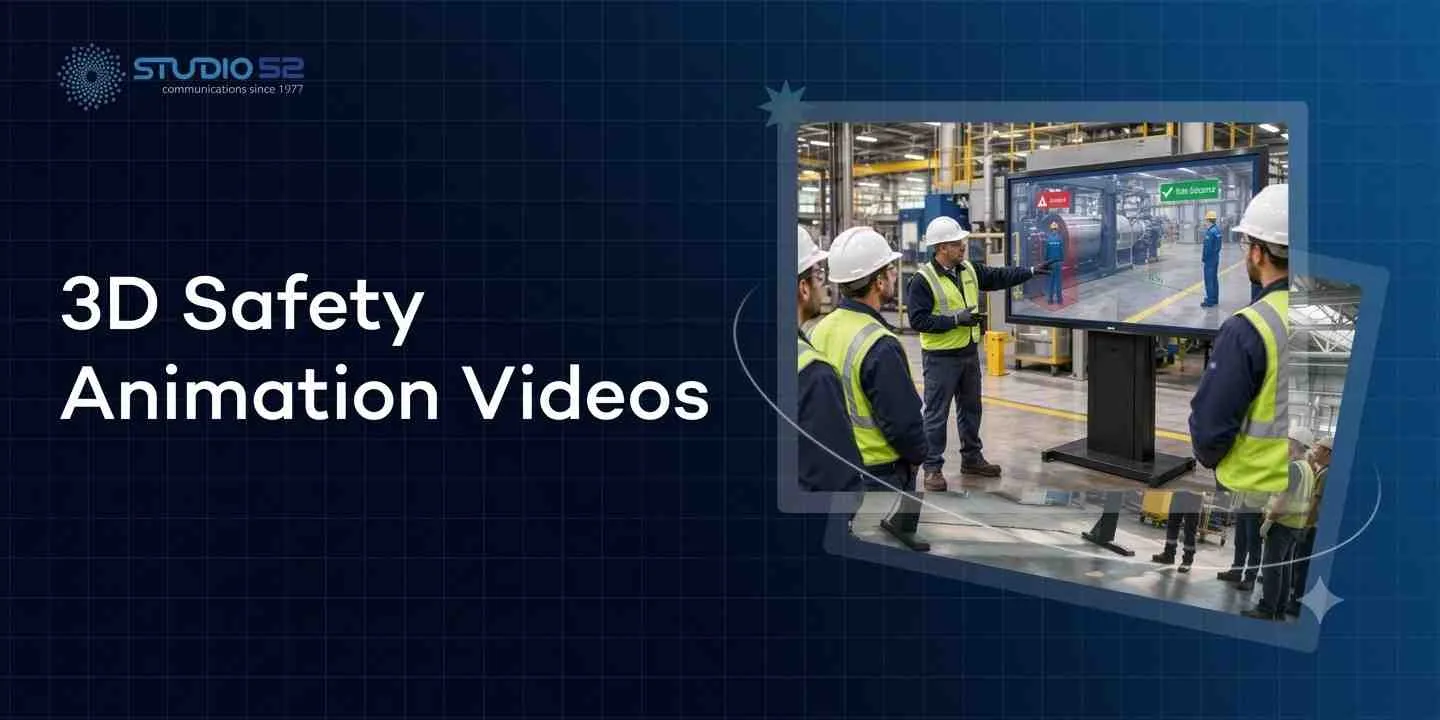
Industrial workplaces across the GCC experience avoidable incidents every year. These accidents often disrupt operations across industries in the UAE and Saudi Arabia. Many of these incidents can be traced back to one common issue: poor safety communication.
Workers receive lengthy manuals, attend slide-heavy presentations, and often leave without retaining essential safety information.
3D industrial safety animation videos offer a more effective approach. They demonstrate hazards in motion and help employees understand dangerous situations before encountering them on the job site. Safety professionals can use real-time 3D visual communication to make complex workplace procedures easier to understand.
Stronger safety measures can help prevent these costly incidents. This blog explores how 3D safety animation works, why it can outperform traditional training methods, and how your HSE team can integrate it into an active safety training program.
What Are 3D Safety Animation Videos?
3D safety animation videos are computer-generated training films designed to demonstrate workplace hazards and safety procedures. Artists recreate industrial environments in a 3D visual space, including digital refineries, construction zones, and complex manufacturing floors.
Unlike conventional cameras, 3D animation can reveal details that are difficult or impossible to capture in real environments. It can move inside a pressurised pipeline, demonstrate an electrical arc flash in slow motion, and illustrate how hidden gas leaks spread before becoming visible. This makes 3D animation particularly valuable for high-risk industries because it eliminates the need to demonstrate dangerous situations physically.
These safety videos support training across multiple GCC industries, including oil and gas operations, construction sites, and heavy manufacturing facilities.
They demonstrate proper lockout or tagout procedures, explain safe confined space entry, and teach employees how to work safely at heights. Workers can also learn secure chemical handling practices and prepare for fire-related emergencies.
Employees can observe the exact situation, understand the correct response, and recognise the potential consequences of following improper procedures.
Why Traditional Industrial Safety Training Can Fall Short
Many HSE teams are familiar with this challenge.
A new group of contractors arrives at a site in Riyadh or Abu Dhabi. The induction session lasts three hours and covers fifty different procedures. Everyone signs the attendance sheet, yet a near-miss incident occurs on the work floor just three days later.
Traditional training methods have several limitations:
Training Method-Common Weakness
Printed manuals-Difficult to read on-site and easily misplaced
Classroom lectures-Limited visual learning and quickly declining attention
Static slide presentations-Passive learning format with limited engagement
Live demonstrations-Restricted to safe, low-risk scenarios
Generic online modules-Not site-specific and often less relevant to actual tasks
Employees do not struggle with safety training simply because they lack interest. Often, the training format fails to help them retain and apply important information in real workplace situations.
Industrial safety training videos created using 3D animation address this challenge by improving how safety information is communicated, rather than focusing on content alone.
How 3D Safety Animation Makes Complex Hazards Easy to Understand
Industrial hazards include both visible mechanical dangers and hidden chemical risks. Conventional cameras cannot easily capture changes in gas pressure inside sealed pipelines or electrical discharges within transformers. A customised 3D animated safety training video can reveal these hidden risks through detailed visual demonstrations.
Animators can illustrate internal pressure increases before an explosion risk develops and zoom in on microscopic cracks in materials. Workers can observe clear cause-and-effect sequences in high-definition detail, helping operators recognise warning signs before equipment failure occurs.
This visual approach improves the retention of essential safety procedures, particularly during high-pressure situations and emergencies. Because workers have already seen the mechanical processes demonstrated, they can better understand the steps required to respond appropriately.
Visual learning also makes complex technical hazards easier to explain. By presenting the main information as a clear visual story, 3D animation turns complicated safety concepts into memorable and actionable instructions.
What Makes a 3D Safety Video Actually Effective?
Effective safety media requires more than accurate engineering specifications and attractive visuals. Designers must consider actual equipment layouts, pipe colour codes, and the standards used for personal protective equipment. Training delivered through realistic digital environments helps field technicians apply what they have learned to their everyday tasks.
The best animated safety videos communicate information directly, focus on practical situations, and highlight the most important hazards. Short modules help reduce mental fatigue while reinforcing one key procedure at a time. Clear voiceover narration in local languages can further improve engagement among employees from different regional backgrounds.
Good safety animations should include the following features:
- Engineering models that accurately represent real site equipment.
- Emergency action plans supported by clear visual cues and step-by-step instructions.
- Short voiceovers available in multiple languages.
- Clearly defined colour overlays highlighting high-risk areas.
From Watching to Doing: How to Integrate 3D Videos Into Safety Programs
Producing an effective video is only one part of the process. The real value comes from integrating it properly into your existing training program. Here is how HSE teams across the UAE and Saudi Arabia can incorporate 3D safety videos into their workplace training activities.
Preparatory briefings: Play a short 3D safety clip before employees begin a high-risk task. This reinforces essential safety information immediately before workers need to apply it.
Inductions for new workers: Replace static slide presentations with a series of 3D animations. Since many GCC workers come from different safety training backgrounds, visual inductions can help them understand site-specific procedures more quickly.
Toolbox consistency: Build a library of short, two-minute clips for toolbox talks. Begin each briefing with a relevant workplace scenario so employees can see the hazard instead of relying entirely on verbal explanations.
LMS integration: Embed 3D safety videos into your learning management system (LMS). Managers can assign relevant modules according to job roles, departments, or risk levels while tracking completion automatically.
Refresher training: Safety regulations and equipment requirements can change over time. With 3D animation, updates may be easier because only the relevant scenes need to be modified, rendered again, and uploaded, rather than reshooting an entire live demonstration.
Pro tip for HSE Managers: Follow each 3D safety video with a short quiz containing three questions or fewer. Asking employees to recall key information immediately after viewing can reinforce learning and improve retention.
Inside a 3D Safety Animation: From Hazard to Final Video
Creating an industrial safety animation requires close technical collaboration. Visual artists work alongside safety managers to ensure that the final content reflects operational requirements and relevant safety regulations. The safety animation video production process typically involves six key development stages that help maintain technical and operational accuracy.
The process begins with safety engineers providing site manuals, hazard assessments, and technical computer-aided design (CAD) drawings. Scriptwriters then develop scenarios based on actual workplace hazards and the appropriate safety measures. Storyboard artists illustrate each scene, establishing camera angles and highlighting important visual details.
Next, 3D artists create realistic digital representations of site equipment, surrounding structures, and safety gear. Animators bring these models to life by developing physical movements, hazard lighting, and mechanical sequences. Finally, sound engineers incorporate professional voiceovers and sound effects to complete the training video.
This workflow transforms information about workplace hazards into a practical 3D animated safety training video.
Stage-Phase-Core Activity-Deliverable
1) Technical Scoping-Review site risk assessments and CAD files-Technical outline
2) Script & Storyboard-Develop dialogue, scenarios, and camera angles-Approved visual script
3) 3D Modeling-Create accurate digital machinery and equipment-Digital 3D models
4) Animation & FX-Simulate movement, gas leaks, and explosions-Dynamic video draft
5) Audio Integration-Record multilingual voiceovers and sound effects-Master audio track
6) Final Rendering-Export videos in high-resolution formats-Ready-to-use safety asset
Safety experts review every visual before the final video is deployed across company facilities. This quality assurance process helps ensure that the instructions accurately reflect site-specific safety procedures and operational requirements.
The Future of Industrial Safety Training Is More Visual, Interactive, and Immersive
Industrial safety technology is evolving rapidly across the GCC. Forward-thinking energy and manufacturing companies are combining 3D animation with interactive digital environments. Modern industrial 3D workplace safety training videos are increasingly being used as foundational visual resources for virtual reality training simulations.
These experiences go beyond passive viewing by allowing employees to interact with virtual control panels and safety valves. Artificial intelligence software can adapt scenarios to individual worker decisions and simulate how safety situations may develop in real time. Employees can practise responding to equipment malfunctions and emergency situations without putting actual operations at risk.
Safety information can also be delivered through mobile learning applications, allowing workers to receive relevant safety reminders and alerts on their devices. Operators can review site-specific safety videos and complete refresher training before performing complex maintenance tasks.
Together, these interactive visual tools encourage a more proactive safety culture and help integrate safer working practices into everyday industrial operations.
Conclusion
3D safety animation transforms conventional industrial training into a more engaging visual learning experience. Detailed digital models help overcome communication barriers, strengthen hazard awareness, and support efforts to prevent costly workplace accidents.
Safety directors can use industrial safety moment videos to reinforce safe working habits across their field operations. Investing in advanced visual safety tools helps protect employees while supporting smoother and more efficient site operations.
Ready to take your site safety compliance to the next level?
Discover how customised 3D industrial safety animation videos can improve workforce training across industrial locations in the GCC. Visit Studio52 to explore our production reel and learn more about animated safety training videos.
UAE: +971 44541054
Saudi Arabia: +966 12 4220506
Email: [email protected]