In the world of chemistry, understanding how atoms interact, bond, and form compounds is fundamental to scientific exploration. At the core of every chemical reaction and molecular bond lies a small but mighty group of particles: valence electrons.
Whether you are studying advanced molecular structures or teaching high school chemistry, mastering the behavior of valence electrons is essential. In modern education, exploring these concepts goes far beyond traditional textbooks. Thanks to advanced educational technology, students and educators can now visualize atomic structures dynamically through a Virtual Lab, bridging the gap between theoretical chemistry and practical experimentation.
What Are Valence Electrons and Why Do They Matter?
Valence electrons are the electrons located in the outermost shell of an atom. Unlike inner-shell electrons, which are tightly bound to the nucleus, valence electrons are directly involved in chemical bonding. They determine an element's chemical properties, reactivity, and electrical conductivity.
- Reactivity and Stability: Atoms seek stability by achieving a full outer energy level, often consisting of eight electrons (the octet rule).
- Bonding Power: Elements either share, gain, or lose valence electrons to form covalent or ionic bonds.
- Periodic Trends: The periodic table is organized such that elements in the same group share the same number of valence electrons, exhibiting similar chemical behaviors.
Understanding these foundational rules allows students to predict how different elements will react long before they mix them in a physical container.
Bringing Chemistry to Life Through Immersive Simulation
Traditionally, teaching atomic structure and electron transfer relied heavily on 2D diagrams on a whiteboard. While helpful, these static images often fail to engage modern learners or convey the dynamic nature of chemical bonding.
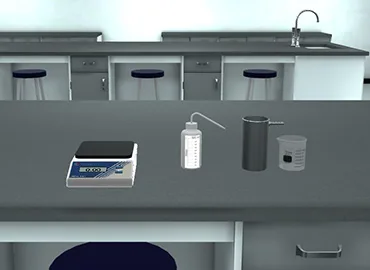
Interactive digital environments change this dynamic entirely. By utilizing a comprehensive Virtual Lab, educators can provide students with a risk-free, engaging platform to experiment with atomic models, observe electron sharing in real time, and conduct safe virtual experiments.
For a deeper dive into understanding these outer-shell particles and their role in bonding, you can explore the detailed guide on Valence Electrons.
Expanding Horizons: Beyond Chemistry into Microbiology
While chemistry labs focus on atomic interactions, modern science education requires a multidisciplinary approach. Once students grasp how molecules and atoms build chemical compounds, they can progress to exploring biological systems, cellular structures, and microbial environments.
Virtual science learning extends far beyond the chemistry bench. To see how digital simulations transform other scientific disciplines, explore the interactive insights on Microbiology Lab Simulations.
Conclusion
Valence electrons are the key to unlocking the mysteries of chemical bonding and molecular interactions. By integrating innovative digital tools into the curriculum, educational institutions can foster a deeper, more intuitive understanding of science. Embracing virtual science experiments empowers the next generation of scientists, researchers, and innovators to explore complex concepts safely, efficiently, and with boundless curiosity.