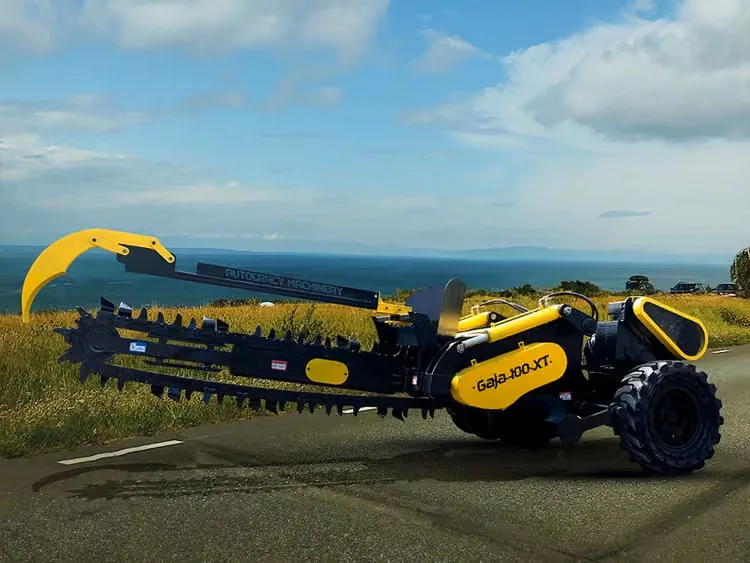
As project volumes increase, contractors are moving away from treating every excavation task as a general earthmoving job. Instead, they are selecting equipment based on trench depth, width, soil condition, route length, and restoration needs. This shift has made tractor-mounted trenchers an important part of utility and infrastructure planning.
The Problem With One-Size-Fits-All Excavation
Large excavators remain essential for major earthmoving work, but they are not always the most efficient choice for narrow utility trenches. In many cases, a wider excavation creates more spoil, requires more backfill, and increases the time needed for site restoration.
For projects such as rural water supply schemes, OFC cable routes, irrigation pipelines, and solar power connections, the requirement is often a controlled trench rather than a large open pit. Precision matters because pipe bedding, cable protection, drainage gradient, and backfill quality all depend on the accuracy of the initial cut.
How Tractor-Mounted Trenchers Improve Control
A tractor-mounted trencher uses the tractor’s power and mobility to cut a defined trench along a planned route. This approach is particularly useful for linear projects, where the work moves continuously from one section to another.
The Gaja 100XT Tractor Mounted Trencher, manufactured by Autocracy Machinery, is an example of equipment designed for this type of application. It is intended for tractors above 60 HP and uses a PTO/Hydraulic transmission system with a heavy-duty gearbox to support trenching across varied ground conditions.
Its trenching range includes depths of 1200–1500 mm and widths of 110–280 mm. This flexibility allows contractors to adapt the trench profile to different pipes, cables, conduits, and drainage requirements without changing to another machine.
Matching Equipment to Soil and Route Conditions
Soil conditions play a major role in trenching productivity. Soft soil may allow faster progress, while compacted or hard ground demands stable power transmission and a machine capable of maintaining consistent cutting performance.
The Gaja 100XT is designed to operate at up to 200 m/hr in soft soil and 150 m/hr in hard soil. Its approximate fuel consumption of 5–6 litres per hour also helps project teams estimate operating costs more realistically before mobilising equipment to site.
For contractors handling multiple sites, fuel efficiency and predictable output are not minor details. They directly affect daily productivity targets, labour planning, transport costs, and project margins.
Applications Across Infrastructure Sectors
Precision trenching equipment is relevant across several sectors:
- Water management: Pipeline installation, irrigation distribution, and drainage networks.
- Telecom and OFC: Underground fibre-optic cable routes requiring uniform trench depth.
- Solar projects: Power cable trenches, earthing systems, and utility connections.
- Agriculture: Irrigation pipelines and field drainage systems.
- Construction: Electrical conduits, communication cables, and utility corridors.
The Gaja 100XT is suitable for these applications because it combines tractor mobility with controlled trench dimensions. Its gross weight is 2100 kg, and its overall dimensions are 5.1 m x 1.85 m x 1.3 m, making it a comparatively compact option for contractors who need to move equipment between project locations.
Planning Trenching Work Properly
Before selecting a trencher, project teams should assess soil type, required trench depth and width, tractor horsepower, auxiliary hydraulic flow, site access, and backfill requirements. The Gaja 100XT requires auxiliary hydraulic flow above 25 lpm, so confirming carrier compatibility before deployment is important.
Good planning also includes marking underground utilities, finalising the trench route, arranging spoil management, and planning restoration work. When these steps are handled early, trenching equipment can deliver its intended benefit: faster execution with fewer site disruptions.
A Practical Shift in Infrastructure Equipment Strategy
The growing demand for water infrastructure, rural connectivity, renewable energy, and underground utilities is changing how contractors approach excavation. Instead of relying only on large machines, many teams now use specialised attachments for repeatable, narrow trenching work.
The Gaja 100XT Tractor Mounted Trencher reflects this practical shift. By pairing tractor mobility with controlled trenching capability, it supports infrastructure teams that need accuracy, fuel efficiency, and dependable performance across water, telecom, solar, agricultural, and construction projects.