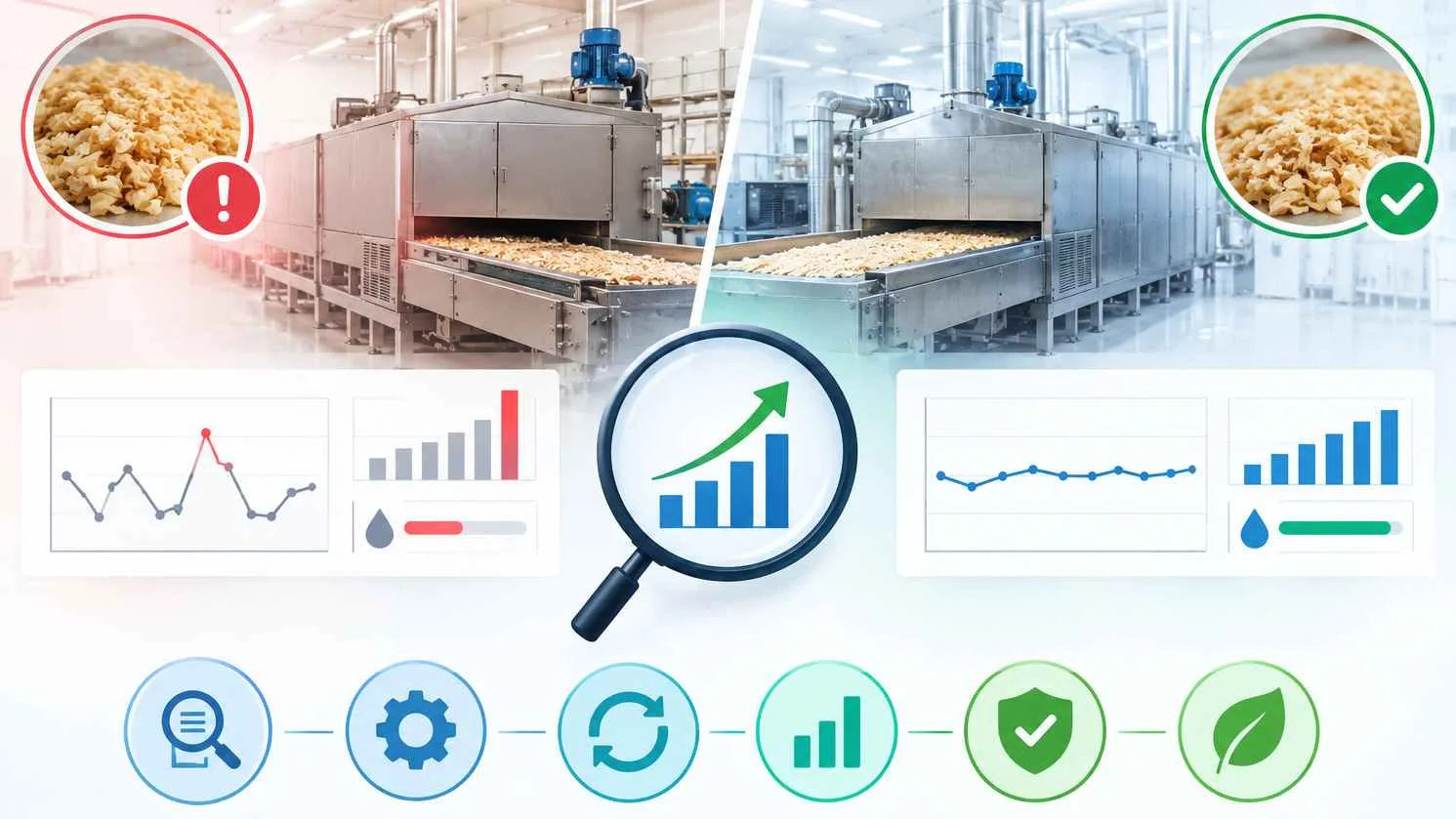
In industrial research, product development, and process optimization, we’ve all experienced that rush: a trial finishes faster, a heating cycle sips less energy, or a batch comes out with noticeably higher quality. It's tempting to lock in the settings and call it a win.
The catch? A single successful trial doesn’t automatically mean you’ve cracked the code.
That sudden performance spike might just be normal experimental noise, a slight shift in ambient humidity, or a fluke in how the sample was measured. For engineers and research teams making high-stakes decisions, telling the difference between a repeatable, genuine improvement and a one-time lucky break is crucial. You aren't just looking for a better number on a spreadsheet; you need to know if that result will hold up tomorrow under routine operating conditions.
Getting to Know Your Baseline (Normal Variation)
Every process has a heartbeat; a normal range of variation that happens even when you keep all the dials and settings identical. In a real-world industrial setting, minor fluctuations are inevitable:
- Raw material batches vary slightly.
- Ambient humidity and temperature shift throughout the day.
- Equipment behaviour drifts as components heat up or wear down.
- Operator practices and sampling methods introduce subtle differences.
For instance, if you're running a material drying trial, your final moisture content is bound to bounce around across different runs, even if your temperature and time setpoints are locked down. Those differences don't mean your process is suddenly getting better or worse; it’s just operating normally.
Before you tweak a single parameter, you need to map out this baseline. Without knowing your process's baseline behaviour, it's impossible to tell whether an observed shift is a meaningful breakthrough or just routine noise.
The Danger of Changing Too Much at Once
When you want to improve something say, cutting down drying times the worst thing you can do is compare a single run of your new method against a single run of the old one.
What if your old process just happened to hit an unusually slow batch that day? Your modified process might look like a roaring success simply because the baseline had a bad day, not because your change actually worked.
To build a reliable baseline:
- Document existing performance metrics (cycle times, energy use, yield, temperature uniformity) carefully.
- Run multiple observation cycles under consistent, well-defined conditions.
- Understand the actual scale of variation you live with every day so you know what size of improvement actually matters in the real world.
Why Repeat Trials Are Non-Negotiable
A single good result is interesting trial; a repeatable result is actionable. If your process tweak looks great on Tuesday, can you get the exact same numbers on Wednesday, Thursday, and Friday?
If an improvement only shows up once and then vanishes in subsequent runs, you can chalk it up to uncontrolled variables or random noise.
When planning repeat trials:
- Keep your procedures consistent and log every variable that might matter (initial conditions, material specs, equipment settings, and ambient conditions).
- Decide how many runs you need based on how noisy your process is and how big of an impact an incorrect decision would have. For major changes, guessing an arbitrary number of repeats isn't enough—you need a structured testing plan.
Using Control Experiments to Find the Real Driver
How do you know your tweak actually caused the improvement, and not some coincidence? That’s where control experiments come in.
If you're testing a new heating profile, run it side-by-side with your established profile while keeping everything else locked down—same batch size, same material type, same measurement routine.
The golden rule: Change one thing at a time. If you alter three different parameters simultaneously, you'll never figure out which change actually drove the result (or which ones cancelled each other out). Structured experimental design is your best friend here.
Accounting for Measurement Uncertainty
Every instrument has limits. Resolution, sensor placement, calibration drift, and sampling technique all bake a little bit of doubt into your data.
Imagine your new process claims a tiny reduction in energy consumption. Before you pop the champagne, ask yourself: Is that difference larger than the measurement error of your power meter?
Measurement uncertainty doesn’t mean your data is wrong; it just defines the boundary of your confidence. Using well-calibrated instruments, consistent measurement steps, and understanding your error bars separates guesswork from rigorous engineering.
Avoid Making Big Calls on One Success Story
Early success is a great morale booster, but it's dangerous evidence to base a capital investment or production overhaul on. Adopting a change too early can lead to expensive equipment modifications, missed production targets, or complete failure when scaling from the lab bench to the factory floor.
Before signing off on a process change, run through a quick gut-check:
- Is the improvement consistent across multiple repeat trials?
- Does it actually punch through the normal noise and variation of your existing process?
- Do you understand your measurement error and potential sources of bias?
- Were your baseline and modified processes fairly compared under identical conditions?
- Does the win still matter when you look at the broader operational picture?
Statistical tools like confidence intervals and hypothesis tests can help clear up the ambiguity, but remember: statistical significance doesn't automatically equal economic or operational value. The real-world impact has to make sense on the shop floor.
Bringing It All Together
Whether you're troubleshooting a production bottleneck, trying to slash energy waste, or developing a brand-new technology, disciplined experimentation is what separates professional engineering from trial-and-error guesswork.
Solid conclusions require clear goals, consistent controls, repeatable measurements, and honest interpretation. Organizations tackling industrial R&D such as the technical work and research outputs documented by groups like Kerone Research, rely on these exact fundamentals to validate performance before rolling changes out to routine operation.
At the end of the day, proving a process improvement takes more than picking the best number out of a handful of tests. Understand your baseline, verify your data through repeat trials, control your variables, account for instrument error, and make sure your wins are real, reproducible, and ready for prime time.