
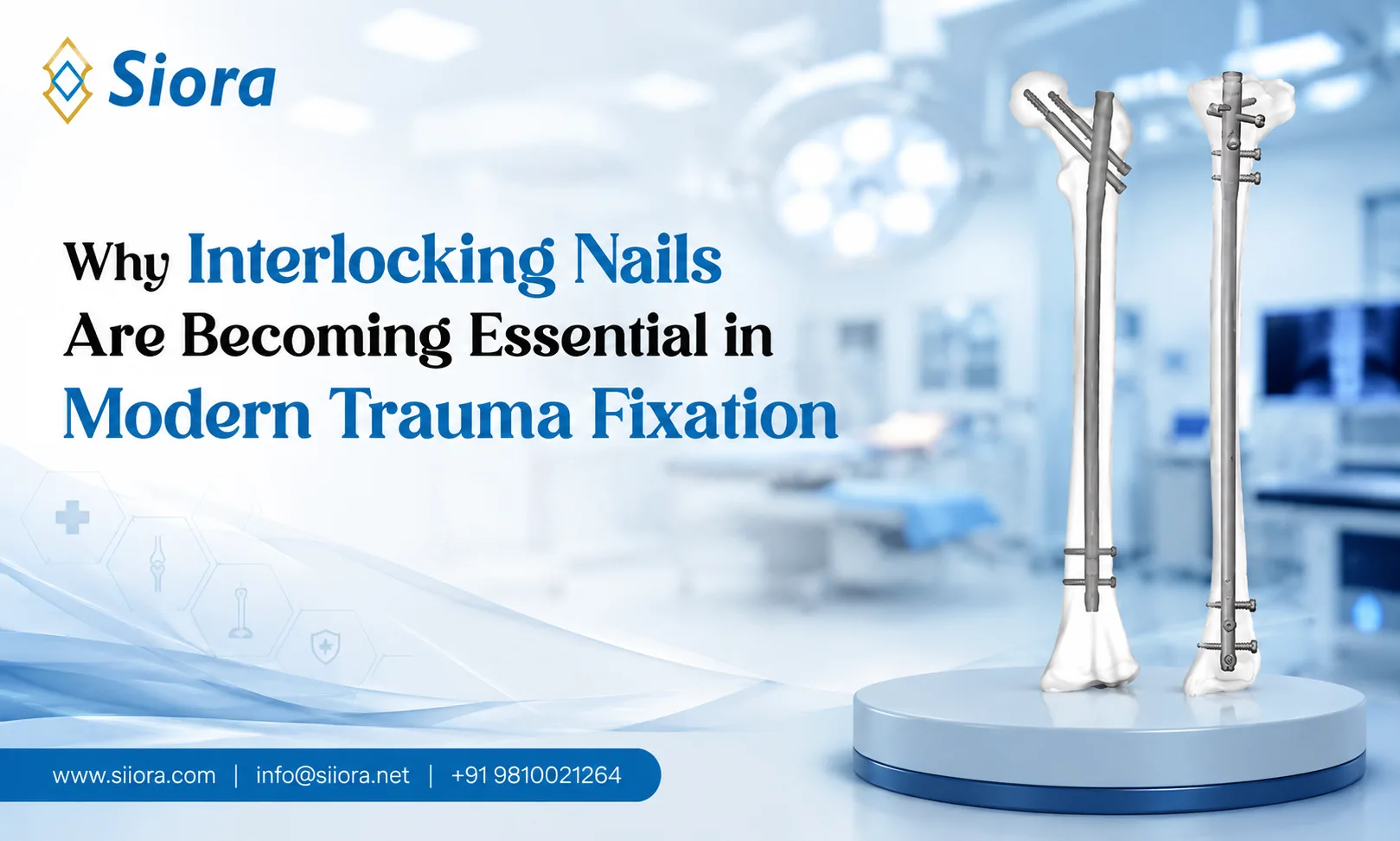
Traumatic bone fractures are among the most common injuries treated by orthopedic surgeons worldwide. Whether caused by road accidents, sports injuries, falls, or workplace incidents, these fractures often require stable internal fixation to restore mobility and ensure proper healing. Over the years, orthopedic technology has evolved significantly, and one innovation that has transformed fracture management is the interlocking nail.
Today, interlocking nails have become a preferred solution for treating long bone fractures because they provide excellent stability, encourage early rehabilitation, and improve overall patient outcomes.
Understanding Interlocking Nails
Interlocking nails are specialized intramedullary implants inserted into the central canal of long bones such as the femur, tibia, and humerus. Unlike conventional intramedullary nails, they are secured with locking screws at both ends. These screws prevent rotational and axial movement, creating a stable construct that keeps fractured bone fragments properly aligned throughout the healing process.
This added stability makes interlocking nails particularly valuable for complex fractures where maintaining alignment is challenging.
Enhanced Stability for Better Healing
One of the primary reasons interlocking nails are becoming increasingly essential is their ability to provide superior mechanical stability. Fractures involving multiple fragments or unstable patterns often require fixation that can withstand daily physiological loads without losing alignment.
By locking the implant at both ends, surgeons can effectively control shortening, rotation, and angulation of the fractured bone. This stability creates an ideal environment for natural bone healing while reducing the likelihood of fixation failure.
Patients also benefit from improved confidence during rehabilitation, knowing the fracture has been securely stabilized.
Minimally Invasive Surgical Technique
Modern orthopedic surgery increasingly focuses on minimizing soft tissue damage, and interlocking nailing aligns perfectly with this objective. The implant is inserted through a relatively small incision, avoiding extensive exposure of the fracture site.
Because the surrounding muscles, blood vessels, and soft tissues experience less disruption, patients generally experience:
- Reduced blood loss during surgery
- Lower risk of infection
- Less postoperative pain
- Smaller surgical scars
- Faster recovery of surrounding tissues
Preserving the natural blood supply around the fracture also supports healthier bone healing.
Encouraging Early Mobilization
Early movement plays a crucial role in successful fracture recovery. Prolonged immobilization can lead to muscle wasting, joint stiffness, delayed rehabilitation, and other complications.
Interlocking nails provide sufficient strength to allow controlled weight-bearing much earlier than many traditional fixation methods, depending on the fracture type and the surgeon's recommendations. Early mobilization helps patients regain independence sooner while reducing complications associated with extended bed rest.
This advantage is especially valuable for elderly individuals and patients with multiple injuries.
Suitable for a Wide Range of Fractures
Another reason for the growing popularity of IM nails is their versatility. They can be used for various fracture patterns involving different long bones, including:
- Femoral shaft fractures
- Tibial shaft fractures
- Humeral shaft fractures
- Segmental fractures
- Comminuted fractures
- Certain non-union and delayed union cases
Advancements in implant design have further expanded their clinical applications, allowing surgeons to manage increasingly complex trauma cases with greater precision.
Improved Long-Term Patient Outcomes
Successful trauma fixation extends beyond achieving bone union. It also focuses on restoring function, reducing complications, and enabling patients to return to their normal activities.
Clinical experience has consistently shown that stable intramedullary fixation contributes to:
- Faster functional recovery
- Improved fracture alignment
- Lower rates of implant failure
- Reduced need for revision procedures
- Better patient satisfaction
These advantages make intramedullary nails a dependable choice for both surgeons and healthcare institutions striving for high-quality orthopedic care.
Continuous Advancements in Implant Design
The development of orthopedic implants continues to evolve with better materials, improved instrumentation, and refined surgical techniques. Modern interlocking IM nails are available in multiple diameters, lengths, and locking configurations to accommodate different anatomical requirements and fracture patterns.
Many manufacturers now produce implants using high-quality titanium alloys and surgical-grade stainless steel that offer excellent strength, corrosion resistance, and biocompatibility. These improvements contribute to greater durability and long-term clinical performance.
Conclusion
Interlocking nails have fundamentally changed the way long bone fractures are managed in modern orthopedic trauma surgery. Their ability to provide strong internal fixation through a minimally invasive approach has made them an essential component of contemporary trauma care. From enhancing fracture stability and preserving soft tissues to promoting early mobilization and improving patient outcomes, their advantages continue to drive widespread adoption across hospitals and trauma centers worldwide.
Siora Surgicals Pvt. Ltd. is a leading manufacturer of an internationally certified range of trauma implants, including intramedullary interlocking nails. You can explore Siora’s product portfolio at the SAOA conference 2026 at booth no. 01.