
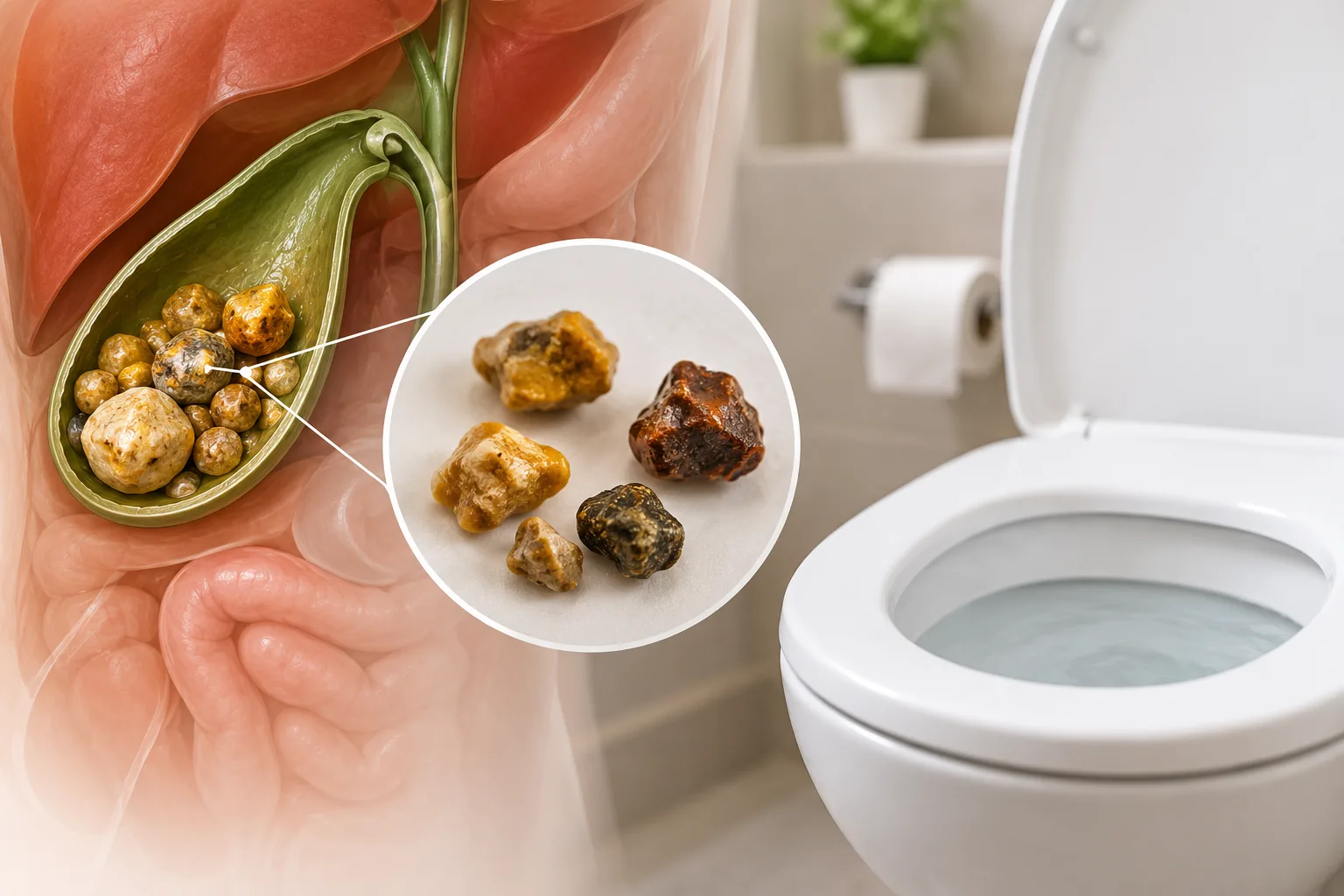
Have you noticed something unusual in the toilet and wondered whether it could be a gallstone? It is a reasonable question, especially if you have also been experiencing stomach pain, nausea or changes in your bowel movements.
Gallstones are hard deposits that form inside the gallbladder. They can vary in size and colour, but there is something important to understand: most gallstones do not pass out of the body in your stool. They usually remain in the gallbladder, although some can move into the bile ducts and occasionally pass into the intestine.
So, what do gallstones look like in the toilet? Can you recognise them by their colour or shape? And what should you do if you notice something unusual?
Let's look at what the appearance of gallstones can tell you, which symptoms deserve attention, and how doctors confirm whether gallstones are actually the problem.
What Do Gallstones Look Like in the Toilet?
Gallstones are usually described as small, hard, pebble-like deposits. Their appearance varies depending on their composition, and they can range from tiny particles to stones measuring several centimetres.
If a gallstone passes into the intestine and eventually leaves the body, it might occasionally be noticed in a bowel movement. However, this is not how gallstones are normally discovered. Most are identified during an ultrasound or another medical investigation.
Gallstones may be:
- Yellowish or yellow-green: Cholesterol stones often have a yellowish appearance.
- Brown: Some pigment stones are brown and may form in association with conditions affecting the biliary system.
- Dark brown or black: Certain pigment stones are darker in colour.
- Small and pebble-like: Some are tiny, while others are considerably larger and have irregular edges.
These descriptions refer to gallstones themselves, not a reliable way to identify something found in the toilet.
If you have noticed a small, hard object in your stool, you cannot determine whether it is a gallstone simply by looking at it. Food fragments and other material can have a similar appearance.
Can you see gallstones in your stool?
Occasionally, a gallstone that travels through the bile duct and enters the intestine may pass out of the body. But most gallstones stay in the gallbladder or biliary system.
There is another important point here. A stone moving out of the gallbladder does not always mean the problem has ended. It may become lodged in a bile duct, potentially causing pain, jaundice or other complications.
If you have recurring abdominal pain or other symptoms associated with gallstones, it is worth getting checked rather than relying on what you see in the toilet.
Do Gallstones Come Out in Your Poop or Urine?
This is where some confusion arises. Gallstones and kidney stones are both hard deposits, but they form in different parts of the body and follow different routes.
Gallstones develop in the gallbladder or may move into the bile ducts. Kidney stones form in the urinary system.
Can gallstones pass in your poop?
Yes, this can happen occasionally if a stone passes through the bile ducts, enters the intestine and travels through the digestive tract. It is not the usual outcome for gallstones, though, and you should not assume that an unusual object in your stool is a gallstone.
Can you pee out gallstones?
No. Gallstones do not ordinarily pass through urine because they are not formed in the urinary tract. A hard object passed during urination may have a different cause, including a urinary stone, and may need medical assessment.
If you have pain while urinating, blood in your urine or severe pain in your side or back, seek medical advice. These symptoms should not automatically be attributed to gallstones.
What Is the Difference Between Gallstones and Other Things in the Toilet?
Finding something unusual in your stool can be unsettling. The difficulty is that several different things may look similar, and appearance alone rarely gives you a definite answer.
Here are some differences worth understanding.
What you noticeWhat it could meanA small, hard, pebble-like object in stoolCould be food material or another substance; appearance cannot confirm a gallstoneA hard object passed in urineMay be associated with a urinary stone or another urinary issuePale, grey or clay-coloured stoolMay indicate reduced bile flow into the intestineDark urine alongside pale stoolCan be a sign of a bile duct obstruction or another liver or biliary problemBlack, tarry stool or visible bloodMay indicate gastrointestinal bleeding and requires prompt medical assessmentThe last three observations are particularly important because they concern changes in colour rather than the presence of a solid object.
Normally, bile helps give stool its characteristic brown colour. When bile flow is significantly reduced or blocked, stool may become unusually pale. Dark urine can occur when bilirubin builds up in the blood and is excreted through the kidneys.
These changes do not prove that gallstones are responsible. Other conditions can cause similar symptoms.
If your stool has become pale or clay-coloured, particularly if your urine is also dark or your eyes appear yellow, seek prompt medical assessment.
What Does Your Stool Look Like If You Have Gallstones?
There is no single stool appearance that tells you whether you have gallstones. Some people have gallstones for years without noticing any change in their bowel movements.
Still, certain changes can occur when gallstones interfere with the normal flow of bile.
Pale or clay-coloured stools
Bile travels from the liver through the bile ducts and helps with digestion. It also contributes to the normal brown colour of stool.
If a gallstone blocks the common bile duct, less bile may reach the intestine. Your stool can then become unusually pale, greyish or clay-coloured.
This is not a symptom to ignore, particularly if it persists or occurs alongside abdominal pain, dark urine or jaundice.
Dark urine
When bile cannot flow normally, bilirubin may build up in the bloodstream. The kidneys can then excrete more of this pigment into the urine, making it appear darker than usual.
Dark urine has several possible causes, including dehydration. However, dark urine accompanied by pale stools or yellowing of the eyes needs prompt medical evaluation.
Does normal-looking stool mean you do not have gallstones?
Not at all.
Many people with gallstones have normal bowel movements and no noticeable digestive symptoms. Others experience episodes of abdominal pain without any obvious change in stool colour.
This is why doctors do not diagnose gallstones by examining stool alone. Symptoms, medical history and appropriate imaging are much more useful.
What Are the Symptoms of Gallstones?
Gallstones do not always cause symptoms. Some are discovered by chance during an ultrasound performed for an unrelated reason.
Problems can develop when a stone blocks the flow of bile or causes inflammation. The symptoms depend on where the stone is located and whether complications have developed.
Pain in the upper-right abdomen
One of the most recognised symptoms is pain beneath the right side of the rib cage. It may also occur in the upper middle abdomen.
The pain can be steady rather than sharp, and it may last from around 30 minutes to several hours. Some people notice it after eating, particularly following a rich or fatty meal, although this pattern is not present in everyone.
Pain may spread towards the back or right shoulder.
If the pain keeps returning, it is worth arranging a medical assessment, even if it settles on its own.
Nausea and vomiting
Gallstones can cause nausea, and vomiting may occur during an episode of gallbladder pain. Some people also report bloating or indigestion.
These symptoms are common in many digestive conditions, however. Having nausea after a meal does not automatically mean you have gallstones.
The overall pattern of symptoms matters.
Fever, chills or jaundice
Fever and chills, especially when accompanied by abdominal pain, may indicate inflammation or infection. Yellowing of the skin or whites of the eyes can suggest that bile flow has been obstructed.
These are warning signs, not symptoms to watch at home for several days.
Seek urgent medical care if you experience severe or persistent abdominal pain, fever with abdominal pain, jaundice or repeated vomiting. Severe symptoms may require assessment in an emergency department.
When Should You See a Doctor About Possible Gallstones?
You do not need to wait until you see something unusual in your stool before seeking help.
Arrange a medical appointment if you have recurring pain in the upper abdomen, unexplained digestive symptoms or persistent changes in stool or urine colour. A doctor can assess whether the symptoms are consistent with gallstones or suggest another condition.
Seek urgent medical attention if you experience:
- Severe or persistent abdominal pain.
- Fever or chills with abdominal pain.
- Yellowing of the eyes or skin.
- Dark urine together with pale stools.
- Repeated vomiting or rapidly worsening symptoms.
If you are in Dubai and experience severe abdominal pain or other emergency warning signs, go to the nearest emergency department. Do not delay urgent assessment while waiting for a routine appointment with a specialist.
For less urgent, recurring symptoms, a consultation with an appropriate doctor can help determine which investigations are needed.
How Are Gallstones Diagnosed?
If your symptoms suggest gallstones, your doctor will usually start by asking about the pain, when it occurs, how long it lasts and whether you have noticed any changes in your digestion, urine or stool.
You may then need one or more of the following investigations.
Abdominal ultrasound
An abdominal ultrasound is commonly the first imaging test used to look for gallstones in the gallbladder.
It uses sound waves to produce images of the abdominal organs and can often identify stones without the need for an invasive procedure.
However, an ultrasound does not answer every question. If your doctor suspects a stone in the bile duct, further investigation may be needed.
Blood tests
Blood tests can help assess liver function, bilirubin levels and signs of inflammation or other complications.
The results may provide clues about whether a stone is affecting the bile ducts or whether another condition needs to be investigated.
Blood tests alone do not usually establish the presence of gallstones in the gallbladder.
MRCP and other imaging tests
If a bile duct stone is suspected, your doctor may recommend magnetic resonance cholangiopancreatography (MRCP). This specialised MRI examination produces detailed images of the bile ducts and pancreatic ducts.
In selected situations, other investigations or an endoscopic procedure may be appropriate.
The tests you need will depend on your symptoms, examination findings and initial results. Not everyone requires every investigation.
What Is the Treatment for Gallstones?
Treatment depends on whether the stones are causing symptoms, where they are located and whether complications have developed.
There is no need to assume that every gallstone requires surgery. Equally, recurring pain or evidence of a blocked bile duct should not be ignored.
Do all gallstones need treatment?
People who have gallstones but no symptoms may not need immediate treatment. Their doctor may recommend observation, depending on their circumstances and any additional risk factors.
When gallstones cause repeated episodes of pain or lead to complications, treatment is more likely to be necessary.
When is gallbladder removal recommended?
For symptomatic gallstones, doctors commonly recommend a procedure called laparoscopic cholecystectomy. This involves removing the gallbladder using small incisions and a camera-assisted surgical technique.
The recommendation depends on the diagnosis and the patient's overall health.
Removing the gallbladder prevents new stones from forming inside that organ, although stones in the bile ducts may require separate treatment. Recovery and suitability for surgery vary from person to person.
If you have been diagnosed with symptomatic gallstones, discussing Gallbladder Stones Surgery in Dubai with a qualified surgical specialist can help you understand the available options, the likely benefits and the risks relevant to your situation.
What if a gallstone blocks the bile duct?
A stone lodged in the common bile duct may require endoscopic treatment, often using a procedure called endoscopic retrograde cholangiopancreatography (ERCP), to remove the obstruction.
Gallbladder removal may also be recommended, depending on the circumstances.
The treatment plan is individual. A person with uncomplicated gallbladder stones may need a different approach from someone with jaundice, infection or pancreatitis.
When Should You Consult a Gastrointestinal Surgeon in Dubai?
If you have recurring upper abdominal pain or have been diagnosed with symptomatic gallstones, it may be appropriate to discuss your condition with a gastrointestinal surgeon in Dubai.
A specialist can review your symptoms, ultrasound findings and blood test results, then explain whether surgery is recommended or whether further investigation is needed.
During the consultation, you can ask about the procedure, recovery time, possible complications and what to expect after gallbladder removal. These are practical questions, and the answers should be based on your individual circumstances rather than a standard recovery promise.
Most importantly, do not make the decision about surgery based on the appearance of something in the toilet. A proper diagnosis comes first.
If you have severe pain, fever, jaundice or other emergency warning signs, seek urgent medical care rather than waiting for a scheduled surgical consultation.
Frequently Asked Questions About Gallstones
What colour are gallstones when they come out?
Gallstones may be yellowish, yellow-green, brown or black, depending on their composition. However, these colours describe the stones themselves. You cannot reliably identify a gallstone by examining an object in your stool.
Can gallstones pass naturally in your stool?
Occasionally, a stone may move through the bile ducts, enter the intestine and pass out of the body. This is not the usual way gallstones are detected. A stone passing does not necessarily mean that the underlying problem has been resolved.
What does gallstone poop look like?
There is no specific stool appearance that confirms gallstones. Pale or clay-coloured stool may indicate reduced bile flow, while an unusual solid object could have several explanations. Medical assessment is needed to establish the cause.
Can gallstones cause dark urine?
Yes. A gallstone blocking a bile duct can contribute to a buildup of bilirubin, which may darken the urine. If dark urine occurs with pale stools, jaundice or abdominal pain, seek prompt medical assessment.
How do doctors confirm gallstones?
Doctors commonly use abdominal ultrasound to identify gallstones in the gallbladder. Blood tests and additional imaging, such as MRCP, may be needed if a bile duct obstruction or another complication is suspected.
Do I need gallbladder surgery if I have gallstones?
Not necessarily. People with gallstones that cause no symptoms may not need immediate treatment. Surgery is commonly recommended for symptomatic gallstones, but the decision depends on your diagnosis, symptoms and overall health.
The Bottom Line
If you have noticed a pebble-like object in the toilet, it is understandable to wonder whether it could be a gallstone. But appearance alone cannot tell you what it is, and most gallstones do not pass out of the body in stool.
Pay attention to the bigger picture. Recurring pain beneath the right ribs, pale stools, dark urine or yellowing of the eyes can all be reasons to seek medical advice.
An ultrasound and, when needed, other investigations can help establish whether gallstones are present and whether treatment is necessary. If you are experiencing symptoms, getting the right diagnosis is far more useful than trying to identify a stone by sight.
Medical disclaimer: This article is for general educational purposes and does not replace professional medical advice, diagnosis or treatment. Seek urgent medical care for severe or persistent abdominal pain, fever with abdominal pain, jaundice or other concerning symptoms.