Introduction
Walk into any hospital ward and you will still see the same familiar sight: a doctor with a stethoscope around the neck. The tool looks the same as it did decades ago. But in some clinics, something has started to change. A small number of doctors now listen to the heart, then glance at a phone screen, then play the sound back once more.
This is digital auscultation. It has not arrived with big announcements or dramatic headlines. It is spreading quietly, one clinic and one classroom at a time. This article looks at what it actually is, where it helps in everyday practice, where it falls short, and what doctors should think about before adopting it.
What Is Digital Auscultation?
Auscultation simply means listening to sounds inside the body, usually the heart, lungs and abdomen, to help understand what is happening. For generations, this has been done with an acoustic stethoscope, where sound travels through tubing straight to the doctor’s ears.
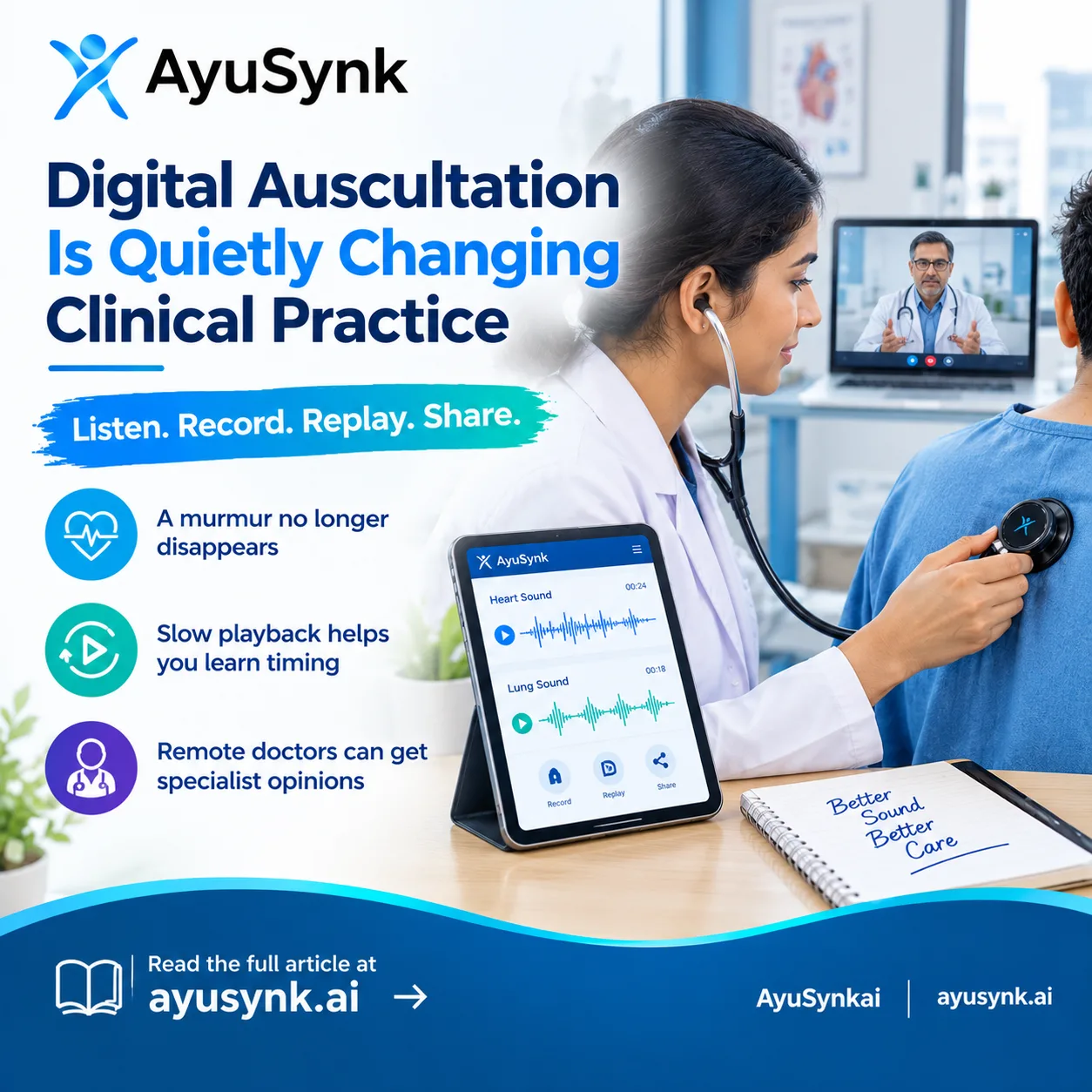
Digital auscultation adds one step in the middle. The sound is captured by a sensor and converted into a digital signal. Once it is digital, it can be made louder, cleaned up, saved, replayed and sent to someone else. That single step is what makes everything else possible.
A digital stethoscope from a brand such as AyuSynkai typically works with a smartphone app, so the doctor can listen live, record the sound and review it afterwards.
The Problem With Sounds That Disappear
A murmur does not wait for your seniorEvery medical student knows this moment. You hear something unusual in a patient’s chest. You are not sure what it is. By the time your senior arrives, the patient has shifted, taken a deep breath or fallen asleep, and the sound seems different, or gone.
With a regular stethoscope, auscultation is a live event. You hear it once, you remember it as best you can, and you describe it in words. Words are a poor substitute for sound.
Why this matters beyond learningIt is not only students who face this. Practising doctors also compare what they heard last month with what they hear today, usually from memory. A saved recording gives a more reliable reference point. It does not replace clinical notes, but it adds something they cannot hold: the sound itself.
Where Digital Auscultation Is Making a Difference
In teaching and learningLearning heart sounds is hard. They are short, quick and easy to confuse. Digital tools help in a few simple ways.
Replay and slow playback
Being able to replay a sound again and again is a huge advantage for a learner. Some devices also slow the sound down. The AyuSynk 2 Pro Advance, for instance, can play back at speeds as low as 0.25x, which helps you notice the gaps and timing between heart sounds that are easy to miss at normal speed.
Seeing what you hear
Many apps display the sound as a visual pattern. For many learners, connecting a waveform on screen with the sound in their ears makes textbook descriptions finally click.
Group learning
A recording can be played to a whole group at once. Instead of one student listening while the others wait, everyone hears the same sound and discusses it together.
In everyday clinic workBusy clinicians are not looking for gadgets. They want tools that save effort and add confidence. Digital auscultation helps here in modest but real ways.
- Better documentation. A recording can be saved alongside a patient’s file, with proper consent.
- Easier follow-up. Comparing a sound from today with one from earlier gives a clearer picture of change over time.
- Adjustable volume. Doctors with mild hearing difficulty can raise the volume without straining.
- Noise reduction. In a loud ward or a crowded outpatient department, reducing background noise can make the body sound easier to hear, though it is not magic and a quiet room still helps.
This may be the most meaningful change of all. India has many areas where a specialist is hours away. Tele-auscultation allows a local doctor to record a heart or lung sound and share it with a specialist elsewhere.
What tele-auscultation can and cannot do
It can help a doctor decide whether a patient needs to be referred sooner. It can give a specialist something concrete to listen to instead of a verbal description. What it cannot do is replace a full examination, a proper history or the specialist’s own judgment. It is a supporting tool, not a shortcut.
Devices built for this purpose, such as the AyuSynk 2 Pro Advance, include live streaming and AI screening features meant for remote consultations. Doctors who plan to work in telemedicine or rural programmes may find these features useful, while others may not need them.
A Closer Look at Children
Examining children is a skill of its own. Their chests are small, their hearts beat faster and they rarely stay still for long. A regular adult chestpiece can be awkward on a small patient.
A pediatric stethoscope is designed with this in mind, usually with a smaller chestpiece that sits better on a child’s chest. Digital technology adds another advantage. A quick recording lets the doctor capture a sound in a short, calm moment and study it afterwards, without asking an unsettled child to be still again and again.
If you work with children, it is worth reading about how smarter technology is shaping pediatric examination, and asking any manufacturer whether its device suits small patients.
The Honest Limits of Digital Auscultation
A balanced view matters here, because no tool is perfect.
It does not make you a better listener by itselfA digital stethoscope will not teach you what a murmur sounds like if you never practise. The device gives you more chances to learn, but you still have to use them.
AI features are a second look, not a diagnosisSome devices now include AI-based screening that can flag a possible abnormality. This can be a helpful prompt, but it is not a diagnosis. It cannot replace your examination, your history taking or your clinical judgment. Treat it the way you would treat a quick opinion from a colleague: useful, but not final.
Privacy and consent come firstA recorded heart sound is still patient data. Doctors should record and share only with the patient’s consent and in line with their institution’s policies. Ask any company how recordings are stored and who can access them.
Cost and convenienceA regular stethoscope needs no battery, no charging and no app. It is lighter, cheaper and always ready. A digital model has to be charged and paired with a phone. For some doctors, especially students with tight budgets, a reliable acoustic stethoscope is the sensible choice for now.
Choosing Wisely: What to Check Before You Buy
If you decide a digital model suits your practice, a little homework goes a long way.
Sound quality before specificationsDo not choose on amplification numbers alone. A big number is meaningless if the sound is distorted. Ask for sample recordings or a demo.
Battery and chargingLook for a device that lasts through a working day. AyuSynkai lists up to 8 hours of continuous use after about 2 hours of charging, though real use may vary.
App supportCheck that the app works on your phone, whether Android or iOS, and that the company keeps updating it.
Warranty and supportA longer warranty protects you if something fails. The AyuSynk 2 Pro Advance, priced at ₹34,990, comes with a two-year warranty according to its product page.
Where you buy mattersIf you are buying an online stethoscope, buy from the maker or an authorised seller. Read the return and shipping policy, and check that the box includes everything it should, such as the charging cable and warranty card.
What the Future Looks Like
Digital auscultation is unlikely to replace the regular stethoscope overnight, and it probably should not. More likely, the two will sit side by side. A doctor may use a regular one for a quick check and a digital one when a sound deserves a closer listen, a recording or a second opinion.
What seems certain is that listening is becoming something doctors can keep, share and learn from, not only something that happens and vanishes. For young doctors in particular, that is a real change in how skills are built.
Final Thoughts
The stethoscope has been a doctor’s companion for generations, and it will remain one. But the way we listen is quietly expanding. Digital auscultation gives clinicians the ability to replay, slow down, see and share the sounds of the body, and that makes learning more active and remote care more possible.
If you are curious, start small. Decide what you would actually use it for, compare a few options, ask for a demo and read the warranty carefully. The AyuSynkai team can guide you on which model suits your stage and your needs.
Contact Us
Call: 08047191146
Website: https://ayusynk.ai
Follow AyuSynkai: Facebook | Instagram | LinkedIn | YouTube