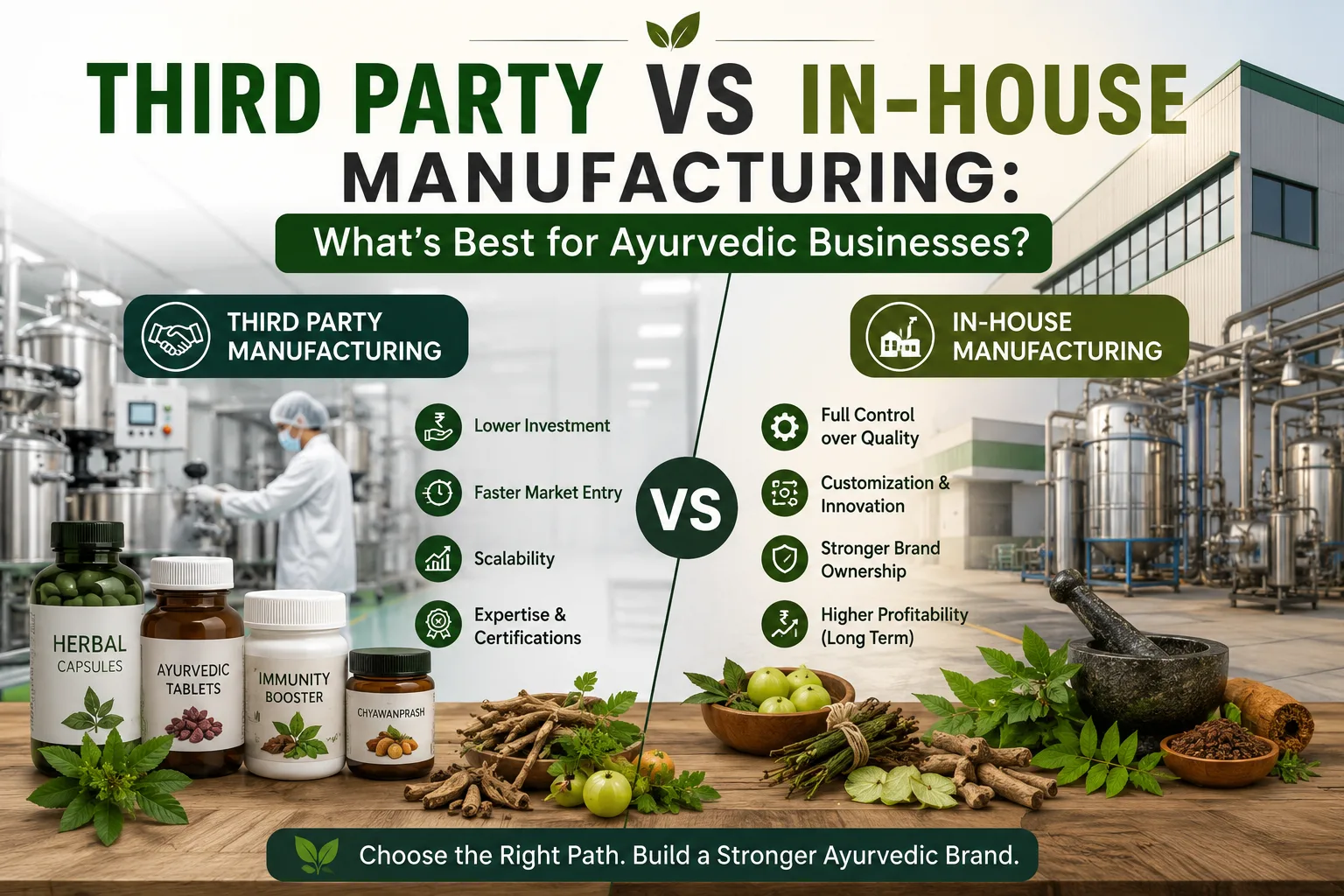
The global Ayurvedic industry is experiencing rapid growth, driven by increasing consumer demand for natural and holistic healthcare solutions. India, being the hub of Ayurveda, plays a critical role in supplying herbal products worldwide. For businesses entering or expanding in this sector, choosing the right manufacturing model is one of the most important strategic decisions.
Whether you are a startup, exporter, or an established brand, the decision between outsourcing production or building your own facility can directly impact your costs, scalability, and profitability. This is where the debate of in-house vs third party manufacturing becomes highly relevant.
In this blog, we will explore both models in detail, compare their advantages and challenges, and help you determine which approach is best suited for your Ayurvedic business.
What is Third Party Ayurvedic Manufacturing?
Third party manufacturing refers to outsourcing production to a specialized manufacturer who produces goods under your brand name. A third party ayurvedic medicine manufacturer typically handles everything from formulation and production to packaging and labeling.
How it works:
- You share product requirements or formulations
- Manufacturer develops or uses existing formulations
- Production begins under certified conditions
- Packaging and branding are customized
- Finished products are delivered ready for sale
Key highlights:
- Requires minimal investment
- Faster product launch timelines
- Access to certified facilities (GMP, ISO)
- Ideal for startups and growing brands
This model allows businesses to focus more on branding, marketing, and distribution rather than production complexities.
What is In-House Ayurvedic Manufacturing?
In-house manufacturing involves setting up your own production facility and managing the entire process internally. This includes sourcing raw materials, hiring skilled staff, ensuring compliance, and handling production operations.
What it involves:
- Infrastructure development and machinery setup
- Hiring qualified professionals (Ayurvedic experts, technicians)
- Procuring raw herbs and ingredients
- Managing regulatory approvals and certifications
Many large-scale ayurvedic medicine manufacturers prefer this model because it offers complete control over product quality and operations.
Key highlights:
- High initial investment
- Full operational control
- Strong brand positioning
- Long-term profitability potential
Third Party vs In-House Manufacturing: Detailed Comparison
FactorThird Party ManufacturingIn-House ManufacturingInitial InvestmentLowVery HighTime to MarketFastSlowControlLimitedFullScalabilityHighModerateCompliance BurdenLowHighOperational ComplexityLowHighRiskLowerHigherKey Insight:
According to industry trends, over 60% of emerging Ayurvedic brands prefer outsourcing during their initial growth phase due to lower risk and faster market entry.
Benefits of Third Party Ayurvedic Manufacturing
Choosing third party manufacturing offers several advantages for B2B businesses:
- Cost Efficiency: No need for heavy capital investment
- Faster Market Entry: Products can be launched quickly
- Expertise Access: Manufacturers bring technical knowledge and experience
- Scalability: Easily increase production as demand grows
- Regulatory Ease: Compliance is handled by the manufacturer
This model is particularly beneficial for companies involved in ayurvedic products manufacturing who want to focus on branding and sales rather than production.
Benefits of In-House Manufacturing
In-house production offers its own set of advantages, especially for established businesses:
- Full Quality Control: Direct supervision over production processes
- Brand Authority: Builds trust and credibility in the market
- Customization: Greater flexibility in product innovation
- Higher Margins: Long-term profitability improves after ROI
Companies with consistent demand and strong financial backing often benefit from this model.
Top Challenges of Both Models
Third Party Manufacturing Challenges:
- Dependency on external partners
- Limited control over production
- Risk of inconsistent quality if the partner is unreliable
In-House Manufacturing Challenges:
- High setup and operational costs
- Complex regulatory requirements
- Longer time to break even
- Requires skilled workforce and management
Understanding these challenges is crucial before making a strategic decision.
Cost Analysis: Which is More Profitable?
Cost is one of the biggest deciding factors when choosing between these two models.
Third Party Manufacturing:
- Low upfront investment
- Pay-per-production model
- Lower financial risk
- Ideal for startups
In-House Manufacturing:
- High initial capital expenditure
- Long-term cost benefits
- Higher margins after scale
Fact-Based Insight:
Studies in the herbal manufacturing sector show that businesses opting for outsourcing can reduce initial operational costs by up to 40–60%, making it a preferred option for early-stage companies.
When Should You Choose Third Party Manufacturing?
You should consider third party manufacturing if:
- You have limited capital
- You want faster market entry
- You lack manufacturing expertise
- Your focus is on branding and distribution
- You are testing new product lines
This model allows businesses to stay agile and reduce risks during the initial stages.
Hybrid Model: The Smart B2B Strategy
Many successful Ayurvedic businesses adopt a hybrid approach to maximize efficiency.
How it works:
- Start with third party manufacturing
- Build brand and market presence
- Gradually invest in in-house production
- Continue outsourcing selected product lines
Benefits:
- Balanced risk and investment
- Flexible scalability
- Optimized cost structure
This strategy is increasingly popular among modern Ayurvedic brands aiming for sustainable growth.
How to Choose the Right Third Party Ayurvedic Manufacturer
Selecting the right manufacturing partner is critical for success.
Key factors to consider:
- Certifications: GMP, ISO, WHO compliance
- Experience: Proven track record in Ayurvedic manufacturing
- Product Range: Ability to handle diverse formulations
- Customization: Private label and packaging capabilities
- MOQ Flexibility: Suitable for your business size
- Quality Assurance: Strict testing and quality control processes
A reliable partner ensures consistency, compliance, and long-term business growth.
Conclusion
Choosing between third party and in-house manufacturing is not a one-size-fits-all decision. Each model has its own advantages, challenges, and ideal use cases, much like the strategic considerations involved in OEM vs Private Label Manufacturing. Third party manufacturing is best for startups and businesses looking for flexibility, low investment, and faster market entry. In-house manufacturing is suitable for established brands seeking control, customization, and long-term profitability. Ultimately, the right choice depends on your business goals, budget, and growth strategy. Many companies are now adopting hybrid models to combine the strengths of both approaches. If you are planning to scale your Ayurvedic business, evaluating these factors carefully will help you make a smart, future-ready decision.