In the rapidly evolving landscape of modern higher education, traditional laboratory courses face unprecedented challenges. From managing tight departmental budgets and hazardous chemical safety protocols to ensuring equitable access for remote or hybrid learners, academic institutions must rethink how practical science is taught. To meet the demands of today’s tech-savvy students, universities and colleges are increasingly turning to advanced virtual science platforms to bridge the gap between complex theoretical concepts and hands-on laboratory mastery.
The Challenge of Modern Science Education
For science majors, hands-on experimentation is the cornerstone of academic success. Traditional university laboratories demand substantial capital investment in equipment, specialized reagents, and ongoing maintenance. Furthermore, safety constraints often prevent students from performing high-risk procedures independently or repeating experiments to master difficult techniques.
When students struggle to grasp abstract biochemical pathways or reaction mechanisms, static textbook diagrams are rarely enough. For instance, explaining foundational biological mechanisms like Cell Cycle Regulation requires a deep understanding of cellular dynamics and molecular interactions—concepts that come alive only when students can visualize, manipulate, and analyze them in an interactive environment.
Elevating STEM Curricula with Virtual Labs
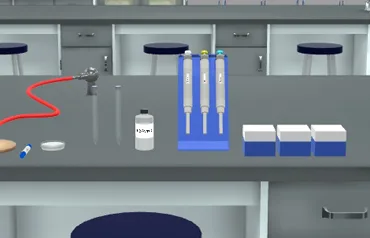
Virtual laboratory simulations have redefined what is possible in higher education. By replacing physical constraints with interactive, high-fidelity 3D environments, educational institutions can empower students to conduct experiments anytime, anywhere.
A state-of-the-art Virtual Lab acts as a risk-free workspace where students can safely conduct complex procedures, perform error analysis, and repeat protocols until they achieve conceptual mastery. Beyond safety, virtual platforms eliminate the recurring costs of physical consumables, enabling universities to expand their course offerings and increase lab capacity without expanding their physical footprint.
Key benefits for higher education institutions include:
- Unrestricted Practice: Students can pause, rewind, and repeat experiments to reinforce learning objectives.
- Complete Safety: Learners safely handle reactive chemicals and complex apparatus without physical risk.
- Immediate Feedback: Embedded guidance and automated evaluation help students correct mistakes in real time.
- Seamless Accessibility: Fully accessible via standard web browsers, supporting hybrid, distance, and fully online degree programs.
Engaging Today’s Students with Next-Gen Chemistry Simulations
To prepare students for competitive careers in research, medicine, and industrial chemistry, colleges must offer learning experiences that match modern technological standards. Incorporating immersive 3D simulations into standard coursework bridges the gap between passive reading and active problem-solving.
Whether covering organic synthesis, analytical titrations, thermodynamics, or advanced biochemical reactions, providing immersive Chemistry Experiments for College ensures that students build true technical confidence and deep analytical skills before stepping into a professional setting.
Take Your Institution's Science Program to the Next Level
Empower your faculty and inspire your students with PraxiLabs' industry-leading interactive virtual laboratory solutions. Explore our comprehensive library of chemistry, physics, and biology simulations today to elevate your academic curriculum.