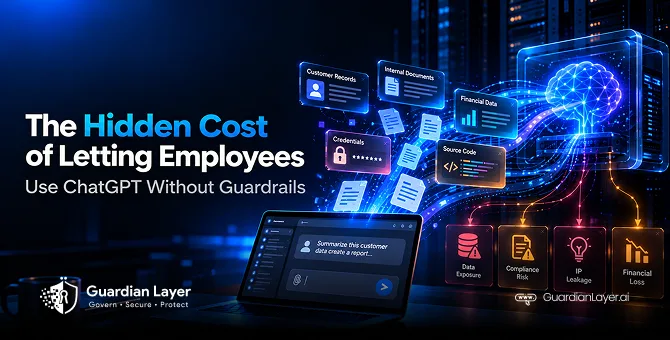
Right now in your organization, there's probably somebody using ChatGPT to create a summary of a customer contract in two minutes rather than spending twenty minutes reading it. Nobody noticed. Nobody approved it. It just happened because it was faster than the alternative.
That's the part most security teams get wrong. They treat unsanctioned AI use like a discipline problem, something you fix with a policy memo and a line added to the employee handbook. It isn't. It's an infrastructure gap. And employees will keep filling that gap with whatever tool is open in their browser tab, policy or no policy.
The companies that get burned by ChatGPT guardrails being an afterthought aren't the ones with careless staff. These are the systems that never managed to create a better route for their work with AI. This blog post will discuss the cost, the manifestation of this problem, and how it is solved in practice.
What Actually Happens When an Employee Pastes Data Into ChatGPT?
The moment the data is moved from your application or from your email to a third-party model, you lose all control over its further movement, storage time, and even potential future reuse, which you might not be happy about. This is exactly the behavior that was described as sensitive information disclosure in LLM interactions and listed as one of the leading risk types by OWASP LLM Top 10.
It rarely looks dramatic. It looks routine. A few common examples we see across enterprise clients:
- A finance analyst pastes account numbers and a customer name into a prompt asking for a dispute summary
- A developer drops a chunk of proprietary code into ChatGPT to debug an error faster.
- An HR manager uploads a termination letter template with real employee names still in it.
- A sales rep pastes a pricing sheet into a prompt to generate a competitor comparison.
- A support agent copies a full customer ticket, PII included, to draft a response.
None of these people think they're doing anything wrong. That's what makes employee AI risk so hard to manage with policy alone. The behavior is well-intentioned and, on the surface, harmless.
Why Don't Most Companies Know How Much Shadow AI Use Is Happening?
Ask any CISO how many employees used ChatGPT last week and, most likely, they will estimate. The existing Data Loss Prevention systems were created for monitoring file transfers, emails, and network communication. However, they were not created to interpret prompts.
That blind spot shows up in a few predictable ways:
- No visibility into which teams are pasting sensitive data into AI tools, or how often
- No record of what left the building if a customer, auditor, or regulator ever asks
- No way to tell the difference between a harmless prompt and one that just leaked a trade secret
- Security reviews that stall at the exact moment someone asks, "How do we know what's actually going out"
The inability to answer this question often becomes the reason why a pilot project related to AI implementation fails. But not because of the inadequacy of the model itself, but due to the impossibility of giving an accurate answer on visibility.
What's the Real Price Tag on "We'll Deal With It Later"?
Usually, the cost of using unapproved AI comes into effect not during a single breach event, but as a result of gradual exposure revealed at a most inappropriate moment, usually during an audit, customer security questionnaire, or an incident.
Here's where that cost tends to land:
- Regulatory exposure. GDPR, HIPAA, and similar frameworks don't care that the disclosure happened inside a chat window instead of an email.
- Lost intellectual property. Source code or product roadmaps pasted into a public model can't be un-pasted.
- Failed customer audits. Enterprise buyers increasingly ask vendors to prove AI governance controls exist, not just claim them.
- Breach notification and legal costs. If customer PII data leakage related to ChatGPT can be traced back to your environment, notification obligations still apply.
- Trust that doesn't come back easily. A customer who learns their data touched an ungoverned AI tool remembers that longer than almost any other kind of mistake.
None of this requires malicious intent. It just requires nobody watching the door.
Where Does the Data Actually Leak From?
Unsanctioned AI use isn't one problem. It's three, layered on top of each other.
The Prompt Itself
This is the most obvious path and the one most policies try to address, usually by just telling people not to do it. The prompt text, including anything pasted or typed, leaves your environment the moment it's submitted.
Browser Extensions and AI Plugins
Plenty of employees install AI writing assistants, meeting summarizers, or "helper" extensions that quietly read page content, including internal dashboards and CRM records, and send it to a model in the background.
Copy-Paste Between Internal Tools and Consumer AI Apps
This is the quiet one. Someone copies output from an internal system into a personal ChatGPT tab to reformat it, then pastes the result back. The round trip through an ungoverned model is easy to miss because it never looks like a file transfer.
Can You Just Block ChatGPT and Call It Solved?
Blocking the domain feels like the fast answer. It isn't a real one.
- Personal phones aren't on the corporate network, and the ChatGPT app works fine there
- Employees route around a block through personal email, home wifi, or a browser the IT team didn't think to restrict
- Blocking pushes usage further underground, which means you lose even the limited visibility you had before
- Teams that actually need AI to stay competitive will find a way to use it anyway, sanctioned or not
Blocking treats the symptom. The employees who were pasting data into ChatGPT last week are still going to need that speed next week. Take away the tool without replacing the workflow, and you just make the problem harder to see.
What Do Real ChatGPT Guardrails Actually Look Like?
This is where most companies stall out, because "add guardrails" sounds simple until you try to do it without breaking the workflows people already depend on. In practice, it comes down to a few things working together at the point where the prompt actually leaves the building.
Redaction Before the Prompt Ever Leaves
PII, PHI, secrets, and proprietary code get masked in real time, before the request reaches the model. Done well, this happens in under 30 milliseconds and doesn't require rewriting how the app or the employee already works.
Policy Enforcement, Not Just a Policy Document
A written policy tells people what they should do. Enforcement decides what a specific prompt is allowed to do, based on role, team, and data sensitivity, at the moment it's submitted. If a call violates policy, it gets blocked or flagged before it goes anywhere, not after someone notices in a quarterly review.
An Audit Trail That Actually Holds Up
When a customer, regulator, or internal review asks what left your environment and when, "we're not totally sure" is not an answer anyone wants to give. A proper audit trail records every prompt and response, tamper-evident, so the answer is a lookup instead of a guess.
How Do You Put Guardrails in Place Without Slowing Teams Down?
The goal isn't to make AI harder to use. It's to make the safe path the fast path, so people stop reaching for the ungoverned one.
- Start with an honest inventory: which teams are already using AI tools, sanctioned or not
- Put a gateway between your applications and the models, rather than relying on individual tool settings
- Set model access by role, so a support agent and a finance analyst aren't working under the same rules
- Track spend and usage per team so shadow costs show up before they become a budget surprise
- Keep a human in the loop for anything flagged, instead of hard-blocking every edge case
None of this requires banning ChatGPT. It requires putting something between your data and the model that actually pays attention.
The Bottom Line
The hidden cost of unguarded ChatGPT use isn't really about one bad prompt. It's about not knowing, months later, how many prompts like it already happened. That's the gap that gets expensive, not the individual mistake.
Employees aren't going to stop reaching for AI to move faster. The only real choice is whether that path runs through something that's watching, or through a browser tab nobody's checking at all.