https://www.actowizsolutions.com/salla-inventory-and-seller-insights.php
Introduction
Most e-commerce intelligence programs in the Gulf are built around the same three or four marketplaces. Amazon.sa. Noon. Namshi. Jarir. They are the obvious places to look, and everyone is already looking there — which is precisely why the interesting signal has moved somewhere else.
That somewhere else is Salla. The Riyadh-born commerce platform now powers tens of thousands of independent merchant storefronts across Saudi Arabia and the wider GCC — fashion labels, perfume houses, abaya boutiques, dates and coffee sellers, electronics resellers, home and beauty brands, and a long tail of D2C operators who never list on a marketplace at all. Each one runs its own store, sets its own prices, runs its own promotions, and manages its own inventory. Collectively they represent one of the most commercially revealing datasets in the region — and one of the least systematically tracked.
That is the gap. If you are a brand trying to understand where your products are actually selling and at what price, a marketplace-only view misses the Salla channel entirely. If you are an investor sizing the Saudi D2C opportunity, aggregate platform PR doesn't tell you what merchants are actually charging or how fast they're moving inventory. If you are a merchant on Salla yourself, you are competing against hundreds of stores whose pricing you cannot see.
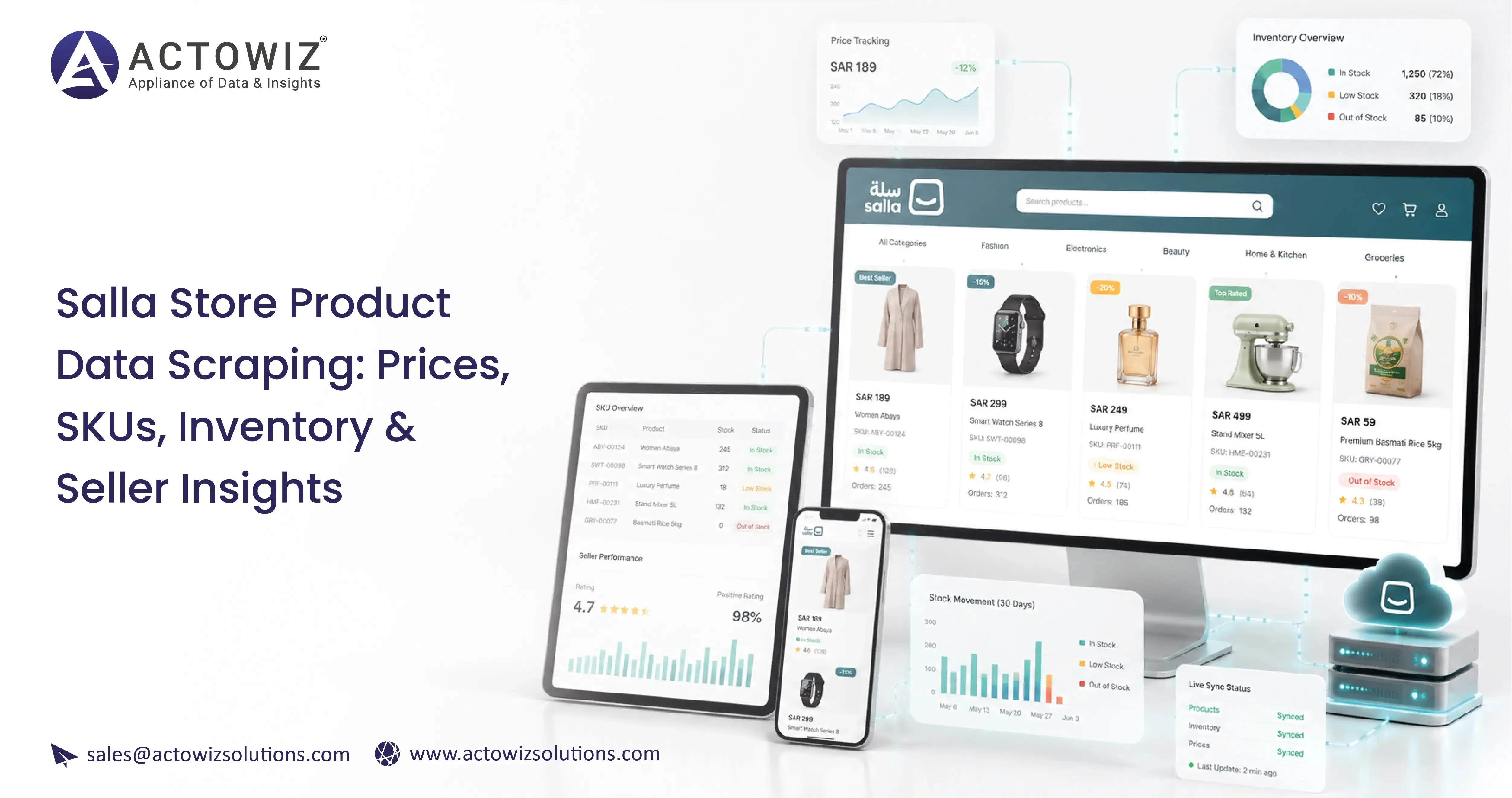
Salla Store Product Data Scraping closes that gap. It means systematically collecting product, price, inventory, promotion and seller-level data across the Salla merchant network — structured, normalized, and refreshed often enough to be actionable.
This guide covers what to collect, how to structure it, what the data actually reveals about how Saudi D2C commerce prices itself, and how Actowiz Solutions (1) builds and runs these programs for brands, retailers, investors and platform operators across the GCC.
Why Salla Is a Different Kind of Data Problem
Scraping a marketplace and scraping a merchant network are not the same task. Treating them the same is the reason most Salla projects stall.
It is a network, not a marketplace. There is no single catalogue, no unified search results page, no canonical product ID shared across sellers. Each Salla store is its own storefront with its own domain or subdomain, its own category tree, and its own naming conventions. Before you can extract anything, you have to discover the store universe — and keep discovering it, because new merchants launch constantly.
The same product exists under a hundred different names. A perfume that a marketplace would list once under a canonical ASIN-style ID appears across forty Salla stores as forty different product pages, with forty different titles, forty different images, and prices that vary by 60%. Product matching is not a nice-to-have here. It is the entire foundation.
The content is bilingual, and mostly Arabic. Product titles, descriptions, variant labels, category names and promotional copy are predominantly Arabic, frequently mixed with English brand names and transliterations. Any extraction pipeline that doesn't handle Arabic text normalization — including diacritics, alef variants, and the ta marbuta — will fail at matching, and fail silently.
Merchant sophistication varies enormously. Some Salla stores are run by professional brands with disciplined pricing, full variant data and clean inventory management. Others are one-person operations with inconsistent SKUs and stock counts that mean nothing. Your pipeline has to grade data quality, not just collect it.
Seasonality is intense and locally specific. Ramadan, Eid al-Fitr, Eid al-Adha, Saudi National Day, White Friday and back-to-school reshape pricing and promotional behaviour across the network. A dataset that doesn't span these cycles describes a market that only exists between them.
Any serious Salla E-commerce market Data intelligence program is designed around these five realities from day one.