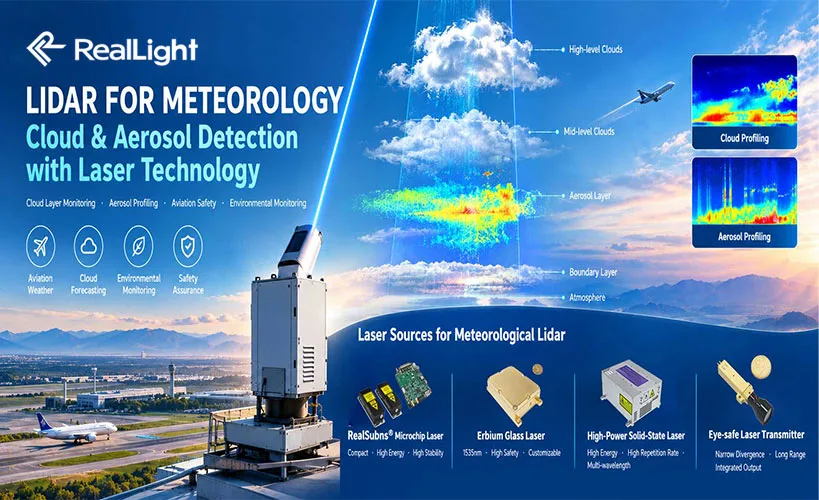
Atmospheric clouds and aerosols are key factors affecting aviation safety, weather forecasting and environmental monitoring. Traditional sounding balloons and manual visual observations are limited by time and weather conditions and cannot realize all-weather continuous monitoring with high temporal resolution. Laser weather radar (Laser Lidar), based on the principle of laser back-scattering, can remotely sense high-altitude atmospheric particles and perform automatic observation of cloud-base boundaries and vertical aerosol profiles. It has become a core remote-sensing device for weather stations, airports and environmental monitoring sites[1].
Among relevant devices, laser ceilometers and aerosol lidars are the two most widely used categories. Though derived from the same technical origin, they feature different functional priorities and place differentiated technical requirements on pulsed laser light sources.
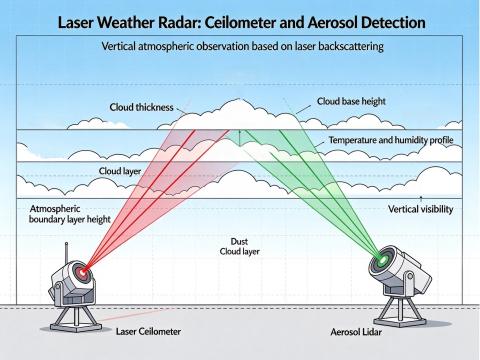
Main Applications of Laser Weather Radar
1. Laser Ceilometer: Core Equipment for Aviation Meteorological Support
1.1 Working Principle
Clouds are visible condensates suspended in the atmosphere, mainly composed of tiny water droplets, super-cooled water droplets or ice crystals, often existing in mixed forms. Some clouds also contain small amounts of raindrops, snow crystals and other particles. Different from fog, the base of clouds does not touch the ground.
Water vapor evaporated from surface water bodies rises with airflows and condenses or desublimates under low-temperature conditions at high altitudes to form clouds after massive accumulation. Clouds of different altitudes and forms correspond to distinct atmospheric temperature, humidity and airflow conditions and can directly reflect weather evolution. Daily weather phenomena including sunny, cloudy, rainy and snowy days, as well as severe weather such as thunderstorms, typhoons and heavy rain, are closely related to cloud development and variation.
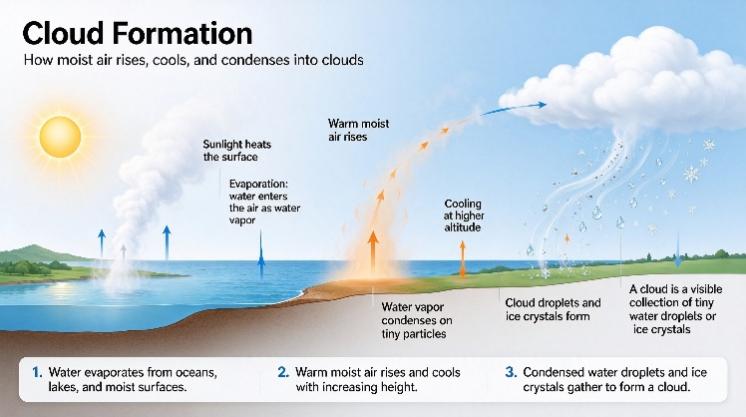
Cloud Formation
A laser ceilometer is a specialized Mie-scattering lidar. It emits nanosecond pulsed lasers vertically upward. Lasers produce almost no echo signals in clean atmosphere. When the laser beam hits tiny water droplets and ice-crystal particles at the cloud base, intense Mie back-scattering occurs, and part of the optical signal returns along the original path to the receiving telescope.
The system records the time difference between laser emission and echo reception. Given the constant speed of light, cloud-base height is calculated by the formula:
H=(cx△t)/2 [2][3]
Meanwhile, variations in echo-signal intensity are analyzed to identify multi-layer clouds and cloud-top height, and output parameters such as cloud thickness and vertical visibility.
1.2 Significance of Laser Ceilometers
Airport take-offs and landings are highly sensitive to cloud-base height. Excessively low cloud bases degrade visibility and lead to flight delays or diversions, and may pose flight-safety risks under extreme conditions. Manual observations and sounding balloons cannot deliver 24-hour uninterrupted continuous monitoring.
Advantages of laser ceilometers:
1. Automatic round-the-clock operation, outputting cloud-base height and multi-layer-cloud information day and night;
2. High detection accuracy with capability of identifying low-altitude broken clouds, complying with civil-aviation meteorological specifications;
3. Compact size, suitable for long-term unattended operation at monitoring sites[4].
2. Aerosol Lidar: Powerful Tool for Stereoscopic Atmospheric-Environment Monitoring
Atmospheric aerosols refer to a large number of tiny solid and liquid particles suspended in air, generally ranging from 0.001 μm to 100 μm in diameter. Individual particles are mostly invisible to naked eyes, yet massive aggregation gives rise to visible phenomena such as haze, dust storms and smog.
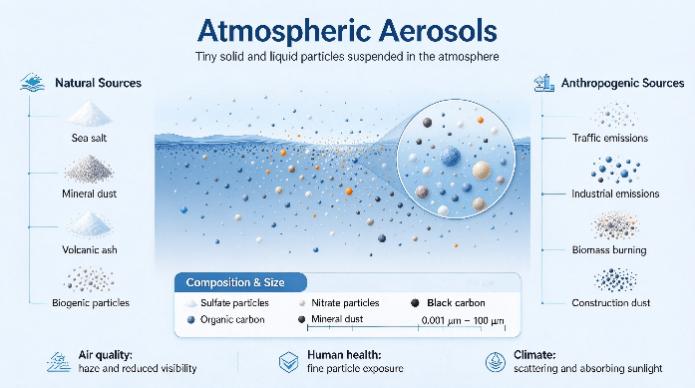
Atmospheric Aerosols
Impacts of aerosols:
· Environment and air quality: Elevated aerosol concentrations trigger haze and reduce atmospheric visibility. Fine particles such as PM2.5 also endanger human health.
· Meteorology and cloud-formation processes: Aerosols act as cloud-condensation nuclei. Water vapor adheres to aerosol particles and condenses into cloud droplets upon cooling. Aerosol quantity directly influences cloud-droplet number and cloud morphology, and indirectly affects rainfall and thunderstorm genesis and evolution.
· Climatic effects: Aerosols scatter and absorb sunlight, alter atmospheric radiation balance and exert impacts on regional climate.
2.1 Working Principle
An aerosol lidar is a general Mie-polarization lidar also based on atmospheric laser back-scattering. When laser light is transmitted to high altitudes, aerosol particles such as dust, haze, smoke and fog droplets generate back-scattered signals.
By analyzing echo-signal intensity and depolarization ratio, parameters including aerosol extinction coefficient, atmospheric boundary-layer height and vertical particle distribution can be retrieved. Clouds can also be identified to distinguish clouds from dust pollution, enabling detection of the full atmospheric vertical profile.
2.2 Significance of Aerosol Lidars
Traditional ground-based environmental monitoring stations only obtain pollutant concentrations at ground points and cannot capture the vertical distribution, transport and diffusion of pollutants at high altitudes.
Aerosol lidars can:
1. Acquire vertical spatial distribution of pollutants to trace pollution sources and dust transport;
2. Locate atmospheric boundary-layer height to assess haze formation and dissipation trends;
3. Simultaneously identify clouds to support weather forecasting and weather-modification operations;
4. Be widely deployed for ecological-environment monitoring, scientific research and urban atmospheric observation[5].
Core Requirements for Laser Sources of Meteorological Lidars
Pulsed lasers serve as the core light source for both ceilometers and aerosol lidars. Laser-source performance directly determines detection range, signal-to-noise ratio (SNR) and long-term reliability of the complete system. Core requirements include:
1. Narrow nanosecond-pulse output: Pulse width determines spatial ranging resolution; narrower pulses deliver superior height-resolving capability.
2. Stable pulse energy: Low energy fluctuation guarantees stable echo signals and favorable data repeatability.
3. Superior beam quality and small divergence angle: Facilitates beam expansion and improves detection range.
4. External-trigger support: Enables time-sequence synchronization with receiving-and-acquisition systems.
Selection of Laser Sources for Meteorological Lidars
To meet stringent laser-source specifications for meteorological lidars, the RealSubns® series of microchip pulsed lasers developed by RealLight are tailored for laser ceilometers and aerosol lidars, satisfying most core light-source demands for meteorological remote-sensing equipment.
Applicable to laser ceilometers and micro-pulse aerosol polarization lidars (operational equipment for airports and weather stations).
· Pulse width: 1.5-2 ns
· Wavelength: 1064 nm / 532 nm
· Maximum single-pulse energy: 180 μJ
· Repetition rate: 2.5 kHz
Custom-designed for meteorological Lidar, it features a hermetically-sealed OEM laser head with external-trigger synchronization. Energy RMS fluctuation is less than 3 %. It outputs TEM₀₀ fundamental-mode beams and supports dual-wavelength customization. It works over a wide temperature range and adapts to long-term 7×24-hour unattended field operation. It is typically deployed in airport laser ceilometers for cloud-base-height and multi-layer-cloud identification, and in aerosol lidars for retrieval of boundary-layer properties, dust characteristics and depolarization ratios.
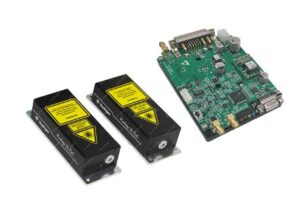
Photo of MCA-R Series Microchip Lasers
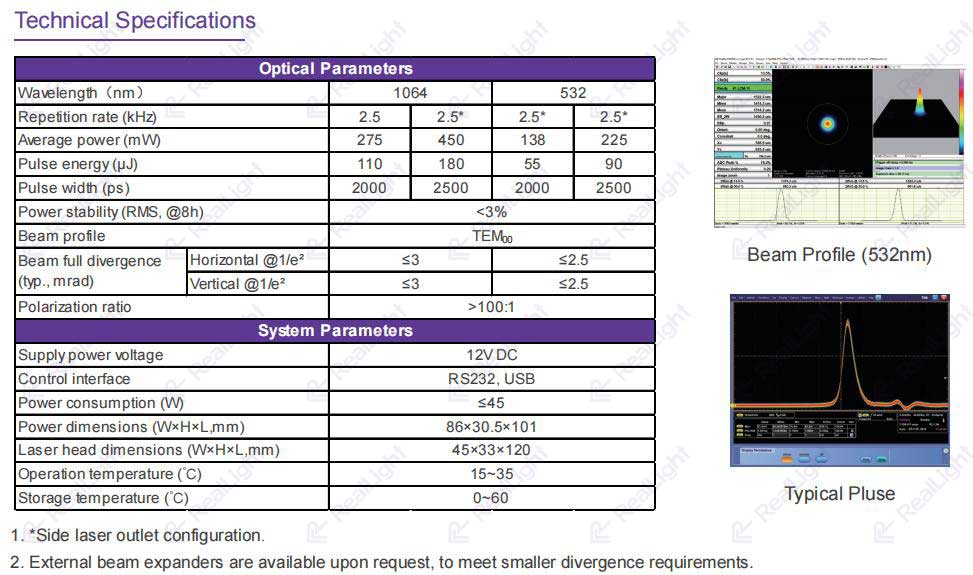
Specification Table of MCA-R Series Microchip Lasers
Suitable for ceilometers requiring higher vertical spatial resolution and high-precision compact meteorological lidars.
· Pulse width can be compressed down to 1 ns for further improved height-ranging resolution.
· Optional wavelengths: 1030 nm / 515 nm; maximum single-pulse energy: 100 μJ.
It demonstrates enhanced capability for identifying low-altitude broken clouds and thin clouds, and fits equipment with strict spatial-resolution requirements.
Laser heads adopt hermetically-sealed integrated structures with compact dimensions, well-suited for miniaturized complete-system design of ceilometers and aerosol lidars. They fulfill reliability requirements for unattended long-term outdoor operation at meteorological stations and airports. They can be used in ceilometers to detect cloud bases, multi-layer clouds and cloud thickness, as well as in aerosol lidars to resolve vertical aerosol profiles, atmospheric boundary-layer height and differentiate dust and cloud signals.
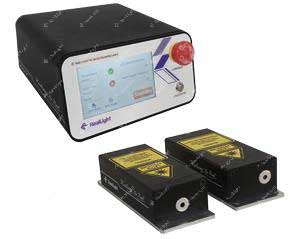
Photo of MCJ Series Microchip Lasers
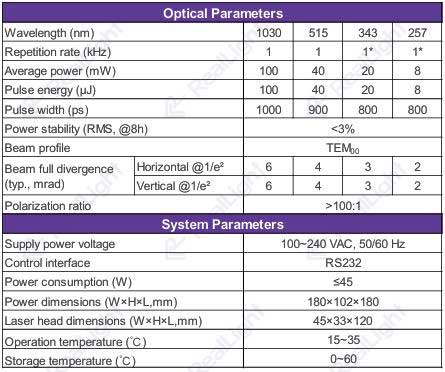
Specification Table of MCJ Series Microchip Lasers
In addition, RealLight 1535 nm erbium-glass eye-safe lasers can act as light sources for meteorological lidars. The 5 mJ high-energy variant targets eye-safe lidar applications.
The 1535 nm band is eye-safe and reduces laser-safety-management burdens for open-path deployment. High single-pulse energy of 5 mJ effectively boosts echo-signal strength, compensating for the relatively weak Mie-scattering cross-section of fine aerosols at 1535 nm and improving SNR for long-range cloud detection. The laser adopts a compact hermetically-sealed module with PD synchronous-signal output, satisfying time-sequence requirements for time-of-flight cloud-base-height calculation. It adapts to vehicle-mounted and portable eye-safe meteorological lidars.
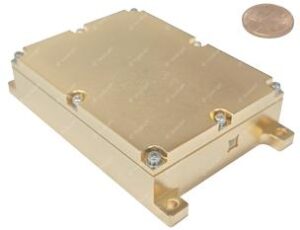
Photo of 1535 nm Erbium-Glass Laser
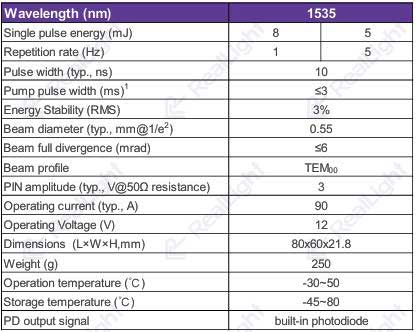
Specification Table of 1535 nm Erbium-Glass Laser
The 40 μJ, 1 kHz variant of RealLight 1535 nm erbium-glass eye-safe laser can also serve as a light source for laser ceilometers. It delivers stable repetition-rate output for continuous acquisition of cloud echo signals. Its compact hermetically-sealed module with PD synchronous-signal output meets time-sequence demands for time-of-flight cloud-base-height computation. It fits fixed compact ceilometers, balancing miniaturization and long-term stability for field meteorological observation.
RealLight erbium-glass lasers support optional dedicated beam expander modules optimized for meteorological-lidar optical systems.
A beam expander compresses laser-beam divergence angle, reduces geometric divergence loss during atmospheric propagation, elevates on-orbit beam energy density at high altitudes, and thus increases maximum lidar detection range and improves detection performance for high-altitude clouds and weak-echo clouds. The beam expander can be integrally assembled with the laser head to lower optical-alignment difficulty while preserving system compactness, ideal for integration within portable and vehicle-mounted meteorological lidars.
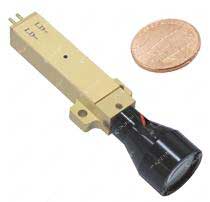
Photo of T03 Series Eye-safe Laser Transmitter
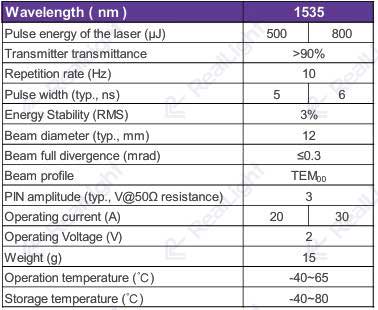
Specification Table of T03 Series Eye-safe Laser Transmitter
The AQE series RealShock® active Q-switched lasers from RealLight can be deployed as high-energy ceilometer light sources, with multi-wavelength options including 1064 nm and 532 nm. Maximum single-pulse energy reaches 180 mJ with nanosecond-scale pulse output. It delivers uniform beams and favorable energy stability, featuring a hermetically-sealed air-cooled integrated structure supporting internal and external trigger synchronization. It generates strong echo signals for long-range cloud detection and enables cloud observation from 5 km to 15 km, suitable for fixed high-precision ground-based cloud-detection radars.
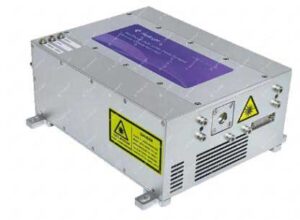
Photo of AQE Series 180mJ Diode Pumped Actively Q-switched Laser
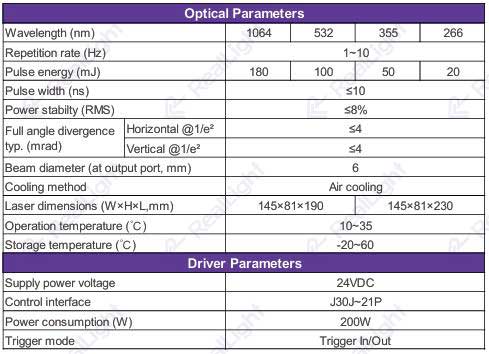
Specification Table of AQE Series 180mJ Diode Pumped Actively Q-switched Laser
The HQP series high-power sub-nanosecond lasers target high-sampling-rate micro-pulse ceilometers. Supporting 1064 nm / 532 nm wavelengths with repetition rates up to 50 kHz, sub-nanosecond narrow pulses enhance ranging resolution. It provides excellent fundamental-mode beam quality within a compact low-power-consumption module, suitable for lightweight continuous cloud-base-monitoring equipment with high temporal resolution.
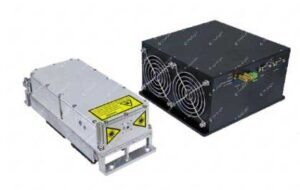
Photo of HQP Series High Peak Power Sub-nanosecond Lasers
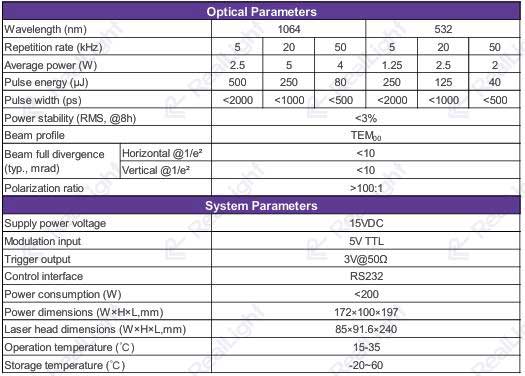
Specification Table of HQP Series High Peak Power Sub-nanosecond Lasers
Disclaimer: Part of the content in this document is sourced online, intended solely for technical-research exchange and reference purposes. Feedback is welcome for factual or academic errors. Should any copyright concerns arise, please contact us for prompt verification and removal.
References
1. Tian Xiaomin, Liu Dong, Xu Jiwei, et al. Review of Atmospheric Detection Lidar Technology[J]. Journal of Atmospheric and Environmental Optics, 2018,13(05):321-341.
2. Sun Jingqun. Laser Atmospheric Detection[M]. Beijing: Science Press,1992.
3. Li Xiao, Shu Zhiliang, Cao Ning, et al. Comparative Analysis of Cloud-Measurement Performance between Laser Ceilometer and Ka-band Cloud Radar[J]. Meteorological, Hydrological and Marine Instruments,2023,40(03):57+11.
4. ICAO Annex 3, Meteorological Service for International Air Navigation[S].
5. ISO 28902-1:2012, Air quality-Environmental meteorology-Part 1: Ground-based remote sensing of visual range by lidar[S].
6. MCA-R Series 2ns Microchip Laser
7. MCJ Series 1ns Microchip Laser
8. 5-8mJ 1535nm Erbium Glass Lasers
9. T03 Series Eye-safe Laser Transmitter
10. HQP Series High Peak Power Sub-nanosecond Lasers
11. AQE Series 180mJ Diode Pumped Actively Q-switched Laser