
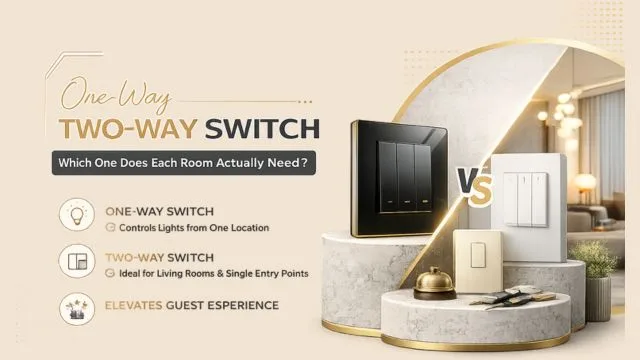
Choosing the right electrical switch is not just about choosing a switch that suits the interior decor of your house. Depending on which type of switch you install, the functioning of lights in your house will get affected.
Even though there is no major difference in the looks of one-way and two-way switches, the wiring and purpose of installation are different. Using the right type of switch in the right location will make your chores easier. It is very essential to know the difference between these two types of switches so that you can make the right decision when building a house or remodeling an old house.
One-way switches are switches where the lighting operates from just one place by pressing the switch. Two-way switches are those where the lighting operation takes place from two different places by pressing any one of the switches. Here wiring takes place through traveler wires connecting both points of operation of lighting.
One-way switches are used for kitchens and bathrooms, while two-way switches are used for stairs and bedrooms.
What Is a One-Way Switch?
The single-pole switch is the most common switch installed in residences. Technically, it is referred to as a single-pole single-throw (SPST) switch since it can control the lighting or other electrical fitting through one position only. It has one live input terminal and one live output terminal, as well as an earth terminal fixed in the mounting plate of the switch. When you press the switch, you allow the current to flow to light the bulb or else break the circuit in order to turn off the light.
Since the single-pole switch can be controlled using only one control point, wiring is relatively easier. The live wire enters the switch, while the switched live wire leaves the switch to enter the light fitting. On the other hand, the neutral wire goes directly to the fitting.
Where Is a One-Way Switch Used?
One-way switches are best suited for spaces where a light only needs to be controlled from a single location. Common applications include:
What Is a Two-Way Switch?
A two-way switch is a switch in the electrical circuit that operates a specific light or any other electrical appliance by using two positions. This is technically called a single-pole, double-throw switch. This consists of one common terminal and two traveler terminals, which join the two switches together. The wiring system allows the completion or breaking of the circuit connection by either switch.
Unlike the one-way switch, which has the fixed ON/OFF position, two-way switches change their position depending on the positioning of the two switches. If either of the two switches is pressed, the circuit status is changed, and the lighting can be operated from both switches. This makes the use of two-way switches easy in places where you enter from two ends.
It may be true that two-way switches need more wiring than one-way ones and hence are more costly, but they increase the effectiveness of the place.
Where Is a Two-Way Switch Used?
Two-way switches are ideal for areas where the same light needs to be operated from two different locations. Common applications include:
What If You Need to Control a Light From Three or More Locations?
A one-way switch controls a light from a single location, while a two-way switch allows the same light to be operated from two different locations. But what happens if you need to control one light from three or more points, such as in a long corridor, a staircase with multiple landings, or a large home with several entrances?
In these cases, the solution is an intermediate switch (also known as a four-way switch in some countries). A standard two-way switching circuit is designed for only two control points. To add a third or additional switch, an intermediate switch is installed between the two two-way switches. The switches at either end of the circuit remain two-way switches, while every extra control point uses an intermediate switch.
This arrangement allows you to turn the same light on or off from any switch location, regardless of the position of the others. For example, you could switch on a corridor light at one entrance, turn it off from the middle of the hallway, and switch it back on again from the opposite end. The same principle is commonly used in staircases with multiple floors, long hallways, hotels, offices, and other buildings where people approach the same light from different directions.
Although intermediate switching requires additional wiring and planning, it provides a far more practical and user-friendly lighting system for larger spaces. If your home's layout includes three or more switch points for the same light, discuss this requirement with your electrician during the design stage. Installing the correct switching configuration from the outset is simpler, more reliable, and more cost-effective than modifying the wiring after the installation is complete.
One-Way vs Two-Way Switch: Comparison Table
Which Switch Should You Pick?
There is no clear winner between the one-way and two-way switches because the selection ultimately depends on the configuration of your house, its usage, and the places where you wish to have control over the lighting. Although the one-way switch will be sufficient for many rooms, the two-way switch provides you with some extra convenience in case there are several ways to access that area.
Pick the one-way switch when:
- The room has one entrance point only.
- The light can be switched on/off from just one place.
- You need something simple and easy in terms of wiring.
- The room is a bathroom, a kitchen, a utility room, a balcony, or any other room accessible through one entrance.
Pick the two-way switch when:
- There are two entry/exit points in the room.
- The light can be switched on/off from two places.
- The room is a bedroom, a staircase, a hallway, or a long corridor where it would be more convenient to switch on/off the lights at both ends.
- You are constructing/renovating your house and want to install extra wires easily.
Planning your switch layout before installation can improve convenience, enhance safety, and reduce the need for costly electrical modifications in the future. Selecting the right switch type for each room ensures your lighting system works the way you expect every day.
How Can You Tell Which Switch Type You Already Have?
- If you are in doubt about the type of your switch, whether it is one-way or two-way, there is an easy way to figure out the answer without having to remove the plate or inspect the wires inside.
- Find out the number of switches controlling the light.
- If the light is controlled by a single switch and cannot be switched from any other location, then the switch is one way. It is the most frequent case when we see it in bathrooms, kitchens, utility rooms, and other single-access rooms.
- Check if the light is controlled from two points.
- If there are two switches controlling the same light, for example, in different parts of the hallway or upstairs/downstairs on the staircases, then you have a two-way switching configuration. Switch the light on and off using both switches and check if one of them works regardless of the position of another one. If it is the case, then everything is wired correctly.
- Otherwise, it means that the circuit is not properly wired or that the switches control other devices. Do not attempt to repair the circuit by yourself.
Can You Convert a One-Way Switch to a Two-Way Switch?
Yes, in most cases, a one-way switch can be converted into a two-way switch, but it requires more than simply replacing the switch. A two-way switching circuit needs additional wiring between the two switch locations so both switches can control the same light. If this wiring wasn't installed during construction, new cables may need to be routed through the wall or conduit, which can involve extra time and renovation work.
For this reason, it's best to plan where two-way switches are needed during the construction or renovation stage. Installing the required wiring before the walls are finished is easier, more cost-effective, and helps avoid expensive retrofitting later.
If running new wiring isn't practical, wireless or smart switching systems can provide two-point control without additional traveler wires. These systems are a convenient option for existing homes, although they require compatible smart modules and, in some cases, battery-powered companion switches.
For the safest and most reliable installation, always consult a qualified electrician before converting a one-way switch to a two-way switch.
Typical Errors of Homeowners When Selecting Switches
Small errors can make a big difference in your home planning process. The following are the typical errors of homeowners when selecting switches:
Installation of One-Way Switches in Bedrooms
It seems that one switch is enough, but having a two-way switch will enable you to turn off the lights from the bedside, which is much easier.
Selection of One-Way Switches for Staircase
A staircase requires switches to be installed both on top and on the bottom end. That way, you improve your convenience and minimize the chances of walking down the stairs in darkness.
Selection of Switches Only According to Looks
It doesn't mean that a good-looking switch plate is always of good quality. It has to be made of good material, have reliable mechanisms, and have appropriate certifications for safety.
Ignoring the Issue of Intermediate Switches
When the light in your room needs to be controlled from three or more locations, you should install an intermediate switch along with two-way switches.
Wrong Ampere Rating Selection
The correct ampere rating for lighting circuits is 6A, while you need 16A or 20A switches for high-load equipment.
Why Switch Build Quality Matters as Much as the Wiring
The choice of the right wiring arrangement is not everything. The quality of the switch itself determines the durability, reliability, and effectiveness of its operation. Consider these aspects when choosing a switch:
- ISI certification: It means that the switch meets IS 3854 safety standards for electrical switches and accessories.
- Reliable mechanism: Quality contacts and mechanisms are intended for long life and minimal wear with intensive use.
- Fire-retardant case: Polycarbonate materials have fire-resistant properties, which are particularly important for installation in kitchens and utility rooms.
- Reliable terminals: Such design elements as captive screws prevent weak contacts and electrical connection problems over time.
- Compatibility with LEDs and dimmers: It should be taken into account if you use dimming systems or LEDs.
Moreover, another feature of the switches is their modular nature. A modular system means that switches, sockets, USB chargers, and other parts can be changed independently from other parts in case of need without changing the faceplate.
Choosing a Modular Switch Range
If you're selecting switches for an entire home, choosing a single modular switch range helps maintain a consistent look, feel, and user experience across every room. Instead of mixing different brands or collections, opt for a modular system that offers flexibility without compromising on design or performance.
When comparing modular switch ranges, look for:
- A complete range of modules, including one-way, two-way, and intermediate switches.
- ISI-certified components that comply with relevant safety standards.
- Fire-retardant materials for improved safety and durability.
- Compatible accessories, such as sockets, fan regulators, USB chargers, and other modules that fit the same plate system.
- Multiple cover plate designs and finishes to match different interior styles while maintaining a uniform switch platform.
Simon modular switch ranges are designed with this flexibility in mind. The range includes one-way, two-way, and intermediate switch modules that share the same modular platform, allowing different rooms to have the required functionality while maintaining a consistent appearance throughout the home.
Built with durable internal mechanisms, captive screw terminals, and fire-retardant materials, these switches are engineered for reliable everyday performance. For homeowners looking to complement different interior styles, the Simon 38 range also offers a variety of premium cover plate finishes without changing the underlying switch system.
Frequently Asked Questions
1. Is it possible to use one-way switches to control light fixtures from two places? No. A one-way switch is created for controlling light from only one place. To be able to control the same light fixture from two different points, two-way switches will be needed.
2. In which rooms it is necessary to have two-way switches? Two-way switches can be used effectively in bedrooms, stairs, halls, long passages, and rooms with two entrances.
3. Is it possible to convert one-way switches into two-way switches? Yes, it is possible. However, it will require additional wiring between the two places where the switches are placed. Sometimes, wireless or other alternative solutions can be considered if rewiring is not feasible.
4. What is the difference between a two-way switch and an intermediate switch? A two-way switch allows controlling the light from two places. In case it is required to control the light from three or more places, an intermediate switch will be installed between two two-way switches.
5. Are two-way switches suitable for LED light fixtures? Yes. Two-way switches are fully suitable for working with LED lights. If it is planned to install dimmable LEDs, special dimmers for two-way switching must be chosen.
Final Thoughts
Choosing between a one-way and two-way switch isn't about selecting a better product; it's about choosing the right solution for your home's layout and everyday needs. A one-way switch is ideal for single-entry spaces, while a two-way switch offers added convenience in bedrooms, staircases, hallways, and other areas where controlling a light from two locations makes daily life easier. If you need control from three or more locations, an intermediate switch is the correct solution.
Planning your switch layout during construction or renovation helps avoid unnecessary rewiring and ensures every room is both practical and comfortable to use. By selecting the right switch type and investing in a quality modular switch range, you can create a safe, reliable, and future-ready electrical system for your home.
Explore Simon's range of one-way, two-way, and intermediate modular switches to find the right solution for every space and achieve a consistent blend of safety, functionality, and design throughout your home.