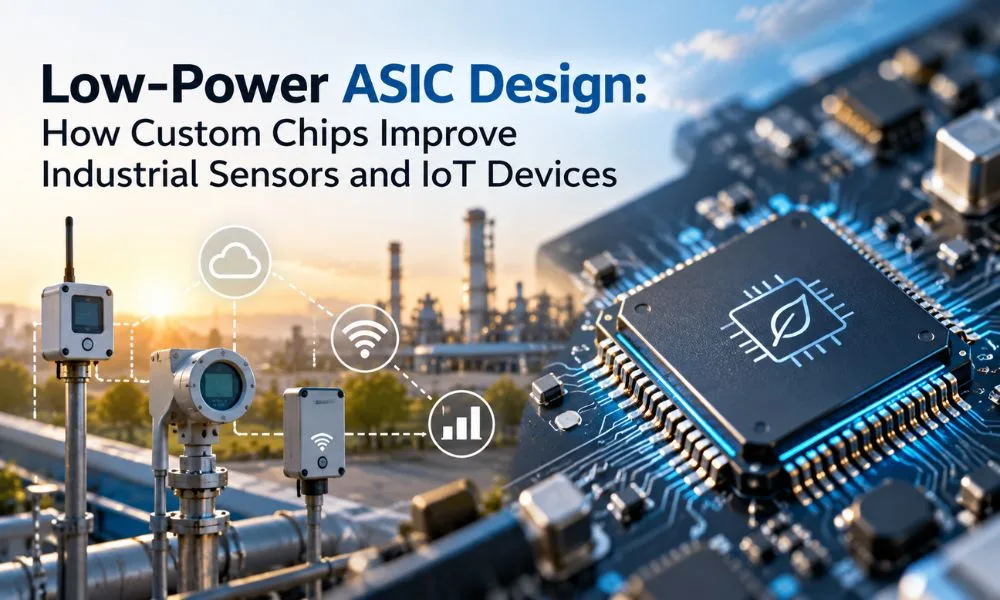
Industrial sensors are becoming more sophisticated. A single device may need to measure temperature, pressure, movement or other physical conditions while communicating data to a larger monitoring system.
Some sensors operate continuously. Others spend most of their time waiting for an event.
In both situations, power consumption can influence battery life, operating temperature, circuit size and overall product design.
For engineering teams building industrial monitoring systems or connected devices, low-power ASIC design provides one possible approach to integrating essential electronic functions efficiently.
However, creating a low-power chip is not simply about selecting the smallest manufacturing process.
It requires careful decisions about architecture, analog performance, operating modes and system requirements.
What Is a Low-Power ASIC?
A low-power ASIC is an integrated circuit designed to perform specific functions while meeting defined energy or power-consumption targets.
The chip may contain analog circuits, digital logic or both.
In sensor applications, it may perform signal conditioning, conversion, control and communication functions.
Instead of assembling these functions from numerous standard components, a custom ASIC can integrate selected circuits into a single device.
This may reduce board complexity and help manage power consumption.
However, the actual benefit depends on the architecture, manufacturing technology and application requirements.
Why Power Consumption Matters in Sensor Systems
Power consumption affects more than electricity costs.
Battery Life
Wireless sensors may operate from batteries for extended periods.
Reducing average power consumption can extend operating time between battery replacements or recharging.
Heat Generation
Electronic circuits generate heat during operation.
Lower power dissipation can simplify thermal management and support stable operating conditions.
Device Size
Power-efficient electronics may reduce some supporting component requirements.
The overall product size still depends on the battery, enclosure, connectors and other components.
Remote Operation
Sensors installed in difficult-to-access locations may benefit from efficient power management.
Replacing batteries frequently can increase maintenance expenses.
Understanding Active and Standby Power
A device does not necessarily consume the same amount of power throughout the day.
Some sensors continuously measure signals.
Others remain in standby mode and wake periodically to collect data.
Average power consumption depends on the time spent in each state.
For example, suppose a sensing circuit consumes 10 milliwatts when active and 0.1 milliwatts in standby.
If it is active only 1% of the time, its average power is approximately 0.199 milliwatts, assuming those are the relevant operating states.
This illustrates why duty cycling can be useful.
However, frequent wakeups, startup energy and required response time also affect the final design.
The Role of Analog Front-End Design
The analog front end receives and prepares signals from the sensor.
It may contain amplifiers, filters, programmable gain stages or signal conversion functions.
Analog circuit design involves a balance between noise, bandwidth, precision and power consumption.
Reducing bias current can lower power usage but may also influence noise or speed.
For applications measuring very small signals, aggressive power reduction can compromise accuracy.
Engineers therefore need to establish the minimum acceptable performance before optimizing power.
Companies evaluating low-power analog ASIC design services should define these trade-offs early.
How Mixed-Signal Integration Can Reduce System Complexity
Mixed-signal ASICs combine analog processing and digital control.
A chip may include an amplifier, an analog-to-digital converter and digital configuration registers.
Integrating these functions can reduce external connections and simplify some aspects of board design.
It may also improve control over the signal path.
However, placing analog and digital circuits on the same chip introduces challenges.
Digital switching can generate interference that affects sensitive analog measurements.
Good physical layout, supply isolation and grounding strategies help manage these effects.
Low-Power Design Techniques
Power Gating
Selected circuit blocks can be disabled when they are not required.
This can reduce leakage or standby consumption in appropriate architectures.
The circuit must be designed to restart safely and meet timing requirements.
Clock Gating
Clock gating reduces unnecessary switching in digital logic.
Dynamic power consumption is influenced by switching activity, operating frequency, capacitance and supply voltage.
Duty Cycling
A sensor may take measurements periodically instead of operating continuously.
This approach is suitable only when the application allows intermittent measurement.
Efficient Signal Processing
Careful architecture may reduce unnecessary conversions, data movement or computation.
Appropriate Process Selection
Different semiconductor processes offer different voltage, leakage, analog and integration characteristics.
The newest process node is not automatically the most efficient choice for every sensing application.
Why Sensor Signal Quality Still Matters
Reducing power is useful only if the circuit still meets the required performance.
Industrial sensors may need stable measurement accuracy across varying temperatures and operating conditions.
Noise, offset, drift and channel matching can affect results.
Some applications require programmable gain to accommodate different signal ranges.
Comport Data's CDI12100 sensor analog front-end ASIC integrates amplification, rectification and filtering functions across 12 channels.
It demonstrates the type of integrated signal-conditioning architecture engineers may evaluate for suitable sensor applications.
Product selection must still be based on the actual electrical specifications.
Low-Power ASIC Applications
Industrial Condition Monitoring
Sensors may track machine vibration, operating temperature or other equipment conditions.
Efficient electronics can be useful where monitoring devices operate for long periods.
Portable Measurement Equipment
Battery-powered instruments benefit from careful power management.
Environmental Monitoring
Remote devices may collect measurements at scheduled intervals.
Medical Sensing Equipment
Some medical electronics require precise measurements within strict power and thermal constraints.
Scientific Instruments
Specialized instruments may need multi-channel signal conditioning with predictable electrical performance.
How to Evaluate a Custom ASIC for an IoT Product
Begin with the complete system architecture.
Review the sensor output, measurement frequency, communication requirements and available power source.
Calculate expected active and standby periods.
Next, determine which circuit functions could benefit from integration.
Also consider manufacturing quantities.
Custom development involves non-recurring engineering costs, so a lower component cost does not automatically justify a new ASIC.
Reviewing an existing portfolio of ASIC designs can help engineering teams identify comparable architectures and relevant technical experience.
Common Low-Power ASIC Design Mistakes
Optimizing Power Before Defining Performance
Reducing power without noise and accuracy targets can produce an unsuitable circuit.
Ignoring Startup Energy
Repeatedly switching circuitry on and off may consume more energy than expected.
Underestimating Analog Noise
Low-current circuits can introduce noise-performance trade-offs.
Choosing a Process Only by Feature Size
High-voltage requirements, analog devices and long-term supply considerations may favour other technologies.
Forgetting Production Variation
A low-power design must meet requirements across the intended operating and manufacturing conditions.
Frequently Asked Questions
1. What is a low-power ASIC?
It is a custom integrated circuit designed to perform specified functions within defined power-consumption requirements.
2. Can an ASIC improve IoT battery life?
Potentially. Efficient integration, standby modes and reduced average power can help extend battery life.
3. Why is analog circuit design important for low-power sensors?
Analog circuits must balance power consumption with noise, bandwidth and measurement accuracy.
4. Are smaller semiconductor process nodes always better?
No. Process selection depends on voltage, analog performance, leakage, cost and other application requirements.
5. Can a mixed-signal ASIC replace several discrete components?
Yes, when suitable functions can be integrated efficiently. The benefit depends on design complexity and expected production volume.
Build More Efficient Sensor Electronics
Low-power ASIC development starts with understanding the actual measurement and system requirements.
The right architecture can help manage power consumption while preserving essential signal quality.
Comport Data provides analog and mixed-signal ASIC design services for industrial sensing, scientific instruments and other specialized applications.
Developing a low-power sensor or custom mixed-signal IC?
Contact Comport Data or call +1 514-340-1550 to discuss your specifications and engineering requirements.