
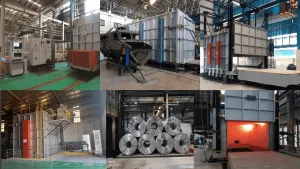
Bogie Hearth Furnace for Heavy Industrial Heat Treatment
Manufacturing industries often work with large metal components that require controlled heating to achieve the desired mechanical properties. Components such as heavy castings, steel fabrications, industrial machinery parts, and forged products may need annealing, normalising, tempering, or stress relieving before they are ready for further processing. A bogie hearth furnace provides a practical solution for applications that require the heat treatment of heavy or oversized loads.
Its movable hearth simplifies material handling and allows manufacturers to process components that may be difficult to load into conventional stationary furnaces. Understanding how this equipment works, where it is used, and which features matter most can help businesses make informed decisions about their industrial heating requirements.
What Is a Bogie Hearth Furnace?
A bogie hearth furnace is an industrial heat treatment furnace equipped with a movable platform called a bogie. The platform runs on rails and can be moved out of the furnace chamber for loading and unloading.
Heavy components are placed on the hearth using suitable material-handling equipment, such as an overhead crane or forklift where appropriate. Once loading is complete, the bogie moves into the furnace, where the material is heated according to a predetermined thermal cycle.
After the treatment is completed, the load is removed and handled according to the requirements of the process.
Also known as a car bottom furnace, this equipment is particularly useful in industries that process large components, heavy fabrications, and substantial batches of metal products.
How Does a Bogie Hearth Furnace Work?
The operation of a bogie hearth furnace involves several stages designed to maintain controlled heating conditions.
1. Loading the Components
The movable hearth is positioned outside the furnace chamber, allowing operators to load components more conveniently. Depending on the load dimensions and weight, cranes or other suitable handling systems may be used.
Correct load arrangement is important because component placement can influence heat circulation and temperature distribution.
2. Moving the Bogie into the Furnace
After loading, the bogie moves along its rails into the furnace chamber. Depending on the design, the movement may be manual, motorised, or mechanically driven.
The furnace door is then closed and secured to establish the required operating conditions.
3. Controlled Heating
The heating system raises the temperature according to the selected process requirements. Electric heating elements or fuel-fired burners may be used, depending on the furnace configuration.
Temperature controllers and suitable sensors help regulate the heating cycle. For processes that require consistent thermal conditions, the heating rate and temperature uniformity must be carefully managed.
4. Temperature Holding
Once the required temperature is reached, the components remain at that temperature for the specified holding period.
The appropriate holding time depends on factors such as material composition, component dimensions, load arrangement, and the intended heat treatment process.
5. Cooling and Unloading
After the holding period, the components are cooled according to the applicable process requirements. Cooling may take place inside the furnace or through another suitable arrangement, depending on the treatment and equipment design.
Once the load reaches the required handling condition, the bogie can be moved out for unloading.
Common Applications of Bogie Hearth Furnaces
Bogie hearth furnaces are used in industries that require controlled heating of large or heavy metal components.
Stress Relieving
Welding, machining, casting, and fabrication can introduce residual stresses into metal components. Stress relieving uses a controlled thermal cycle to reduce these stresses and improve dimensional stability where appropriate.
Large welded structures, fabricated assemblies, pressure vessel components, and heavy engineering parts may require this treatment.
Annealing
Annealing is used to modify the microstructure and mechanical properties of suitable materials. Depending on the alloy and process, it can improve ductility, soften the material, or prepare components for further manufacturing operations.
Normalising
Normalising is a heat treatment process commonly applied to steel to refine its microstructure and achieve the required material properties. The process involves controlled heating followed by cooling under specified conditions.
Hardening and Tempering
Hardening and tempering are used to achieve a suitable combination of hardness, strength, and toughness in appropriate materials.
The required temperature profile and cooling method depend on the material specification and intended application.
Post Weld Heat Treatment
Certain welded components require post weld heat treatment to reduce residual stresses or meet specific metallurgical and engineering requirements. A suitably designed bogie hearth furnace can accommodate large welded assemblies that are difficult to process in smaller equipment.
The treatment cycle must be selected according to the applicable material specifications, welding procedure, and engineering requirements.
Key Features to Consider When Selecting a Bogie Hearth Furnace
Choosing the right equipment requires a detailed understanding of the manufacturing process and operating conditions.
Furnace Capacity and Load Dimensions
The furnace must accommodate the maximum component dimensions, total load weight, and required clearance for loading and unloading.
Manufacturers should also consider the distribution of the load across the hearth. Correct sizing helps avoid operational limitations and supports efficient production planning.
Heating System
Bogie hearth furnaces may use electric, gas-fired, or oil-fired heating systems, depending on the application and equipment design.
Electric heating may suit processes requiring controlled heat input, while fuel-fired systems may be appropriate for other production conditions. The selection should account for energy availability, operating costs, temperature requirements, and maintenance needs.
Temperature Uniformity
Temperature uniformity is an important consideration in industrial heat treatment. Uneven heating can result in variations in the treatment received by different parts of a load.
Heating zone arrangement, air circulation, insulation, component spacing, and temperature monitoring all influence furnace performance.
The required temperature uniformity should be established according to the specific process and applicable standards.
Insulation and Energy Consumption
Furnace insulation helps reduce heat loss and maintain stable operating temperatures. The design of the furnace door, hearth sealing arrangement, and chamber lining can also affect thermal performance.
Manufacturers should evaluate energy consumption under realistic operating conditions rather than relying only on the furnace's rated power.
Automation and Process Monitoring
Modern industrial heating systems may incorporate programmable temperature controllers, PLC-based automation, human-machine interfaces, and temperature recording systems.
These features can help operators manage heating cycles, monitor process conditions, and improve repeatability.
The appropriate level of automation depends on production volume, process complexity, and quality requirements.
Loading Safety and Maintenance
Because bogie hearth furnaces handle heavy loads, their mechanical systems and material-handling arrangements must be suitable for the intended operating conditions.
Regular inspection of rails, drive mechanisms, doors, seals, insulation, sensors, and heating equipment helps maintain reliable operation. Appropriate safety interlocks and operating procedures are also important.
Benefits of Using a Bogie Hearth Furnace
A properly selected bogie hearth furnace can offer several operational advantages.
Convenient Material Handling: The movable hearth allows components to be loaded outside the furnace chamber, making it easier to handle large and heavy products.
Flexible Applications: Depending on its design, the furnace can support different heat treatment processes and component configurations.
Suitable for Large Loads: The spacious chamber and robust hearth construction can accommodate components that exceed the practical loading limits of smaller furnaces.
Controlled Thermal Processing: Suitable heating systems and temperature controls help maintain the conditions required for the selected heat treatment cycle.
Customised Configurations: Furnace dimensions, heating methods, door arrangements, and automation options can be selected according to production requirements.
Actual performance depends on the furnace design, material characteristics, operating procedures, and maintenance practices.
How to Choose the Right Furnace for Your Industry
Before purchasing a bogie hearth furnace, manufacturers should define their production and process requirements.
Start by identifying the material types, component dimensions, maximum load weight, and intended heat treatment processes. Determine the operating temperature, heating rate, holding time, and cooling requirements for each application.
Next, evaluate the furnace's working dimensions, temperature uniformity, energy consumption, and loading arrangements. Consider whether the equipment must handle different component sizes or accommodate future production growth.
It is also important to assess installation requirements, operator training, maintenance schedules, spare parts availability, and technical support.
Businesses comparing industrial heating equipment can review bogie hearth furnace solutions for industrial heat treatment to understand the equipment relevant to heavy-component processing applications.
A careful evaluation of these factors helps manufacturers select a furnace that meets their operational needs while supporting consistent and reliable production.
Conclusion
A bogie hearth furnace is a valuable solution for industrial applications involving the heat treatment of large and heavy components. Its movable hearth simplifies loading and unloading, while its heating and control systems support a range of thermal processes.
The right furnace depends on component dimensions, load capacity, operating temperature, heating method, temperature uniformity, and production requirements. Evaluating these factors before purchasing equipment helps manufacturers make informed decisions and establish suitable heat treatment operations.
With appropriate furnace selection, process control, and preventive maintenance, businesses can support consistent product quality and dependable long-term performance.
Frequently Asked Questions
1. What is the main purpose of a bogie hearth furnace?
A bogie hearth furnace is designed to heat treat large or heavy components using a movable hearth that simplifies loading and unloading.
2. Which industries use bogie hearth furnaces?
Common users include heavy engineering, steel fabrication, automotive manufacturing, foundries, forging operations, and industries that process large metal structures.
3. Which heat treatment processes can be performed in a bogie hearth furnace?
Depending on the design and operating conditions, these furnaces can be used for annealing, normalising, stress relieving, hardening, tempering, and certain post weld heat treatment applications.
4. What heating options are available?
Depending on the equipment design, electric, gas-fired, and oil-fired heating options may be available. The appropriate choice depends on the process requirements and available utilities.
5. What should be checked before purchasing a bogie hearth furnace?
Important considerations include load weight, component dimensions, operating temperature, heating method, temperature uniformity, energy consumption, safety features, automation, and maintenance support.