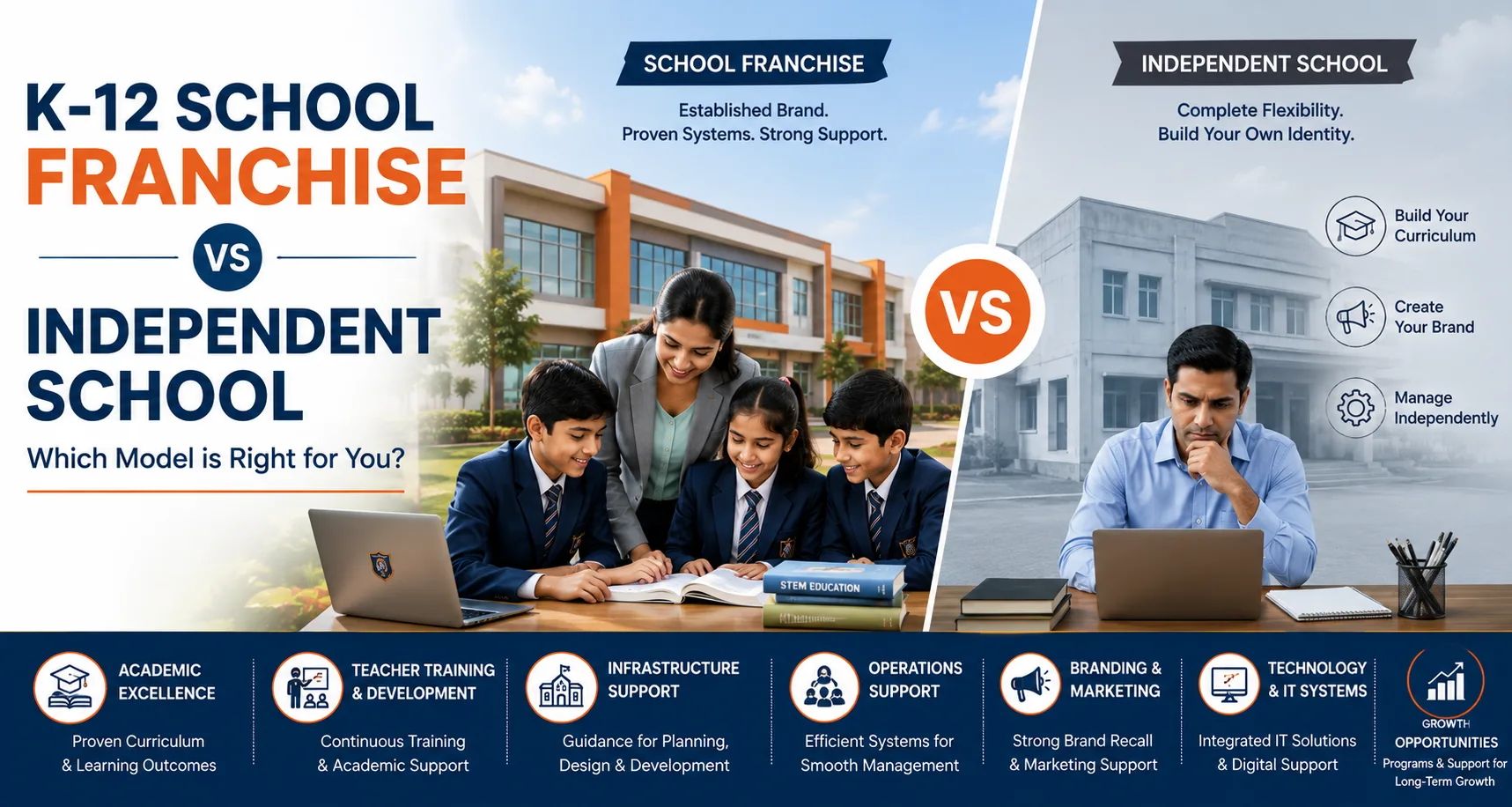
Starting a K-12 school is a major investment that requires careful planning, strong academic leadership and long-term commitment. For entrepreneurs entering the education sector, one of the first decisions is whether to establish an independent school or partner with an established education brand.
Both models have their advantages. The right choice depends on your experience, investment capacity, desired level of support and long-term goals.
What Is an Independent K-12 School?
An independent school is established and managed entirely by its owners or management team. This provides considerable freedom over the school's:
- Curriculum
- Branding
- Fee structure
- Teaching methodology
- Recruitment
- Marketing
- Operations
However, the management team must also develop these systems independently. This can require significant time, expertise and resources, particularly for first-time school entrepreneurs.
What Is a K-12 School Franchise?
A K-12 school franchise allows an entrepreneur to establish a school with the support of an established education brand.
Instead of developing every system from scratch, franchise partners may receive support covering areas such as curriculum, infrastructure, teacher training, admissions, operations, marketing, technology and school management.
For example, Birla Open Minds provides franchise support across infrastructure, academic offerings, teacher training, HR and finance, operations, branding and marketing, and IT.
Key Differences Between the Two Models
1. Curriculum and Academics
An independent school has to develop or source its own academic framework and establish systems for curriculum delivery and assessment.
A franchise generally provides an established academic structure, which can make implementation more organised.
2. Brand Building
Building an independent school brand takes time. The management must establish awareness and trust within the local community.
A franchise provides the advantage of an existing brand identity, although local marketing and reputation building are still important.
3. Teacher Training
Independent schools are responsible for developing their own teacher-training systems.
A franchise may provide induction, professional development, classroom observations and academic support to help educators implement the school's educational approach consistently.
4. Operational Support
Running a K-12 school involves admissions, finance, HR, technology, administration and parent communication in addition to academics.
With an independent school, these systems must be developed internally. A franchise can provide established processes and ongoing guidance.
5. Marketing
Independent schools need to create their own marketing strategy and promotional materials.
Franchise partners may receive support with launch planning, digital marketing, marketing collateral, public relations and local marketing strategies. Birla Open Minds lists these areas among its K-12 franchise support services.
Which Model Requires More Independence?
An independent school generally provides greater freedom because the owners control most aspects of the institution.
This may appeal to experienced education professionals or entrepreneurs with an established management team.
A franchise, on the other hand, provides a structured framework. While franchise partners still manage their school and make important local decisions, they operate within the standards and systems established by the education brand.
What About Investment?
A K-12 school requires significant investment regardless of the chosen model.
Expenses can include:
- Land or property
- Construction
- Classrooms and laboratories
- Furniture
- Technology
- Learning resources
- Staff salaries
- Marketing
- Working capital
- Operational expenses
For example, Birla Open Minds currently indicates a minimum space requirement of 2 acres as per CBSE by-laws and an indicative first-phase project cost of ₹7 crore–₹10 crore for its K-12 franchise model. Actual requirements can vary by project.
Investors should therefore prepare a detailed financial plan before choosing either model.
Which Model Is Better for a First-Time School Entrepreneur?
For someone entering the education sector for the first time, a franchise can provide valuable structure and guidance.
An established framework can reduce the need to create academic, operational and marketing systems from the ground up.
However, a franchise is not a completely hands-off investment. School management still needs to oversee staff, student experience, parent relationships, finances and daily operations.
How to Choose the Right Option
Before deciding between an independent school and a franchise, consider:
- Your experience in education
- Available investment
- Land and infrastructure
- Desired level of operational support
- Curriculum requirements
- Brand-building capabilities
- Local market demand
- Long-term expansion plans
Entrepreneurs who have strong internal expertise and want complete control may prefer an independent model. Those who value an established framework and ongoing support may find a K-12 school franchise in India more suitable.
Conclusion
Both independent schools and franchise schools can become successful education institutions, but the journey can look very different.
An independent model offers flexibility and complete control, while a franchise provides an established brand, academic framework and structured support.
The most suitable option ultimately depends on the entrepreneur's resources, experience and vision for the school. Taking time to compare both models before making a decision can help create a stronger foundation for long-term growth.