
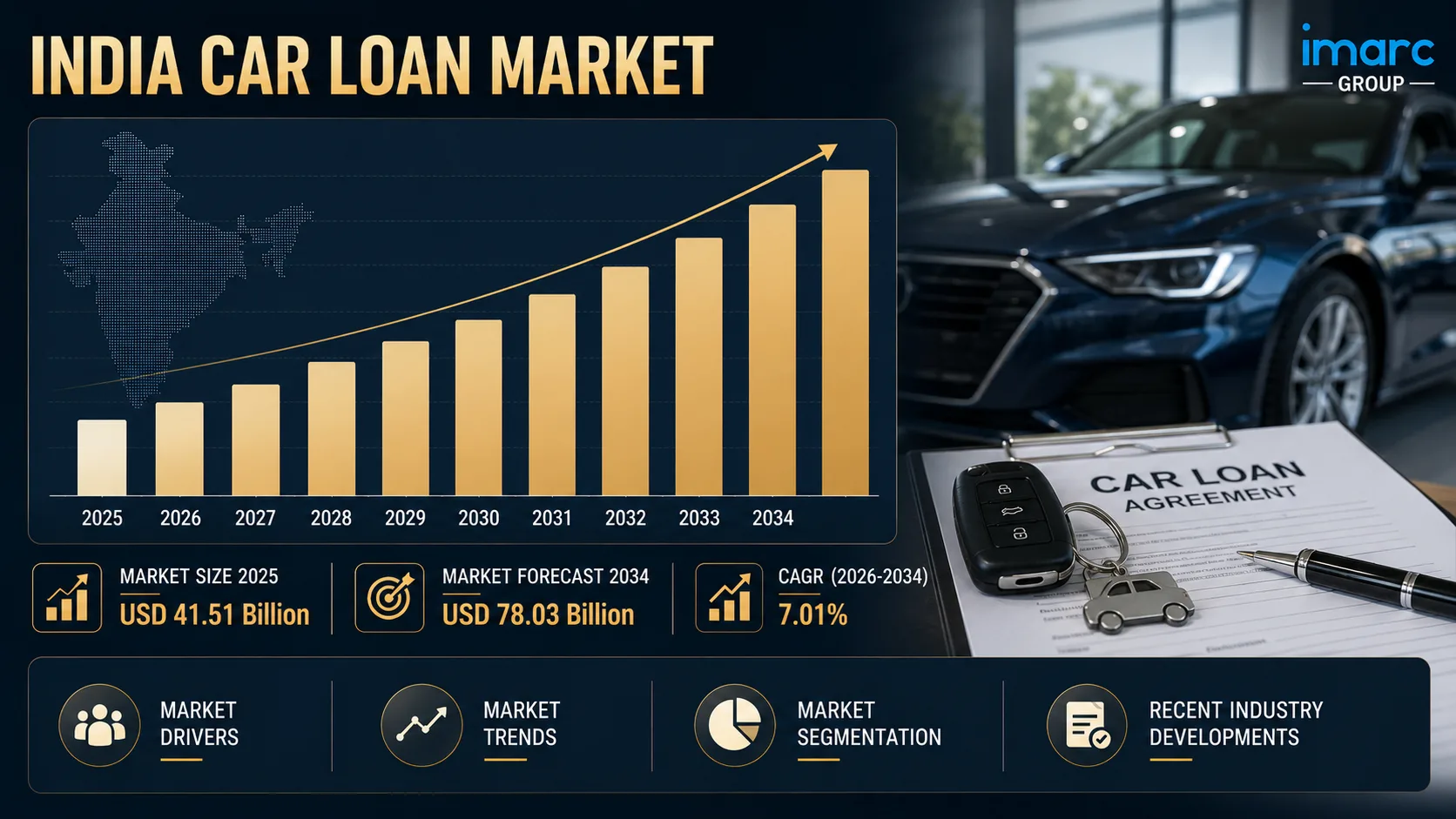
According to IMARC Group's report titled "India Car Loan Market Size, Share, Trends and Forecast by Type, Car Type, Provider Type, Tenure, and Region, 2026-2034", The report offers a comprehensive analysis of the industry, market growth, trends, share, and regional insights.
India’s retail credit ecosystem is experiencing a notable structural transformation, driven by an accelerating shift toward premium vehicle financing and digital credit onboarding. This transition is redefining credit penetration across urban and semi-urban boundaries, offering a stable landscape for institutional financial deployment.
- Market Valuation: The car loan market size in india reached a staggering USD 41.51 Billion in 2025, anchoring its position as a primary retail credit segment.
- Growth Trajectory: Projected to expand significantly to USD 78.03 Billion by 2034, indicating immense commercial room for scalable asset portfolio growth.
- Compounding Performance: The sector is advancing at a steady compound annual growth rate (CAGR) of 7.01% during the 2026–2034 forecast period.
- Segment Domination: New car financing maintains structural dominance, capturing a 74.9% share of outstanding loan balances in 2025.
The Strategic Market Challenge: Navigating the India Car Loan Market in India
Lenders face persistent margin compression due to intense interest rate competition among commercial banks, non-banking financial companies (NBFCs), and digital lending aggregators. Elevated repo-rate-linked borrowing costs ranging from 8.5% to 12% restrain entry-level consumer demand, while sharp vehicle price inflation increases individual loan amounts. This dynamic escalates potential default risks among self-employed borrowers, forcing financial institutions to continuously tighten underwriting frameworks to mitigate rising gross non-performing asset (NPA) ratios across regional portfolios.
➤ Access Industry-Focused Insights and Future Forecasts - Request Sample Report
India's Strategic Vision for the India Car Loan Market
- Transition Toward Electronic and Green Mobility FinTech
The national roadmap places extensive weight on embedding green vehicle options into the mainstream retail credit market to meet long-term sustainability goals. Lenders are systematically designing specialized electric vehicle loan products, incorporating alternative frameworks such as Battery-as-a-Service partnerships to support expanding EV adoption. This synchronized push establishes an organized, high-margin product tier that shields financial entities from localized market slowdowns, embedding modern infrastructure changes into the primary lending ecosystem.
- Deep Formalisation of the Pre-Owned Vehicle Market
Government and financial frameworks are actively accelerating the transparency of certified pre-owned automotive networks to stabilize downstream credit risk. Organized digital vehicle tracking systems and centralized valuation platforms eliminate asymmetric information barriers that historically plagued the used car domain. This formalization provides a structured credit underwriting roadmap, allowing institutional lenders to safely deploy tiered credit lines to an expanding first-time buyer segment across underserved consumer circles.
- Digital Transformation of Rural and Semi-Urban Lending
The regulatory environment heavily promotes the adoption of comprehensive end-to-end digital lending architectures to bridge deep geographic infrastructure deficits. Central financial frameworks incentivize paperless documentation, e-KYC validation, and automated e-mandate systems to process credit requests in non-metropolitan boundaries. This ongoing digitization compresses turnaround limits under 24 hours for salaried professionals, dramatically boosting retail automotive financing accessibility across key tier-2 and tier-3 regional catchments.
Why Invest in the India Car Loan Market: Key Growth Drivers & ROI
- Surging Middle Class Income and Aspirational Ownership
Expanding household income levels and a rapidly growing young workforce are structurally altering consumer spending priorities toward personal mobility. Creditworthy borrowers aged 25 to 40 are consistently demonstrating a strong willingness to secure personal vehicle loans to upgrade their lifestyles. This steady consumption baseline ensures stable disbursement volumes, protecting retail banking institutions from macroeconomic adjustments and generating excellent long-term yields across nationwide automotive clusters.
- Dealer Embedded Financing and Captive Finance Integration
The integration of specialized original equipment manufacturer (OEM) captive finance arms within dealer customer relationship management software optimizes loan origination efficiency. Automated credit checks enable car dealers to secure instant pre-approvals directly at the point of vehicle booking. This operational alignment drastically lowers customer acquisition costs while multiplying dealer-level loan attachment rates, offering corporate financiers superior capital realization and enhanced transaction depth.
- High Margins via Premium SUV Loan Segments
The massive consumer preference for premium, utility-format vehicles drives the total car loan market size in india upward by escalating average loan ticket sizes. Sports utility vehicle loans typically command values 30% to 50% higher than standard hatchback categories, creating a lucrative battleground for premium interest margins. This premiumization trend allows banks and NBFCs to capture excellent risk-adjusted investment returns across highly competitive urban markets.
India Car Loan Market Industry Outlook: Market Trends & Future Trajectories
- Pervasive Premiumisation of the Sports Utility Vehicle Tier
Sports utility vehicles lead the passenger transport segment, capturing a commanding 38.5% market share in 2025. Driven by expanding highway networks and higher urban incomes, this premium tier is projected to expand at an outstanding 8.2% CAGR. Lenders are aggressively designing tailored long-tenure financing packages to match this structural preference, cementing the utility vehicle as the primary driver of absolute value growth.
- Accelerated Volume Sourcing of Used Car Credit Portfolios
The used car financing division is expanding at an exceptional 8.8% CAGR, emerging as the fastest-growing loan category nationwide. Budget-conscious consumers and first-time rural buyers are increasingly securing flexible pre-owned vehicle loans to bypass steep new-car depreciation. NBFCs are actively designing risk-tiered credit structures to serve these underserved semi-urban markets, unlocking massive, stable capital disbursement pipelines over the forecast timeline.
- Deployment of Alternative Data and AI Credit Underwriting
Lenders are systematically deploying enterprise-level machine learning models to evaluate creditworthiness beyond traditional credit scores. Advanced algorithms analyze alternative data sets, including automated bank transaction histories and electronic GST filings, to approve self-employed applicants. This technological progress compresses turnaround times while lowering overall gross non-performing asset probabilities, standardizing operational risk management across diverse, underpenetrated borrower groups.
- Capital Consolidation via Strategic Co-Lending Architectures
Commercial banks are rapidly executing complex co-lending partnerships and loan securitizations with non-banking financial companies to manage balance sheet risks. Private banking giants utilize these capital-efficient structures—exemplified by multi-billion-rupee auto loan securitizations—to optimize capital distribution. These targeted arrangements allow retail banks to expand their portfolio sizes while utilizing the local outreach capabilities of agile NBFC networks.
➤ Explore the Full Report with Charts, Table of Contents, and List of Figures
Regulatory Landscape & Policy Catalysts in India
- Reserve Bank of India Monetary and Retail Credit Guidelines
According to the Reserve Bank of India (RBI), all auto loan originations and banking institutions must conform to strict macroprudential frameworks. The central bank continuously monitors net interest margins and interest rate spreads to ensure market stability amid repo rate fluctuations. This strict monetary oversight compels financial entities to optimize operational efficiencies and refine risk-tiered product structures to preserve profitability across volatile business environments.
- Production Linked Incentive Schemes for Heavy Electronics
According to the Ministry of Heavy Industries, the strategic execution of the INR 18,863.1 crore PLI scheme for large-scale electronics manufacturing acts as a profound catalyst. This state-backed spending program accelerates automotive hardware localization, lowering overall retail manufacturing costs across the nation. The policy indirectly inflates the affordable car loan market by lowering baseline ex-showroom prices for high-tech, premium passenger vehicles.
- National Scrappage Policy Certificate and Invoice Incentives
According to federal transport ministry guidelines, active vehicle scrappage policies are driving a structured replacement cycle across major metropolitan zones. Vehicle owners turning in older, non-compliant passenger vehicles receive official scrappage certificates that grant direct invoice price discounts on newer models. This regulatory mechanism shortens the overall vehicle life cycle, generating continuous auto loan application volumes for organized, showroom-level digital lenders.
- State Level Clean Air Subsidies and Green Financing Policies
According to recent regional draft transport notifications, local state governments are deploying direct acquisition subsidies for environmentally friendly electric passenger vehicles. These central green mandates allow captive finance arms and banks to provide lower-interest green car loans. This legal framework encourages urban tech-sector professionals to adopt clean mobility options, establishing a protected, fast-growing financing asset category across major auto markets.
- Rigorous Credit Bureau Integration and Reporting Rules
According to national credit information company directives, lenders must maintain absolute reporting accuracy regarding delinquent accounts and monthly repayment behaviors. Mandatory data submission to credit bureaus like CIBIL helps prevent systemic over-leveraging among retail credit consumers. This rigorous oversight limits potential gross non-performing asset risks, allowing commercial operators to securely underwrite loans for creditworthy applicants across all urban territories.
By the IMARC Group, the Top Competitive Landscape & their Positioning:
- State Bank of India
- HDFC Bank Ltd.
- ICICI Bank
(Please note that this is only a partial list of the key players, and the complete list is provided in the report.)
Market Segmentation Breakdown and Share Analysis:
Analysis by Type:
- New Car (Dominant segment due to higher ticket size)
- Used Car (Fastest growing segment)
New cars lead the market with a 74.9% share in 2025, driven by strong consumer preference for brand-new vehicles, attractive financing options, and rising demand for advanced safety, technology, and fuel-efficient models.
Analysis by Car Type:
- SUV (Highest demand growth)
- Hatchback
- Sedan
SUVs dominate with a 38.5% market share in 2025, supported by growing demand for spacious vehicles, stronger road presence, improved safety perception, and wider model availability across price categories.
Analysis by Provider Type:
- Banks (Largest market share due to lower cost of funds)
- NBFCs (preferred for faster processing and used cars)
- OEMs (Captive finance units)
Banks account for 52.4% of the market in 2025, benefiting from lower interest rates, strong financial credibility, extensive branch networks, and flexible repayment offerings.
Analysis by Tenure:
- Less Than 3 Years
- 3-5 Years (Most popular tenure)
- More Than 5 Years
The 3–5 year segment leads with a 52.8% share in 2025, balancing affordable monthly installments with moderate overall interest costs.
Regional Insights:
- North India
- South India
- East India
- West India
North India holds a 32.2% market share in 2025, driven by higher vehicle ownership, expanding middle-income households, strong urban demand, and greater access to organized financing services.
Note: If you need specific information that is not currently within the scope of the report, we can provide it to you as a part of the customization.
➤ Tailor the Research to Your Exact Business Needs - Request Customization
Frequently Asked Questions (FAQs):
Q1: What is the current value and projected growth of the India Car Loan Market?
According to IMARC Group, the car loan market size in india reached a valuation of USD 41.51 Billion in 2025 and is projected to reach USD 78.03 Billion by 2034, exhibiting a compound annual growth rate (CAGR) of 7.01% during the 2026–2034 forecast period.
Q2: Which vehicle type dominates the loan disbursement volume in India?
New car loans dominate the product type segment, capturing an impressive 74.9% market share in 2025, driven by the strong, structural preference for new vehicle ownership among the urban middle class and attractive zero-processing-fee festive offers from lenders.
Q3: Why are sports utility vehicle (SUV) financing lines experiencing rapid expansion?
SUVs lead the car type category with a 38.5% market share in 2025, growing at a rapid 8.2% CAGR due to lifestyle shifts, expanding road infrastructure, and high disposable incomes. Additionally, their average ticket size is 30-50% higher than hatchbacks, boosting total market value.
Q4: Which geographical region leads the automotive credit ecosystem in India?
North India commands the largest market share at 32.2% in 2025, heavily driven by dense vehicle ownership and mature credit networks in the Delhi-NCR zone, alongside strong premium segment automotive demand across Punjab and Haryana.
Q5: What role do non-banking financial companies (NBFCs) play in the used car sector?
Used car loans grow at a fast 8.8% CAGR as certified pre-owned vehicle networks formalize. NBFCs leverage this trend by providing specialized, risk-tiered credit structures tailored to first-time and self-employed buyers across tier-2 and tier-3 semi-urban markets.
Strategic Insight & Verdict
Based on comprehensive data analysis, we at IMARC Group have observed that the strategic integration of AI-powered credit underwriting with dealer-embedded SUV and used car financing represents the most profitable frontier for corporate stakeholders. FinTech-driven lenders who expand their local digital platforms into fast-growing tier-2 and tier-3 city networks will effectively minimize acquisition costs and capture high-margin dominance through 2034.
Verified Data Source: India Car Loan Market Report by IMARC Group