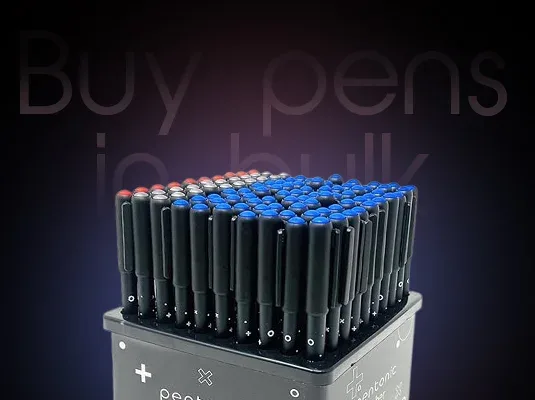
Anyone who has managed an office knows the routine. Pens disappear during the week, some stop writing halfway through a signature, and someone is always looking for a working one. Stocking up feels like the obvious cure, and often it is. But cheaper stock isn’t always smarter stock. When you buy pens in bulk, a poor decision repeats itself across every desk. Here’s how to keep both the budget and the writing experience intact, with a little help from Pentonic.
Why Businesses Buy Pens in Bulk and Where the Savings Go Wrong?
Pens are often overlooked. Nobody plans around them, yet everybody notices the moment they fail. Banks, schools, hotels, clinics, and corporate offices use pens every day, so there are plenty of reasons to buy pens in bulk. Unit costs fall, deliveries become less frequent, and the stationery cupboard stays full.
But there is something to consider. A big order magnifies every flaw. Ink that smudges, barrels that crack, and tips that scratch turn into daily complaints once the cartons land. Many teams approach a bulk pen purchase by comparing prices alone, only to discover the difference in writing quality after the order arrives. By then, sending stock back is a headache nobody wants.
What to Check Before You Buy Pens in Bulk?
Samples tell you much more than a product description. Ask for a handful and put them through real use, rather than just trying a quick scribble on the back of an envelope. Try them on photocopier paper, glossy forms, carbon sets, and whatever else your staff actually writes on. A Pentonic pen should offer consistent writing from start to finish, and that is exactly what you want to check in every sample. Also ask the supplier how each batch is tested, because uniformity matters more than a single perfect prototype.
Here’s what to look for in every sample:
- Ink flow: Does it start instantly, or does it need a warm-up circle?
- Smudge behaviour: Write a line, wait a few seconds, then swipe a finger across it.
- Grip comfort: Hold it through a full page of notes, not just a signature.
- Tip durability: Press slightly harder than usual and see whether the tip survives.
- Click or cap reliability: Cheap mechanisms are usually the first part to fail.
Every point above matters when you buy pens in bulk, because even a small quality issue can affect everyone using those pens.
Choosing a Reliable Manufacturer and Exporter
Not every supplier is built the same way. Some are traders who pass boxes along. Others actually make what they sell. A direct pen manufacturer can explain the materials used, discuss customisation, and help trace quality issues back to the production process. Traders don’t always have that kind of info.
Shipping capability counts too, especially for companies spread across cities or countries. An experienced supplier working as a pen exporter understands packaging standards, paperwork, and delivery timelines. That experience helps businesses avoid problems such as damaged cartons, mismatched batches, and delayed deliveries.
Ask about repeat orders as well. Pens delivered in different batches should offer the same writing experience, and that comes from a consistent process, not luck. A supplier who is relaxed about answering these questions usually has nothing to hide.
Smart Ways to Plan a Bulk Pen Purchase
Once a supplier is shortlisted, planning matters as much as the pens themselves. Teams that regularly buy pens in bulk often follow a simple routine that other businesses can use too:
- Start with a trial order. A smaller batch helps identify problems before the full commitment.
- Ask about lead times and how the cartons will be stored. Ink doesn’t love heat or damp.
- Look beyond the quoted rate and ask how the supplier maintains consistent quality across batches. Get the quality promise in writing.
- Plan branding early. If company names will be printed on barrels, check how well the print survives daily handling.
If your order crosses borders, speak to your pen exporter early about customs paperwork and packing, so nothing stalls at the port.
How Pentonic Supports Businesses That Need Consistent Quality?
Writing instruments are what Pentonic does, and that focus shows. The range caters for the writing needs of everyday life in offices, classrooms, and institutions where pens are used regularly. Smooth ink flow, a comfortable grip, and a dependable finish are treated as basics, not bonus features.
For businesses considering a Pentonic pen, direct communication with the pen manufacturer can make discussions about product requirements and bulk orders easier. If a batch needs a tweak, the conversation happens with the people who actually make the product. That matters a great deal for any procurement manager who has ever chased a middleman for answers.
Choosing a Pentonic pen also makes standardisation easier. When every department uses the same dependable writing tool, complaints drop, and reordering becomes routine. Companies that buy pens in bulk from Pentonic can look for the same writing quality and consistency across every carton.
Conclusion
Buying pens in bulk looks like a simple tick on the supplies list, but a bad batch has a way of showing up on every desk at once. So slow down at the start. Test samples the way your team really writes, ask how batches stay consistent, and lean towards suppliers who make what they sell and know how to ship it.
Begin with a trial order, match pens to the people using them, and get quality promises in writing. When you buy pens in bulk with that kind of care, the savings stay real, and nobody grumbles about skipping ink. Pentonic is built for exactly this kind of buyer, with reliable pens and straight answers. Get it right once, and the cupboard mostly looks after itself.