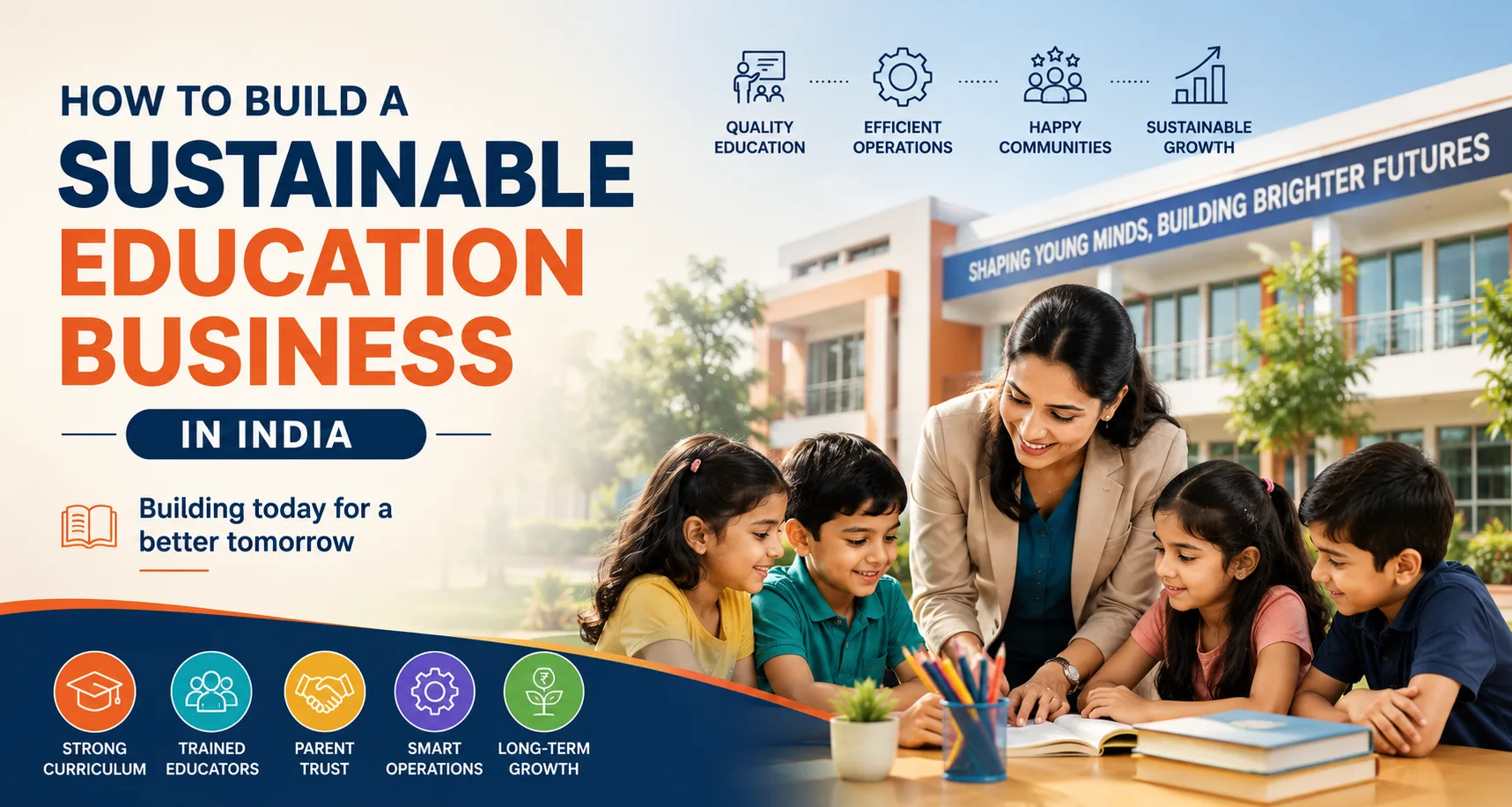
The education sector in India continues to attract entrepreneurs who are looking for business opportunities with long-term potential. Unlike many industries driven by short-term trends, education addresses a fundamental and ongoing need for families. As parents increasingly look for quality learning environments, modern teaching methods, and holistic development, the demand for organised education services continues to create opportunities for entrepreneurs.
However, starting an education business is not simply about opening a school or learning centre. Building a sustainable education business requires careful planning, a strong academic approach, efficient operations, trained educators, parent trust, and a business model that can adapt to changing expectations.
For entrepreneurs considering this sector, understanding what makes an education business sustainable can help them make better investment decisions.
What Makes an Education Business Sustainable?
A sustainable education business needs to balance educational quality with sound business management. Focusing only on enrolment numbers or revenue may not be enough to create long-term success.
Several factors contribute to sustainability, including:
- Consistent demand in the target market
- A strong educational framework
- Experienced and trained teachers
- Efficient operational systems
- Parent and community trust
- Effective marketing
- Financial planning
- Opportunities for future expansion
When these elements work together, an education business can build a strong foundation for long-term growth.
1. Understand the Local Education Market
Before investing in an education business, entrepreneurs should understand the market they intend to serve.
The demand for education can vary significantly between cities, neighbourhoods, and communities. A location with a large population of young families may offer different opportunities from an established urban area with several competing institutions.
Market research should consider:
- Number of families with school-age or preschool-age children
- Existing schools and preschools
- Competitor fee structures
- Local income levels
- Residential development
- Accessibility and transportation
- Parent expectations
- Gaps in existing education services
Understanding the local market can help entrepreneurs identify where genuine demand exists rather than simply following a popular business trend.
2. Choose the Right Education Business Model
Education businesses can operate across several segments. Entrepreneurs may consider preschools, K-12 schools, daycare centres, skill development institutes, activity centres, or other learning-focused businesses.
Each model has different requirements for investment, infrastructure, staffing, curriculum, regulations, and operations.
A preschool, for example, may have different infrastructure and staffing requirements compared with a full-scale K-12 school.
Therefore, entrepreneurs should first determine:
- Which age group they want to serve
- How much they are prepared to invest
- What type of property they can access
- How involved they want to be in daily operations
- What kind of educational experience they want to provide
- Whether they want to operate one centre or eventually expand
Choosing a model that matches available resources and long-term objectives is an important first step towards sustainability.
3. Develop a Strong Educational Framework
The quality of education is at the heart of every successful education business.
Parents are increasingly evaluating institutions based on more than academic results. They may also consider communication skills, creativity, social development, problem-solving, technology exposure, extracurricular opportunities, and overall student well-being.
An effective educational framework should therefore provide a balanced learning experience.
For an education business, this means paying attention to:
- Curriculum design
- Teaching methodology
- Learning resources
- Classroom experience
- Student engagement
- Assessment methods
- Teacher development
- Holistic development
A strong academic foundation can help an institution build credibility and encourage parents to recommend it to other families.
4. Build Trust With Parents and the Community
Education is a trust-driven business.
Parents are not simply purchasing a service. They are choosing an environment in which their children will spend a significant part of their formative years.
This makes reputation especially important.
An education institution can build trust by maintaining:
- Transparent communication
- Consistent teaching quality
- Safe learning environments
- Qualified educators
- Regular parent engagement
- Meaningful learning outcomes
- Responsive administration
Parent referrals can also become an important source of enrolments over time. When families are satisfied with their children's experience, positive word-of-mouth can strengthen the institution's reputation within the local community.
5. Invest in Teachers and Staff
Even the strongest curriculum cannot succeed without effective teachers.
Educators are responsible for translating the curriculum into everyday classroom experiences. Their ability to communicate, engage students, manage classrooms, and understand individual learning needs can have a direct impact on student experience.
A sustainable education business should therefore prioritise:
- Recruitment of suitable teachers
- Initial training
- Ongoing professional development
- Academic mentoring
- Classroom support
- Leadership development
Continuous teacher development can also help institutions maintain consistency as they grow.
6. Use Systems to Improve Operational Efficiency
Running an education institution involves many operational responsibilities beyond teaching.
Admissions, attendance, fee collection, staff management, parent communication, marketing, procurement, infrastructure maintenance, and compliance all require structured processes.
Without effective systems, operational complexity can increase as the institution grows.
Entrepreneurs should consider implementing processes for:
- Admissions
- Student records
- Fee management
- Staff scheduling
- Parent communication
- Marketing
- Inventory
- Academic planning
- Performance monitoring
Well-defined systems can make daily operations more manageable and provide a stronger foundation for expansion.
7. Consider an Education Franchise Model
Building an education brand independently can require considerable time and resources. Entrepreneurs need to develop their own curriculum, branding, operational processes, teacher training systems, marketing strategy, and parent communication framework.
An education franchise can provide an alternative approach.
Franchise partners can benefit from an established brand, structured academic systems, training, operational guidance, marketing support, and other resources provided by the franchisor.
For entrepreneurs comparing different models, it is also useful to understand the potential passive income opportunities with education franchises and how franchise structures can support recurring revenue while providing an established operational framework.
However, education franchises should not be viewed as completely hands-off businesses. Successful institutions still require effective management, staff supervision, parent engagement, and attention to educational quality.
8. Create Multiple Revenue Opportunities
A sustainable education business does not necessarily need to depend on a single source of revenue.
Depending on the business model, additional programmes may create opportunities to serve families beyond the core academic programme.
Potential offerings can include:
- Extended daycare
- Toddler programmes
- Summer camps
- Holiday programmes
- Activity classes
- Skill development programmes
- Enrichment activities
- Workshops
These programmes can help institutions serve different needs within the same parent community while making better use of existing infrastructure and resources.
However, additional programmes should always complement the institution's educational philosophy rather than being introduced purely for revenue generation.
9. Focus on Long-Term Brand Building
An education institution may take time to establish a strong reputation.
Instead of focusing entirely on short-term admissions, entrepreneurs should think about how they want their institution to be perceived five or ten years from now.
Long-term brand building can involve:
- Consistent educational quality
- Strong parent relationships
- Community engagement
- Digital presence
- Local marketing
- Student achievements
- Positive reviews
- Alumni relationships
A trusted local reputation can become one of an education business's most valuable assets.
10. Plan for Future Expansion
Once an education institution establishes a strong foundation, entrepreneurs may consider expanding into additional locations or education segments.
However, expansion should happen only when the existing operation has reliable systems and adequate management capacity.
Before expanding, evaluate:
- Current enrolment levels
- Financial performance
- Staff capabilities
- Operational processes
- Brand recognition
- Local market demand
- Management bandwidth
An institution that successfully establishes repeatable processes at one location has a stronger foundation for scaling to additional locations.
Preschool as an Entry Point Into the Education Sector
For entrepreneurs who want to enter the education industry at a smaller scale, preschool can be an option worth evaluating.
Preschool businesses typically focus on foundational learning and early childhood development, creating an opportunity to build strong relationships with families from the beginning of a child's educational journey.
However, choosing the right preschool model still requires careful consideration of location, curriculum, infrastructure, teacher training, brand reputation, marketing, and operational support.
Entrepreneurs exploring this segment can evaluate the available preschool franchise in India options to understand how an established franchise model can support the process of setting up and operating an early learning centre.
Education Business vs Other Investment Opportunities
One of the biggest advantages of an education business is its potential to combine commercial objectives with a meaningful social purpose.
Entrepreneurs are not simply building a revenue-generating operation. They are creating an institution that can influence children's learning, development, confidence, and future opportunities.
At the same time, education requires patience.
Building parent trust, establishing a reputation, improving enrolments, and creating sustainable operations generally takes time. Entrepreneurs should therefore approach education as a long-term business rather than expecting immediate returns.
Key Questions to Ask Before Starting an Education Business
Before making an investment, prospective entrepreneurs should ask themselves:
Is there sufficient demand in my target location?
Study the local population, competition, demographics, and existing education options.
Does the business model match my investment capacity?
Consider not only the initial investment but also working capital and ongoing operating expenses.
Do I have the right educational support?
If you are not an education professional, determine whether the model provides sufficient academic guidance and teacher training.
Can I manage the operation effectively?
Education businesses require active management, particularly during the initial stages.
Does the model have room for future growth?
Consider whether the business can expand through additional programmes, larger facilities, or new locations.
Conclusion
Building a sustainable education business requires much more than selecting a profitable opportunity. Entrepreneurs need to combine strong educational practices with effective business management, reliable systems, trained educators, parent trust, and a clear understanding of the local market.
An education franchise can provide a structured route for entrepreneurs who want the support of an established educational system, while an independent model may offer greater flexibility but require more groundwork.
Whichever approach an entrepreneur chooses, the focus should remain on creating long-term value for students, parents, educators, and the wider community.
With the right planning, strong operational foundations, and a commitment to educational quality, an education business can develop from a single institution into a sustainable and scalable education venture.