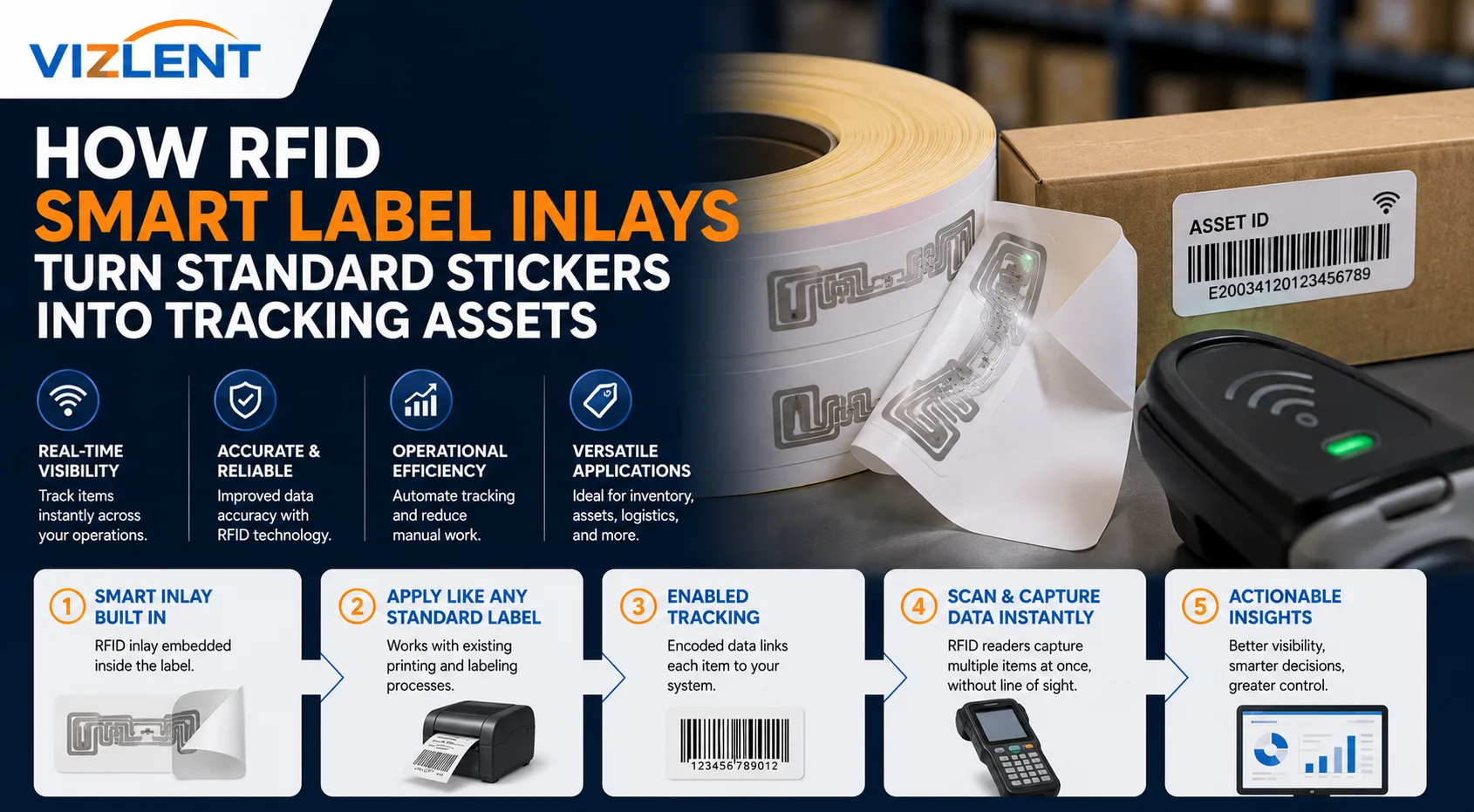
RFID smart label inlays turn standard stickers into tracking assets by placing a chip and a printed antenna between the facestock and the adhesive, so an ordinary label also carries a serial number that readers capture without line of sight. It still looks and applies like a sticker. The difference is that it answers back when a reader asks who it is.
That one change reorganises how stock gets counted and how narrowly a recall can be scoped. A barcode needs a person, a scanner, and a clear view every time. Radio removes all three requirements, which is why the technology has left the pilot stage.
What Actually Sits Inside an RFID Inlay
An inlay has three parts: an integrated circuit, a conductive antenna, and a carrier film holding both in position. The carrier is usually PET between 23 and 50 microns, chosen for dimensional stability through printing and die cutting. Antenna geometry influences read performance more than the chip does.
Almost every inlay used in labelling is passive, carrying no battery. It harvests power from the reader field, backscatters its identifier, then goes dormant. A tag applied in March still answers a reader in November with no maintenance.
- Dry inlay: Chip and antenna on carrier film, laminated into the label during converting.
- Wet inlay: The same build with adhesive applied, ready to insert into label stock.
- Finished smart label: Thermal transfer printable and encodable in one pass.
Why Radio Identification Beats a Printed Barcode
A barcode demands an operator, a scanner, and a clear sightline on every read. RFID smart labels need none of those, because radio passes through corrugate, fabric, and film. One worker with a handheld captures several hundred identifiers in seconds.
Serialisation is the second difference, and it matters more than buyers expect. A retail barcode encodes a GTIN, identifying the product but not the unit. An Electronic Product Code on a Gen2 chip identifies that one item, which is what makes item level counting and targeted recalls possible.
Run one aisle both ways and compare the labour minutes before building a business case.
UHF or HF: Choosing the Right RFID Smart Tag
Frequency drives read range, material sensitivity, and reader cost together. UHF, standardised as ISO/IEC 18000-63 and marketed as RAIN RFID, runs at 860 to 960 MHz and reads at metres. HF runs at 13.56 MHz under ISO/IEC 15693 or 14443, reads close range, and includes NFC, both covered in the GS1 RFID standards library.
An RFID smart tag for pallet and carton visibility is almost always UHF. A tag for authentication or consumer interaction is usually HF or NFC. Permitted UHF sub bands differ by region, roughly 902 to 928 MHz in North America against 865 to 868 MHz in Europe, so global programmes need broadband tuned inlays.
- On metal: Needs a spacer layer inlay, since metal detunes a standard antenna.
- Near liquid: Water absorbs UHF energy, so placement needs testing, not assumption.
Turning an Inlay Into a Finished Label Construction
A smart label is still a pressure sensitive laminate and obeys every rule governing one. The inlay adds roughly 100 to 200 microns of localised thickness, creating a bump the print head must handle. Facestock, adhesive, and liner release still have to match the application surface, which is why converters start from a proven self adhesive material construction rather than treating the inlay as the only variable.
That extra caliper causes most print and apply trouble. Heads skip the chip bump, peel plates catch the stiffer section, and roll diameter grows faster than on plain stock. Most suppliers run an RFID smart label free sample programme for this reason, so trial a roll on your own equipment first.
Encode a hundred labels on your actual applicator and log every misfeed and failed write.
Raw Read Data Is Noisy, and the RFID Smart Label Filter Handles It
A reader in a working warehouse captures far more than you intended. It picks up the adjacent pallet, a forklift passing the door, and the same tag forty times a second. Making that usable requires filtering at three levels.
The first level is written into the standard. The GS1 EPC Tag Data Standard defines a filter value in the Gen2 memory map, letting a dock door hunting pallets ignore item tags outright. Above that, an RFID smart label filter in reader firmware deduplicates repeat reads and applies a signal strength threshold. Middleware then time windows what remains into business events.
- Tag level: the EPC filter value separates item, case, and pallet.
- Reader level: RSSI thresholds and minimum read counts cut stray captures.
- Middleware level: Deduplication turns raw reads into events worth recording.
Logistics and E-Commerce Carry the Volume
Fulfilment operations adopted early, and the reason is arithmetic. A worker scanning barcodes handles one carton per trigger, while a portal reader captures a whole pallet in motion. This is where RFID smart label inlays turn standard stickers into tracking assets at a scale visible on a labour budget.
A chip does not excuse the label from ordinary durability requirements. Adhesive still has to hold on recycled corrugate and low surface energy polybags, and the printed barcode still has to meet carrier scan grade. Specifiers begin from the criteria they would apply to any logistics and e-commerce label material, then layer the inlay requirement on top.
- Dock door portals verifying shipments against the advance ship notice.
- Returnable totes tracked across sites without manual scanning.
- Pallet aggregation, linking case identifiers to an SSCC in one pass.
RFID Smart Label Food Traceability and the FSMA 204 Deadline
Food is the fastest moving regulatory driver at present. Section 204 of the Food Safety Modernization Act requires key data elements at critical tracking events for anything on the FDA Food Traceability List, produced within 24 hours of a request. The original compliance date of January 20, 2026 moved back 30 months to July 20, 2028 through a proposed rule in the Federal Register published in August 2025.
The rule mandates no particular technology, and that deserves saying plainly. What it mandates is a 24 hour electronic response across trading partners, which paper records struggle to deliver. RFID smart label food programmes are one credible route, especially for case level lot codes in produce and seafood, though disciplined 2D barcodes meet the same obligation for less.
Healthcare, Sterilisation, and the Honest Limits
Hospitals tag instrument trays, consignment implants, and specimens, where finding one item fast carries clinical value. The constraints are tighter than retail imposes. A steam autoclave cycle at 121 to 134 degrees Celsius will destroy an inlay never built to survive it.
Gamma irradiation and ethylene oxide impose different stresses, and validation against one says nothing about another. Chip, antenna bonding, facestock, and adhesive must survive the cycle together, which is why teams specify validated pharmaceutical and healthcare label stock rather than adapting a retail construction. Ask for cycle specific test data, not a generic temperature rating.
- Metal and liquid degrade UHF reads unless the inlay was designed for them.
- Cost per label sits an order of magnitude above plain thermal stock.
- Readers, encoders, and middleware often outspend the labels in year one.
Pilot one zone, measure read rate against a manual count, and expand once the gap closes.
Frequently Asked Questions
What is an RFID inlay?
An RFID inlay is the chip and antenna assembly on a carrier film, laminated inside a pressure sensitive label. It supplies electronic identity while the label supplies adhesion, printability, and protection. Inlays ship dry, without adhesive, or wet, with adhesive already applied.
Are RFID smart labels the same thing as NFC tags?
NFC is a subset of HF RFID at 13.56 MHz, so every NFC tag is an RFID tag but not the reverse. NFC reads at a few centimetres using ordinary smartphones, while UHF reads at metres and needs dedicated hardware. Supply chain programmes choose UHF; consumer authentication tends to choose NFC.
Can a normal thermal transfer printer print an RFID smart label?
Only an RFID enabled printer can encode the chip, though many standard printers will feed the stock. RFID capable printers carry an encoder that writes the EPC and verifies it in the same pass as the image. Running smart labels through a non RFID printer gives you a printed label with a blank chip.
Do RFID smart labels work on metal and liquids?
Standard UHF inlays perform poorly on both, since metal detunes the antenna and water absorbs UHF energy. On metal inlays add a spacer layer that lifts the antenna off the conductive surface. For liquid filled containers the usual fix is placement, moving the tag to the neck or shoulder.
What does a search for "rfid smart label free" usually mean?
It generally points to free sample rolls from material suppliers, or free label design and encoding software from printer manufacturers. Sample programmes are common, normally covering a trial roll with the buyer paying courier freight. Free software is typically an entry tier edition, enough for evaluation but rarely production.
Is RFID required for FSMA 204 food traceability compliance?
No. The Food Traceability Rule specifies which records must be kept and how fast they must be produced, not which technology captures them. GS1 compliant 2D barcodes with connected recordkeeping satisfy the same requirements and usually cost less to deploy.
How much does an RFID smart label cost compared with a plain label?
Passive UHF inlays are commonly quoted at a few US cents each in high volume, with finished labels costing more once facestock, adhesive, and printing are added. That still sits an order of magnitude above plain thermal stock. Pricing moves with chip supply and quantity, so quote against your own specification.
How long do passive RFID smart labels last?
Passive tags hold no battery, so service life depends on construction rather than power. Chip manufacturers commonly specify data retention measured in decades under normal storage. In practice the label fails first, through adhesive failure, abrasion, or antenna damage.
Where to Start
Radio identification is less a labelling upgrade than a data programme that arrives on a sticker. Teams getting real value started narrow, measured read rates honestly against manual counts, and widened once the numbers held. The ones that struggled bought hardware first and looked for the use case afterwards.
Pick one process where not knowing an item location costs money today. Tag it, measure for a quarter, and let the result decide the next step.