How a Precision Air Conditioner is Built From the Ground Up
When we step into a modern data center or a high-tech medical laboratory, we are instantly greeted by a steady, humming wall of perfectly conditioned air. To the untrained eye, the towering metal cabinets lining the server rows look just like oversized office air conditioners.
But behind those panels lies an entirely different breed of thermal engineering: the Precision Air Conditioner (PAC).
Unlike standard comfort cooling systems that balance temperature for humans, a PAC is built for machines. It must run 24/7/365, manage massive loads of dry, sensible heat, and maintain room temperatures down to fractional decimal points while perfectly regulating humidity.
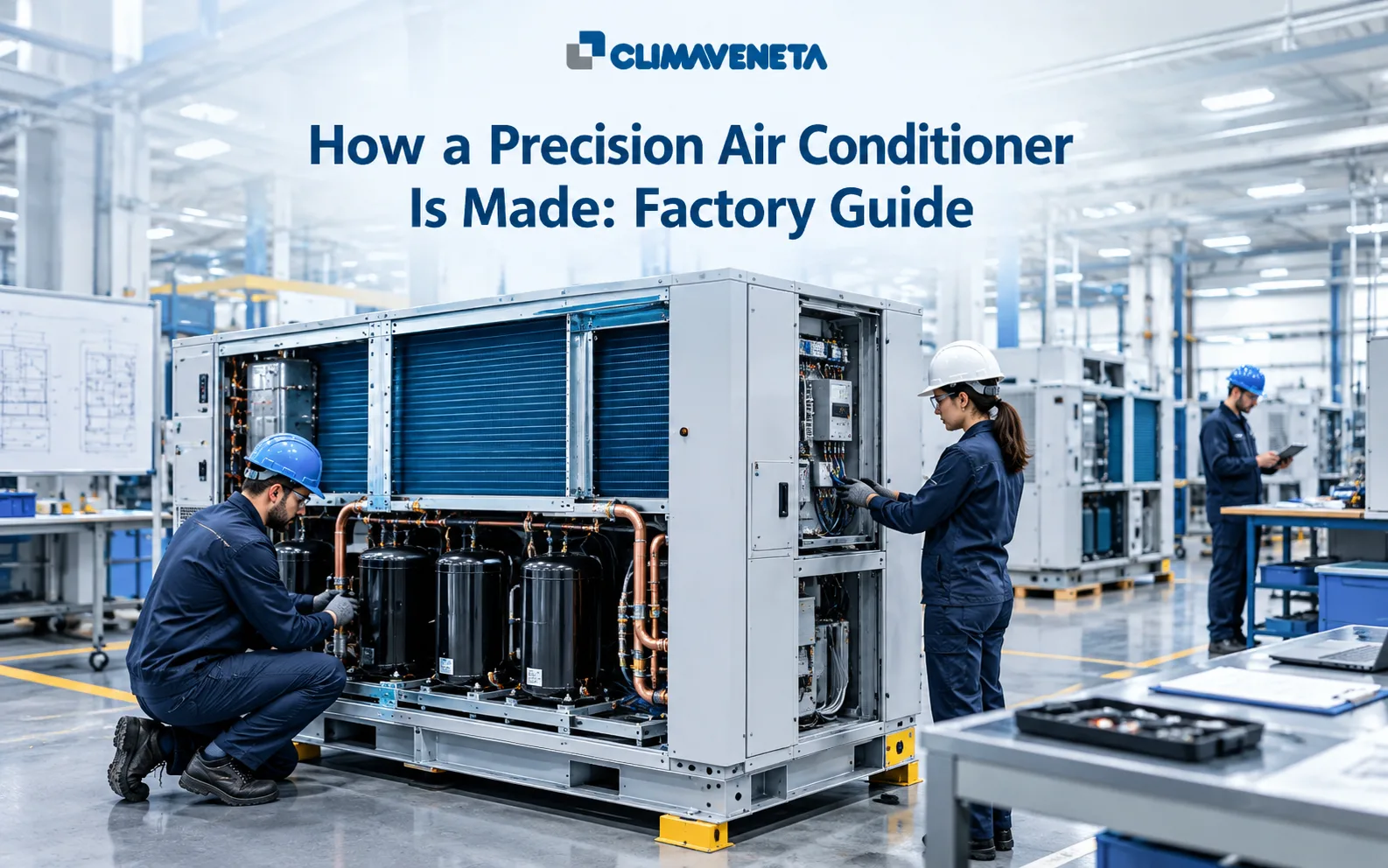
Have you ever wondered how these ultra-reliable climate guardians are actually put together? Let’s pull back the factory curtain and explore the step-by-step manufacturing journey of a modern precision cooling unit, and discover why the world's leading chillers manufacturer brands are uniquely positioned to build them.
Step 1: Laser-Cut Chassis Fabrication
The journey begins on the heavy-duty manufacturing floor with raw sheets of high-grade galvanized steel. Because a PAC moves massive volumes of air at high pressure, the cabinet cannot flex or rattle.
- CNC Laser Precision: Advanced computer-controlled lasers slice the steel sheets with micrometre accuracy.
- Acoustic & Thermal Armoring: Once bent into shape by heavy press brakes, the interior panels are lined with high-density, fire-resistant acoustic insulation. This ensures that the unit keeps heat out and traps mechanical noise inside.
Step 2: The Heart of the System: Coil Manufacturing
At the center of any air conditioner is the heat exchanger loop. A PAC requires highly optimized coils to absorb server heat instantly.
- Copper and Aluminum Fusion: Workers feed long copper tubes through dense stacks of corrugated aluminum fins.
- Mechanical Expansion: The copper tubes are hydraulically expanded from the inside, forcing them into flawless, tight physical contact with the aluminum fins. This ensures maximum heat transfer efficiency.
- Pressure Testing: Before assembly, the coils are submerged in water and pressurized with nitrogen gas up to 45 bar to guarantee they are 100% leak-proof.
Step 3: Integrating the Heavy Industrial Machinery
Next comes the assembly of the mechanical heavy hitters. This is where the technical overlap between a close-control unit and a centralized plant becomes obvious.
Workers carefully mount highly efficient EC (Electronically Commutated) fans, which pull air smoothly through the raised floor. They drop in robust scroll compressors or electronic expansion valves (EEVs) that adjust instantly to shifting server loads. Crucially, they also install dedicated electrode steam humidifiers and electric reheat elements—components you will never find in a standard household AC, but are mandatory here to prevent static electricity from damaging microchips.
Step 4: The Brains – Electrical and Control Wiring
A precision unit is nothing without its intelligence. Electrical technicians route miles of color-coded wiring to connect internal sensors to a centralized microprocessor controller. These sensors read return air temperature, supply air humidity, refrigerant pressures, and airflow velocity in real time. The factory programs the brain to talk to overarching building management systems (BMS) seamlessly.
Step 5: Stringent Quality Control and Factory Run Tests
No PAC leaves the factory without proving it can survive the grueling demands of a data center. Every unit undergoes rigorous automated testing, including:
- Electrical insulation and ground-fault safety tests.
- Deep vacuum pulling to remove trace moisture from the copper lines.
- Live operational run tests to verify that the software controls, fans, and valves respond exactly as intended under load.
Why the Best PACs Come from a Chillers Manufacturer
You might notice that the global leaders in making precision air conditioners are also renowned as Chillers manufacturer giants. Brands like Climaveneta excel at both for a simple reason: they understand the entire thermal loop.
A precision air conditioner inside a server room often relies on a continuous loop of ice-cold fluid supplied by an outdoor centralized Industrial Chiller. By manufacturing both the chilled water source (the chiller) and the indoor delivery system (the PAC), a unified manufacturer ensures that the hardware components, communication protocols, and energy-saving algorithms are perfectly synced. When the indoor PAC senses a drop in server activity, it communicates instantly with the outdoor chiller to scale down compressor speeds—saving facilities massive amounts of electricity.
As a world-renowned Chillers manufacturer and pioneer in specialized IT cooling, Climaveneta India seamlessly bridges this gap. By manufacturing both advanced Precision Air Conditioner units and high-efficiency industrial chillers, Climaveneta delivers a completely integrated, factory-synchronized cooling ecosystem that maximizes uptime, slashes PUE, and ensures flawless climate stability for India's most critical data centers and industrial infrastructures.