
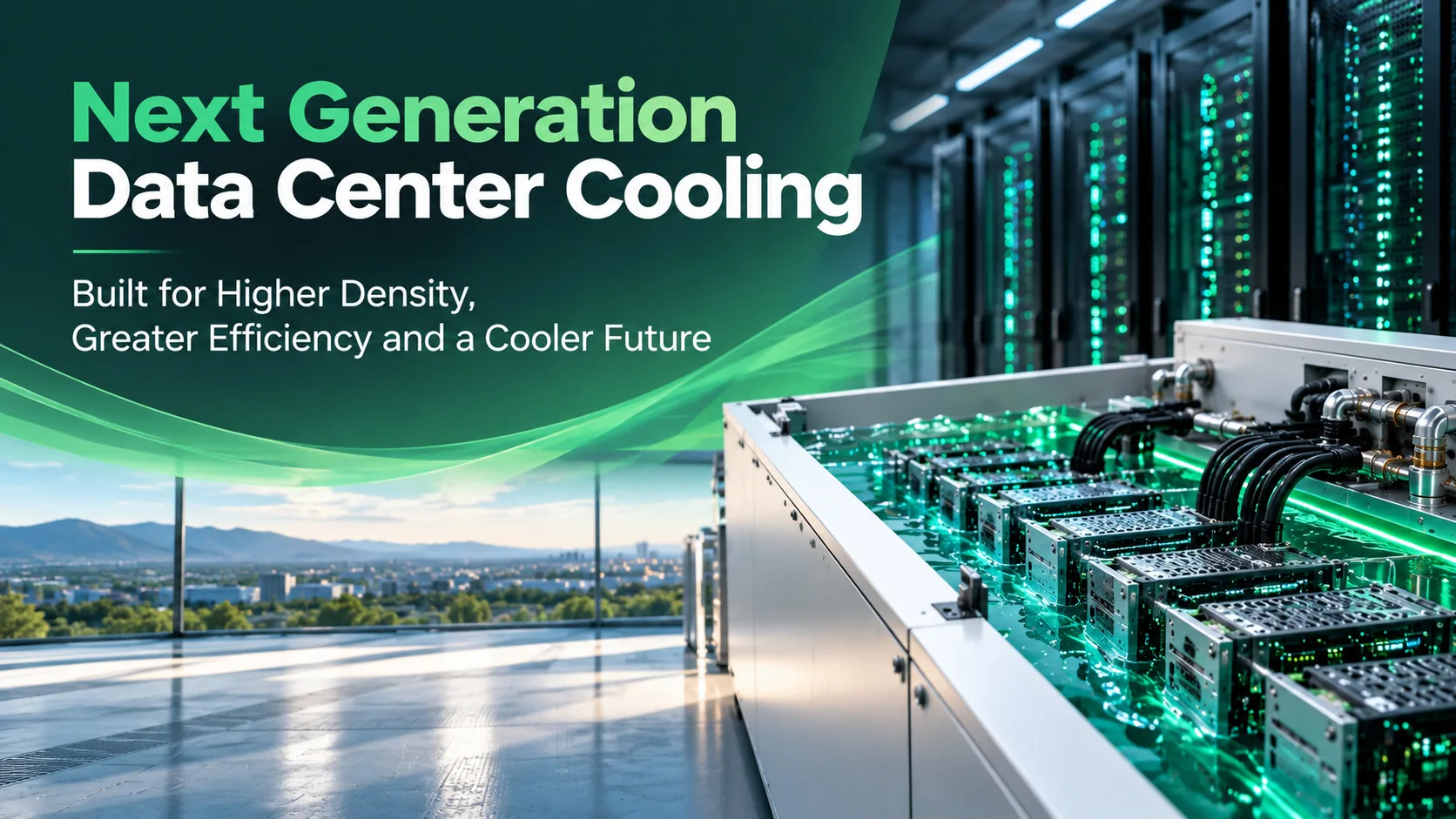
Traditional air-cooling systems have supported data centers for decades. However, as server power densities increase, maintaining optimal operating temperatures becomes more challenging.
Several factors are driving the need for next-generation cooling solutions:
- Increasing power density: AI servers and high-performance computing systems generate substantial heat in compact spaces.
- Growing energy requirements: Conventional cooling infrastructure can consume significant amounts of electricity.
- Space constraints: Higher computing density requires cooling systems that can accommodate more computing power within limited space.
- Scalability challenges: Data centers need flexible infrastructure that can adapt to changing workloads and future expansion.
These challenges are encouraging data center operators to explore immersion cooling as an alternative to conventional air-based cooling.
GRC's Approach to Next Generation Data Center Cooling
GRC uses immersion cooling technology to address the thermal challenges of modern computing. Instead of relying primarily on air to remove heat from IT equipment, immersion cooling involves submerging compatible IT hardware in a dielectric fluid that transfers heat away from the components.
This approach can reduce dependence on conventional air-cooling infrastructure and support high-density computing environments.
GRC's product portfolio reflects this shift toward more flexible cooling architectures, with solutions designed for different computing requirements, deployment sizes, and infrastructure needs.
1. ICEraQ: Modular Immersion Cooling for AI, HPC, and Edge Computing
The ICEraQ product line is designed for organizations looking to adopt immersion cooling across a variety of computing environments. Its rack-based, micro-modular architecture offers flexibility for deployments ranging from edge computing to demanding AI and HPC workloads.
The ICEraQ family includes four configurations:
- ICEraQ NANO: An option within the ICEraQ portfolio for compact and specialized deployment requirements.
- ICEraQ MICRO: A configuration within the modular immersion cooling range.
- ICEraQ FLEX: A flexible option within the ICEraQ family for different infrastructure requirements.
- ICEraQ SX: Another configuration designed to address specific deployment and cooling needs.
Together, these options give organizations a range of configurations to consider when planning immersion-cooled infrastructure.
Supporting Different Computing Densities
One of the important features of the ICEraQ portfolio is its ability to accommodate a wide range of cooling requirements. Depending on the configuration, ICEraQ solutions can support equipment densities from 13 kW with 32°C (89.6°F) water to 368 kW with 13°C (55.4°F) water.
This range makes the portfolio relevant to data centers with different performance and thermal requirements.
By bringing cooling closer to the source of heat, ICEraQ can help organizations pursue higher computing density, reduced cooling energy consumption, and more efficient use of available space.
2. ICEtank: Immersion Cooling for Data Center Infrastructure
GRC's ICEtank product family provides another approach to immersion cooling for organizations evaluating alternatives to conventional data center cooling architectures.
Like other immersion cooling systems, ICEtank solutions use dielectric fluid to transfer heat away from compatible IT equipment. This approach can reduce reliance on traditional air-based cooling and help operators address the thermal demands of modern computing workloads.
ICEtank is relevant for data center operators exploring how immersion cooling can fit into their infrastructure strategy, whether they are evaluating new deployments or considering changes to existing cooling approaches.
By incorporating immersion cooling into their infrastructure planning, organizations can assess opportunities to improve thermal management, manage cooling overhead, and accommodate changing computing requirements.
How GRC's Cooling Equipment Supports Modern Data Centers
GRC's ICEraQ and ICEtank product families address different aspects of the transition toward immersion-cooled infrastructure.
Here are some of the key considerations for data center operators.
Improved Cooling Efficiency
Immersion cooling transfers heat directly from compatible IT components into a dielectric fluid. Depending on system design and operating conditions, this can reduce the energy required for cooling compared with conventional air-based approaches.
Support for High-Density Computing
As AI and HPC workloads increase server power consumption, cooling systems must handle greater thermal loads. Immersion cooling offers an approach for managing heat in high-density computing environments.
Flexible Infrastructure Planning
Different data centers have different space, capacity, and workload requirements. GRC's product families provide multiple configurations for organizations evaluating immersion cooling across different deployment scenarios.
Potential for Lower Operating Costs
Reducing cooling energy consumption and simplifying certain aspects of cooling infrastructure may help lower operating costs. Actual savings depend on the existing system, facility design, energy prices, and operating conditions.
The Future of Data Center Cooling Is Already Taking Shape
As computing workloads become more demanding, cooling infrastructure must evolve alongside them. AI, HPC, and edge computing are increasing the need for solutions that can manage heat while supporting performance, scalability, and operational efficiency.
GRC is already moving in this direction with its immersion cooling portfolio. Through ICEraQ's modular configurations and ICEtank's immersion cooling approach, the company provides options for organizations exploring alternatives to traditional air-cooling systems.
Next Generation Data Center Cooling is no longer simply a future concept. For organizations planning their next infrastructure investment, immersion cooling is an option worth evaluating today.
As data center requirements continue to change, GRC's ICEraQ and ICEtank product families offer a starting point for understanding how immersion cooling can support the next generation of computing.
Explore GRC's immersion cooling solutions at www.grcooling.com.