A camera is easy to buy and hard to place in a South Yarra apartment or terrace. You can install CCTV on anything you own, but shared walls, balconies and common areas need approval from the owners corporation or your neighbour. Apartment owners, terrace owners and landlords should check who owns each surface before choosing a camera.
Homes sit close together here, so a camera can easily see a neighbour’s window or fix to a wall someone else owns. That leads to privacy complaints and removal orders. Victorian law also limits recording private activity and private conversations without consent, so aim and audio settings matter as much as the hardware. Check ownership first, then aim, then hardware.
This guide covers who owns each surface, where cameras can face and which hardware suits tight spaces.
Key Takeaways
- A camera inside your own lot or on your own terrace wall is your decision.
- Common property, such as external walls, corridors and railings, needs owners corporation approval.
- A party wall is shared by two homes, so avoid drilling into it.
- A camera should cover only your own space, with audio switched off.
- Compact, cabled cameras suit tight terraces and apartments best.
Can You Install CCTV in a South Yarra Apartment or Terrace?
Yes, within what you own. A camera inside your apartment, aimed at your own entry, is your decision. On a terrace, the front and rear walls are usually yours as well.
Anything on common property needs approval from the owners corporation, the body that manages the shared parts of a strata building. That includes external walls, corridors and balcony railings. Check your plan of subdivision, because lot boundaries differ from building to building. Most CCTV installation in South Yarra comes down to one question: who owns the surface you want to fix to?
What Do Shared Walls Change?
They limit where you can drill. A party wall is a wall shared by two properties, and it is common in terraces. A bracket fixed into it can affect your neighbour’s side and cause a dispute.
Fix cameras to walls that belong only to you, such as the front or rear facade. In apartments, walls between lots are usually common property, so keep cameras inside your own entry area. Run cables only where you have approval, because even a small hole can count as altering common property.
Can You Mount a Camera on a Balcony?
Sometimes. If the balcony or railing is common property, you need approval first. A camera inside your glass doors, aimed at your own entry, avoids the question.
Do not aim at neighbouring balconies or windows. A camera that watches someone else’s private space can breach Victorian law, even when you only mean to protect your own door. Infrared night lights also reflect off glass, which turns a balcony scene into a white blur, so mount cameras outside the glass or angle them away from it.
What Rules Apply to Terraces With Heritage Overlays?
Many South Yarra terraces sit under a heritage overlay, a council rule that protects older buildings. Changes to a front facade, including visible cables and brackets, may need a permit.
Check with the council before you fix anything to the front. Rear walls and side access often have fewer limits, which is why they are the usual spots for cameras on terraces. Planning early saves you from removing a camera after it is installed.
Where Should Cameras Face?
Towards your own space, and nowhere else. A few habits keep you on the right side of privacy rules:
- Cover your own entry door, courtyard and rear access
- Avoid neighbours’ windows, balconies and gardens
- Use privacy masking, a setting that blacks out parts of the image, to block areas you do not own
- Tell visitors and tenants where cameras are
- Keep footage secure and delete it when you no longer need it
Landlords should tell tenants in writing where cameras sit, and never place one inside a rental home’s private rooms.
Do CCTV Cameras Record Sound?
Many do, and audio is often on by default. Recording a private conversation you are not part of can breach Victorian law, even on your own property. Switch audio off unless you have taken legal advice.
Video of your own entry is a very different matter from sound. Most home setups work well without audio, and turning it off removes a common source of complaints.
Which Cameras Suit Tight Spaces?
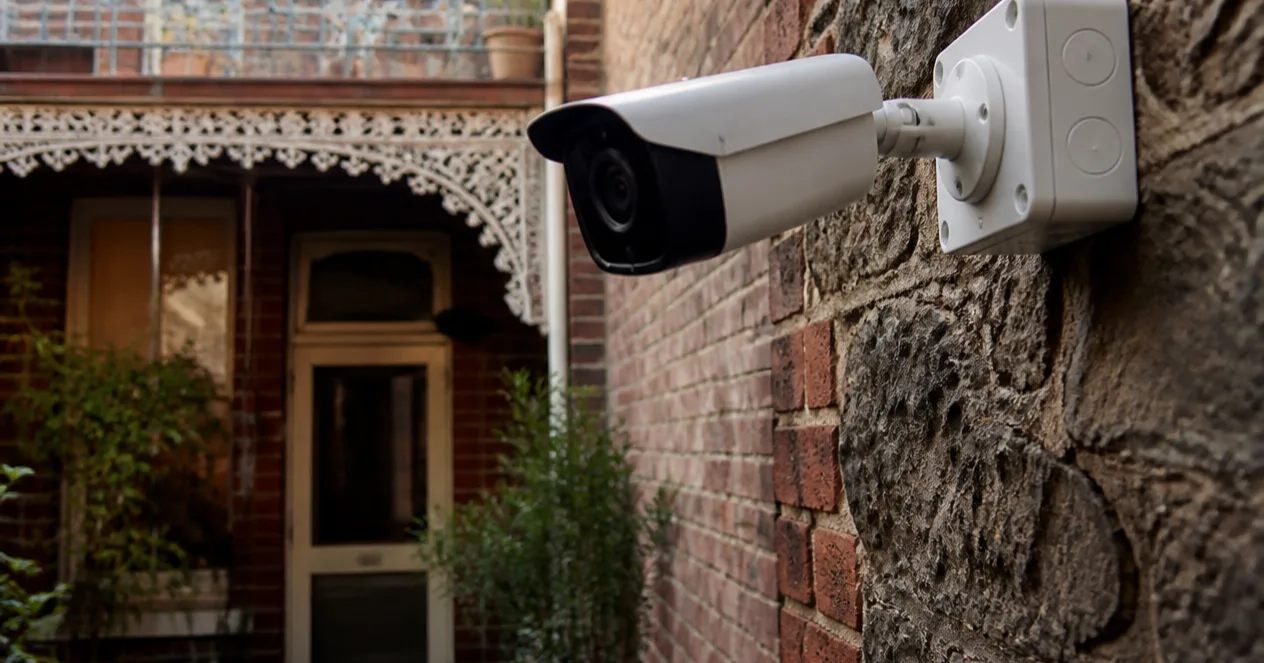
Compact ones with a wide view. Home security camera installation across Melbourne’s inner suburbs often means narrow courtyards and short walls, so a small camera with a wide lens covers more ground. Match the hardware to the space:
- Compact bullet or turret cameras for small courtyards
- Wide-angle lenses for narrow side passages
- Power over Ethernet (PoE), which sends power and video down one cable, for reliable footage
- Battery cameras only where no cable can run
Thick brick walls weaken Wi-Fi, so cabled cameras usually record more reliably than wireless ones in older terraces. Wi-Fi cameras can drop out at the exact moment you need footage.
Which CCTV Setup Suits Your Apartment or Terrace?
For an apartment, choose cameras inside your own entry and ask the owners corporation before touching anything shared. For a terrace, fix compact PoE cameras to your own front and rear walls, check for a heritage overlay and avoid the party wall. In both cases, aim only at your own space and switch audio off.