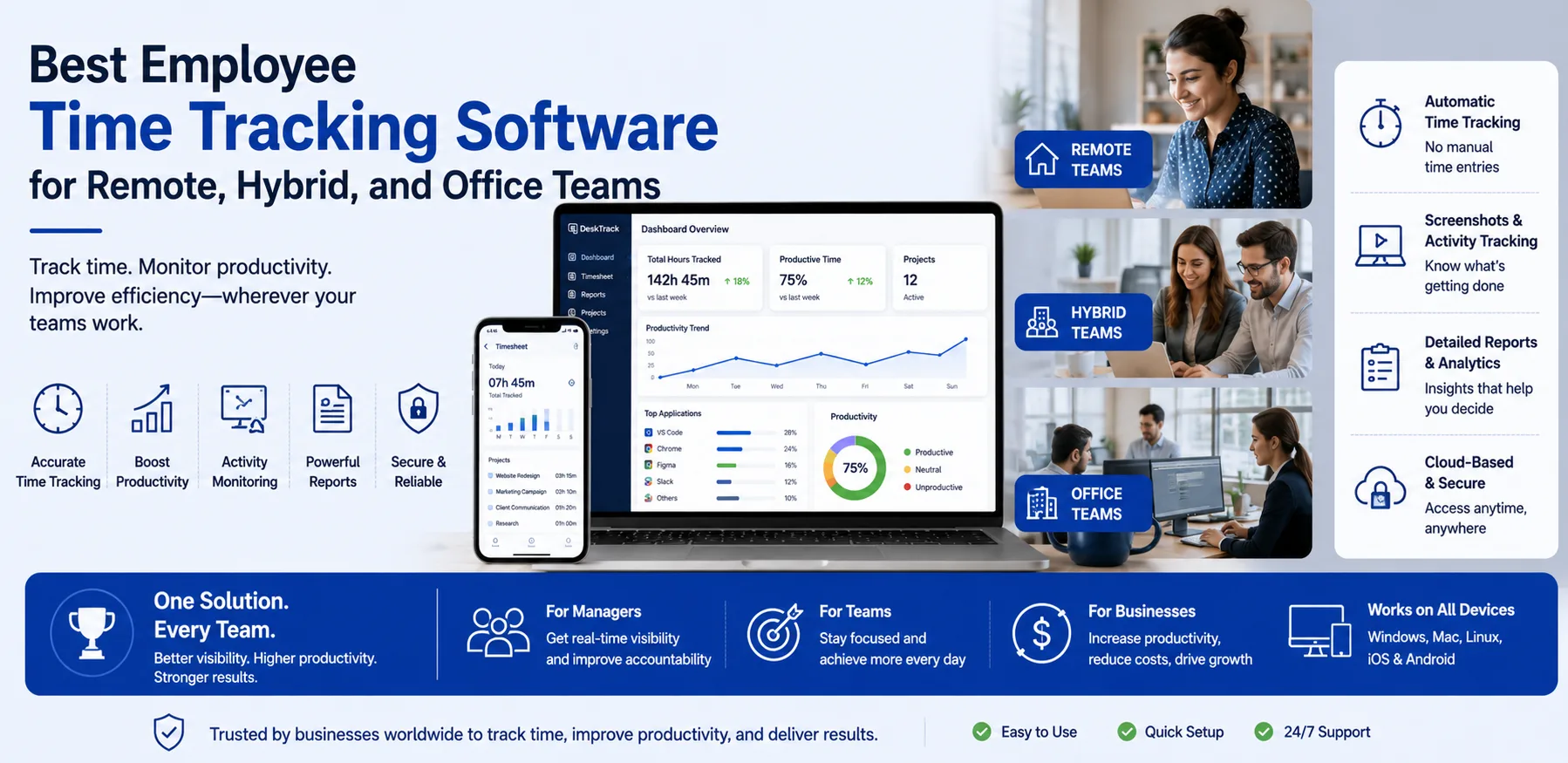
Managing employees across different work environments has become more challenging than ever. Whether your workforce operates remotely, follows a hybrid schedule, or works from a traditional office, maintaining productivity, tracking work hours, and ensuring accountability require the right technology. This is where employee time tracking software becomes an essential business tool.
Modern businesses need more than a simple attendance system. They require a comprehensive solution that automatically records working hours, monitors productivity, tracks projects, generates accurate reports, and simplifies payroll processing. The best employee time tracking software enables organizations to manage teams efficiently while providing employees with transparency and flexibility.
In this guide, you'll learn how time tracking software works, its benefits, must-have features, implementation tips, and why solutions like DeskTrack help businesses improve workforce management across remote, hybrid, and office environments.
Table of Contents
- What Is Employee Time Tracking Software?
- Why Modern Businesses Need Time Tracking
- Challenges of Managing Different Work Models
- Key Features to Look For
- Benefits of Employee Time Tracking Software
- Remote vs Hybrid vs Office Teams
- How DeskTrack Helps Businesses
- Best Practices for Successful Implementation
- Common Mistakes to Avoid
- Frequently Asked Questions
- Conclusion
What Is Employee Time Tracking Software?
Employee time tracking software is a digital solution that automatically records employees' working hours, computer activities, project time, application usage, and productivity throughout the workday.
Unlike traditional attendance systems that only record clock-in and clock-out times, modern software provides detailed insights into how employees spend their working hours.
The software helps businesses:
- Track employee working hours automatically
- Monitor attendance
- Manage projects and tasks
- Generate timesheets
- Improve employee productivity
- Simplify payroll calculations
- Increase workplace transparency
Whether employees work from home, visit client locations, or operate from an office, automated time tracking provides managers with real-time visibility into workforce performance.
Why Modern Businesses Need Employee Time Tracking Software
The workplace has evolved significantly over the past few years. Businesses now operate with distributed teams across multiple locations, making manual tracking inefficient and error-prone.
Without a reliable time tracking solution, companies often face:
- Inaccurate attendance records
- Manual timesheet errors
- Payroll disputes
- Reduced productivity
- Missed project deadlines
- Poor workload visibility
- Difficulty managing remote teams
Employee time tracking software addresses these challenges by automating data collection and providing managers with actionable insights.
Challenges of Managing Remote, Hybrid, and Office Teams
Remote Teams
Remote employees often work independently from different locations. Managers may struggle to understand how work hours are utilized, making it difficult to measure productivity fairly.
Common challenges include:
- Lack of visibility
- Communication gaps
- Time zone differences
- Manual reporting
- Missed deadlines
Hybrid Teams
Hybrid teams split their time between home and office, creating inconsistent attendance patterns.
Challenges include:
- Flexible work schedules
- Mixed attendance policies
- Project coordination
- Productivity measurement
- Resource allocation
Office Teams
Even office employees face productivity issues when attendance is tracked manually.
Problems include:
- Time theft
- Buddy punching
- Manual attendance
- Administrative workload
- Inaccurate payroll
Essential Features of Employee Time Tracking Software
Choosing the right software requires evaluating features that improve operational efficiency.
Automatic Time Tracking
Automatic tracking starts recording work as soon as employees begin working, eliminating manual entries.
Benefits include:
- Accurate work hours
- Reduced human error
- Reliable reports
- Better accountability
Activity Monitoring
Activity tracking records application usage, website activity, active time, and idle time.
This helps managers identify:
- Productive applications
- Time-consuming activities
- Workflow bottlenecks
- Employee engagement
Automatic Timesheets
Employees no longer need to manually fill daily or weekly timesheets.
The software automatically generates:
- Daily reports
- Weekly reports
- Monthly reports
- Project-wise reports
Project Time Tracking
Businesses handling multiple projects need visibility into time spent on each task.
Project tracking helps:
- Allocate resources
- Estimate project costs
- Improve billing accuracy
- Meet deadlines
Attendance Management
Attendance tracking includes:
- Login/logout records
- Shift monitoring
- Leave tracking
- Working hours
- Overtime reports
Productivity Reports
Advanced analytics help businesses understand workforce performance using visual dashboards and reports.
Managers can monitor:
- Productive hours
- Idle time
- Active work time
- Team performance
- Department productivity
Benefits of Employee Time Tracking Software
Improves Employee Productivity
Employees become more focused when they understand how their work contributes to organizational goals.
Automated tracking encourages better time management and reduces unnecessary distractions.
Saves Administrative Time
HR teams spend less time preparing attendance reports and payroll calculations because everything is generated automatically.
Increases Accountability
Transparent reporting builds trust by providing accurate work records for both employees and managers.
Supports Better Project Management
Managers can identify projects that require additional resources and optimize workloads accordingly.
Reduces Payroll Errors
Accurate working hours ensure employees receive correct compensation while minimizing payroll disputes.
Enhances Business Decision-Making
Detailed analytics help leaders identify productivity trends and improve operational efficiency.
Remote vs Hybrid vs Office Teams
FeatureRemote TeamsHybrid TeamsOffice TeamsAutomatic Time Tracking✔✔✔Attendance Tracking✔✔✔Productivity Reports✔✔✔Project Tracking✔✔✔Activity Monitoring✔✔✔Payroll Integration✔✔✔A modern employee time tracking solution supports every work model without requiring separate systems.
Why DeskTrack Is an Excellent Choice
DeskTrack is designed to help organizations manage employee productivity through automated time tracking and activity monitoring.
Key capabilities include:
- Automatic time tracking
- Employee attendance management
- Auto-generated timesheets
- Application and website tracking
- File-level tracking
- Project and task management
- Productivity analysis
- Idle time recording
- Screenshot monitoring
- Detailed reports and analytics
These features make DeskTrack suitable for startups, SMEs, enterprises, IT companies, BPOs, agencies, educational institutions, healthcare organizations, and distributed teams.
Best Practices for Implementing Time Tracking Software
To maximize the benefits of employee time tracking software:
- Clearly communicate the purpose of implementation.
- Train employees on using the software.
- Focus on productivity improvement rather than micromanagement.
- Review reports regularly.
- Set realistic productivity goals.
- Use analytics for coaching and process improvement.
- Integrate the software with project management and payroll systems.
Common Mistakes to Avoid
Many organizations fail to realize the full benefits because they:
- Rely on manual timesheets
- Ignore productivity reports
- Track hours without analyzing results
- Fail to educate employees
- Use outdated attendance systems
- Avoid regular performance reviews
Avoiding these mistakes ensures higher ROI from your time tracking investment.
Frequently Asked Questions
What is employee time tracking software?
Employee time tracking software automatically records working hours, attendance, and work activities to improve productivity and simplify workforce management.
Is time tracking software suitable for remote teams?
Yes. It provides visibility into work hours, projects, and productivity without requiring employees to submit manual reports.
Can small businesses benefit from time tracking software?
Absolutely. Small businesses can reduce administrative work, improve payroll accuracy, and manage projects more efficiently.
Does employee time tracking software improve productivity?
Yes. Automated tracking encourages accountability, identifies workflow bottlenecks, and helps employees manage their time effectively.
Can the software generate automatic timesheets?
Modern solutions automatically generate daily, weekly, and monthly timesheets, reducing manual work.
Is employee data secure?
Reputable time tracking software uses secure cloud infrastructure, role-based access controls, and encrypted data storage to protect business information.
Conclusion
As businesses continue adopting remote, hybrid, and flexible work models, employee time tracking software has become an essential part of workforce management. It eliminates manual attendance processes, improves productivity, enhances project visibility, and simplifies payroll operations.
Organizations that invest in automated time tracking gain better operational control, improved accountability, and valuable insights into employee performance. Whether you manage a small business or a large enterprise, selecting the right solution can significantly improve efficiency and support long-term growth.
If you're looking for a comprehensive solution that combines automatic time tracking, attendance management, productivity monitoring, project tracking, and detailed reporting, DeskTrack provides the tools needed to help remote, hybrid, and office teams work smarter and achieve better results.