
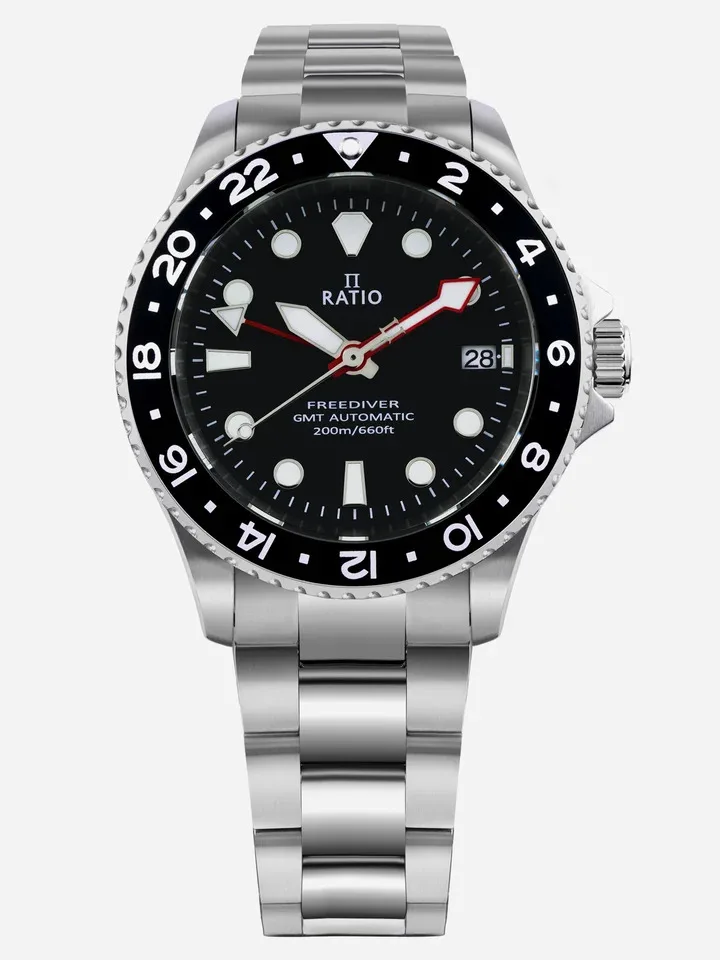
Automatic watches for women are self-winding mechanical watches, powered by wrist movement rather than a battery, and usually sized from 34 to 38mm. The key differences between models lie in the movement, the power reserve, the case thickness and whether the watch keeps full specifications at a smaller size.
Women's watches were long dominated by quartz, partly because small mechanical movements were harder to make and more expensive. That has changed. Compact automatic calibres are now common, and brands offer mechanical watches in sizes that suit smaller wrists without stripping out features. This piece explains how automatics work, what to check at smaller sizes, and how three current watches compare.
How does an automatic watch work?
An automatic watch winds itself as the wrist moves. A weighted rotor spins with motion and tensions the mainspring, which releases energy steadily to drive the hands. No battery is needed.
The mainspring holds a limited reserve, usually 38 to 50 hours in compact calibres. A watch worn daily stays wound, while one left unworn will stop once the reserve runs out and needs restarting. Many automatic watches for women also allow hand-winding through the crown, which helps restart a stopped watch.
Movements made for smaller cases
Compact cases need compact movements. Some calibres are designed specifically for smaller watches, while others are full-size movements placed in slightly larger cases.
Seiko's NH05 is an example of a compact automatic intended for smaller cases. Swiss calibres such as the Sellita SW200-1 and TAG Heuer's Calibre 5 appear in cases from about 36mm upwards. Movement size affects case thickness and diameter, so a smaller calibre helps keep the watch slim. Accuracy and reserve vary by calibre rather than by size.
What to check at smaller sizes
Three checks matter most when choosing a smaller automatic. Those are thickness, lug-to-lug length and whether functional features have been kept.
An automatic rotor adds height, so thickness is worth checking. Lug-to-lug decides whether the watch fits within the wrist. Functional features such as sapphire crystal, a screw-down crown and real water resistance should not be dropped just because the case is small.
Three automatic watches for smaller wrists
The three watches below use three different automatic calibres in cases from 35mm to 38mm. They span accessible to luxury price levels.
Ratio Freediver RTFL831 is the compact NH05 option. The 316L steel case is 35mm across, with 16mm lugs, and thickness is listed at 11.0mm to 12.4mm depending on the retailer. The Seiko NH05 automatic has 21 jewels and a listed power reserve of up to 50 hours. The crystal is sapphire, the crown screws down and water resistance is 200m. It shows how automatic watches for women can keep full dive specifications at 35mm.
Where it falls short: the 16mm lugs limit strap choice. Lug-to-lug is not published. The aluminium bezel insert scratches more readily than ceramic.
Christopher Ward C60 Trident Pro 300 38mm is the Swiss option. The 38mm case is 11mm thick and 45mm lug to lug, with 20mm lugs. The Sellita SW200-1 has 26 jewels, 28,800 vph, hacking and 38 hours of reserve. The bezel is ceramic, the crystal sapphire and water resistance 300m.
Where it falls short: 38 hours is a short reserve. At 38mm it may feel large on very slim wrists. It sits in a higher price bracket.
TAG Heuer Aquaracer Professional 300 Date WBP231J.BA0618 is the luxury option. The 36mm steel case is 11.4mm thick, with a ceramic bezel and screw-down crown. The Calibre 5 automatic runs at 28,800 vph with about 38 hours of reserve. The crystal is sapphire and water resistance is 300m.
Where it falls short: it costs many times more than the other two. The reserve is short for its price. Diamond markers suit dressy wear more than tool use.
FeatureRatio RTFL831Christopher Ward C60 38mmTAG Heuer WBP231J.BA0618Diameter35mm38mm36mmThickness11.0 to 12.4mm11mm11.4mmCalibreSeiko NH05Sellita SW200-1Calibre 5Power reserveUp to 50h listed38hAbout 38hWater resistance200m300m300mThe honest trade-offs
The compact option offers the smallest case and longest listed reserve, with narrower lugs and an aluminium bezel. The Swiss options add ceramic bezels, higher beat rates and 300m, with shorter reserves and higher prices.
All three show that smaller automatics no longer need to drop dive specifications.
Which automatic suits which wearer
Wearers with slim wrists who want a full-spec automatic will find 35mm the best fit. Those who prefer Swiss movements and ceramic bezels may choose 36mm to 38mm cases.
Buyers should compare thickness, lug-to-lug and power reserve first. Automatic watches for women are best judged on fit and movement rather than on labels.
Frequently Asked Questions
Do automatic watches for women need batteries?
No. Automatic watches are powered by a mainspring wound through wrist movement. A rotor spins as the wearer moves, keeping the watch running. If left unworn beyond its power reserve, the watch stops and simply needs winding or wearing to restart.
What size automatic watch suits a small wrist?
Most wearers with smaller wrists are comfortable between 34mm and 38mm. Lug-to-lug and thickness matter more than diameter. A lug-to-lug under about 45mm and thickness under about 12mm usually sit comfortably on slimmer wrists. Trying the watch on remains the most reliable test.
How long does an automatic watch run unworn?
Most compact automatic calibres run for about 38 to 50 hours unworn. After that, the watch stops and needs winding or wearing. Owners who rotate between several watches may use a watch winder or hand-wind before wearing. Most compact calibres also allow hand-winding through the crown.
Are automatic watches for women less accurate?
Accuracy depends on the calibre and its regulation, not on case size or the wearer. Compact calibres and full-size calibres can perform similarly. Published tolerances vary by movement, so comparing rated accuracy gives the clearest picture before buying. Regulation by the maker also affects real-world results.
Can a women's automatic watch be worn swimming?
Yes, if it has the right specifications. A screw-down crown and at least 100m, ideally 200m, make swimming safe. Many compact automatic dive watches meet these standards. Pressure testing every one to two years keeps water resistance reliable. The crown should always be fully closed before entering water.
Automatic or quartz for a women's watch?
Both have strengths. Automatics need no battery and appeal to those who enjoy mechanical watchmaking. Quartz watches are thinner, more accurate and keep running when unworn. The choice depends on wearing habits and personal preference. Many owners enjoy having one of each.