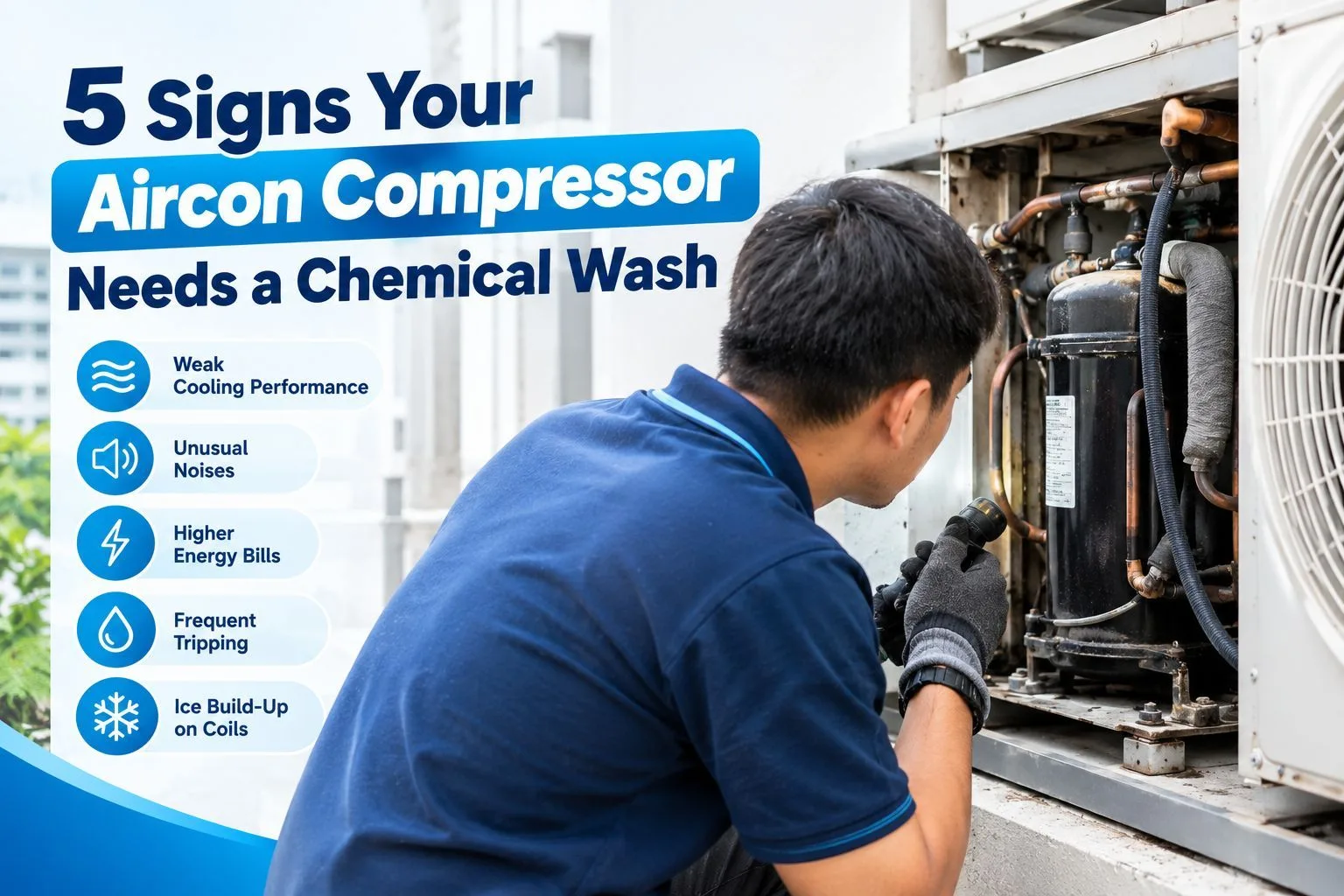
If your aircon is blowing warm air, making odd noises, or struggling to cool the room, the compressor could be under stress from built-up dirt and grime. The signs aircon compressor needs chemical wash are often subtle at first — but ignoring them leads to costly breakdowns. A chemical wash flushes out contaminants that routine servicing cannot remove, restoring efficiency before serious damage sets in.
Before you call a technician for a full compressor replacement, check whether your unit is actually showing warning signs that a deep clean could fix. Many homeowners in Singapore spend thousands on repairs that a timely aircon chemical wash might have prevented.
What Happens When a Compressor Gets Dirty?
The compressor is the heart of your air conditioning system. It pressurises the refrigerant that drives the entire cooling cycle. When dust, mould, and residue build up in the system — particularly in the evaporator and condenser coils — the compressor has to work harder to maintain the same output.
That extra strain raises operating temperatures, reduces efficiency, and accelerates wear. A chemical wash targets these deposits at the source, clearing blockages that a standard wash with water and a cloth simply cannot reach.
Sign 1: Your Aircon Is Not Cold Enough
Weak cooling is one of the most common and easily overlooked symptoms. If you have lowered the thermostat but the room still takes far too long to cool down, the problem may not be the refrigerant level — it may be restricted airflow caused by dirty coils.
When the evaporator coil is coated in grime, it cannot absorb heat effectively. The air passing over it stays warmer than it should, and the result is an aircon that technically runs but delivers noticeably weak cooling. In Singapore's humidity, this effect is amplified quickly.
- Room temperature stays high despite the unit running for 20–30 minutes
- Cool air feels mild rather than crisp
- You find yourself setting the temperature lower than usual just to feel a difference
Sign 2: The Compressor Unit Is Overheating
Compressor overheating is a serious red flag. The outdoor condenser unit releases the heat extracted from your room. When condenser coils are caked with dust and debris, that heat cannot dissipate efficiently — the compressor runs hotter and longer to compensate.
You may notice the outdoor unit feels unusually hot to the touch, or the system trips the circuit breaker repeatedly. In some cases, the unit shuts itself off as a thermal protection measure. This is not a minor inconvenience — prolonged overheating shortens compressor lifespan significantly and can lead to complete unit failure.
A chemical wash clears the condenser coils, restoring proper heat exchange and reducing thermal stress on the compressor.
Sign 3: Strange Noises Coming from the Aircon
An aircon running smoothly is almost silent. Strange aircon noises rattling, hissing, clanking, or a persistent humming often point to something working harder than it should.
When dirt accumulates inside the system, moving parts like the fan motor and blower wheel experience increased resistance. This causes vibration and unusual sounds during operation. A hissing sound, in particular, can indicate refrigerant struggling through partially blocked channels a direct consequence of dirty components reducing flow efficiency.
Do not assume unusual noises mean the unit needs a part replacement immediately. Get a chemical wash done first. If the noise persists after a thorough clean, then investigate mechanical issues further.
Sign 4: Water Leaking from the Indoor Unit
A blocked drain line is one of the most frequent reasons for water dripping from the indoor unit. When mould, algae, and dirt accumulate in the condensate drain tray and pipe, water backs up and overflows — sometimes onto your walls, floors, or furniture.
This is directly linked to aircon performance issues because standing water inside the unit encourages further mould growth. That mould then spreads to the evaporator coil, degrading both air quality and cooling performance simultaneously.
A chemical wash flushes the drain line completely, removes biological growth from the tray, and eliminates the source of the blockage rather than just clearing the immediate overflow.
Sign 5: Unpleasant Smells When the Unit Runs
A musty or stale odour when you switch on the aircon is a strong sign of biological contamination inside the unit. Mould and bacteria thrive in the damp, dark interior of the air handler — particularly on the evaporator coil and in the drain tray.
Standard servicing brushes away surface dust but does not sanitise internal components. Chemical washing uses specialised cleaning agents to break down mould colonies, bacteria, and organic residue that cause these smells.
In Singapore, where air conditioning runs almost year-round, mould build-up is accelerated by continuous condensation inside the unit. If your system smells within weeks of a basic service, it is likely overdue for a proper chemical clean.
How Often Should You Get a Chemical Wash Done?
For most residential units in Singapore, a chemical wash is recommended once every 12 to 18 months, depending on usage frequency and environmental conditions. Units in high-humidity areas, near construction sites, or running more than eight hours a day may need it more frequently.
Usage Pattern
Recommended Frequency
Light use (less than 6 hours/day)Every 18 monthsModerate use (6–10 hours/day)Every 12 monthsHeavy use (10+ hours/day)Every 6–9 monthsNear construction or dusty areasEvery 6 months
Chemical Wash vs. Regular Servicing: What Is the Difference?
A standard aircon service covers basic filter cleaning, checking refrigerant pressure, and a surface wipe-down. It is maintenance — not a cure for performance issues caused by deep contamination.
A chemical wash goes further. Technicians dismantle key components, soak or spray them with chemical cleaning solutions, flush the coils, clear the drain line, and reassemble everything. It removes biofilm, mineral deposits, and compacted dust that block heat exchange and restrict airflow.
Think of it this way: regular servicing is like washing your face. A chemical wash is the full detox your system actually needs after months of continuous operation.
Do Not Wait for a Breakdown
Aircon performance issues rarely appear without warning. The signs are gradual — a room that takes longer to cool, a faint smell you keep ignoring, a unit that trips occasionally. Each of these is your system signalling that it needs attention.
Acting on early symptoms is almost always cheaper than waiting for a compressor to fail. A replacement compressor in Singapore can cost anywhere from S$500 to over S$1,500 depending on the brand and unit type many times the cost of a chemical wash.
If your unit is showing any of the signs above, Aircon Express provides professional chemical wash services across Singapore. Their trained technicians handle everything from single split units to multi-system setups, helping you protect your investment before small problems escalate into major repairs.
Frequently Asked Questions
What are the signs that my aircon compressor needs a chemical wash?
The main signs include weak or warm airflow, compressor overheating, unusual noises during operation, water leaking from the indoor unit, and musty smells when the unit runs. These symptoms suggest internal contamination that standard servicing cannot address a chemical wash is usually the appropriate next step before considering parts replacement.
Can a chemical wash fix an aircon that is not cold?
Yes, in many cases it can. Weak cooling is often caused by dirty evaporator coils restricting heat absorption rather than a refrigerant problem. A chemical wash removes the grime coating the coils, restoring their ability to cool air effectively. If cooling performance does not improve after a chemical wash, a refrigerant check would be the logical follow-up.
How long does an aircon chemical wash take?
For a standard single split unit, a chemical wash typically takes between 1.5 to 2.5 hours. Multi-system or ducted units take longer. The technician disassembles internal components, cleans them with chemical agents, flushes the drain line, and reassembles the unit so allow sufficient time for the job to be done properly.
Is a chemical wash safe for all types of aircon units?
Yes, chemical washing is suitable for most residential aircon types in Singapore, including split units, multi-split systems, and cassette units. Professional technicians use solutions formulated specifically for air conditioning components. It is important to have the work done by a qualified technician to ensure the correct dilution and safe handling of cleaning agents.
How much does an aircon chemical wash cost in Singapore?
Pricing varies depending on the unit type and number of units. For a standard single split unit, chemical wash services in Singapore typically range from S$80 to S$150. Multi-system or larger units cost more. Getting the service done proactively is considerably cheaper than repairing or replacing a compressor damaged by long-term contamination and neglect.
How is a chemical wash different from a chemical overhaul?
A chemical wash cleans the unit in place with minimal disassembly, focusing on coils, drain lines, and key surfaces. A chemical overhaul involves complete disassembly of the indoor unit for deeper cleaning of every component. Overhauls are recommended when the unit has not been serviced for a long time or when a standard chemical wash has not resolved the performance issue.