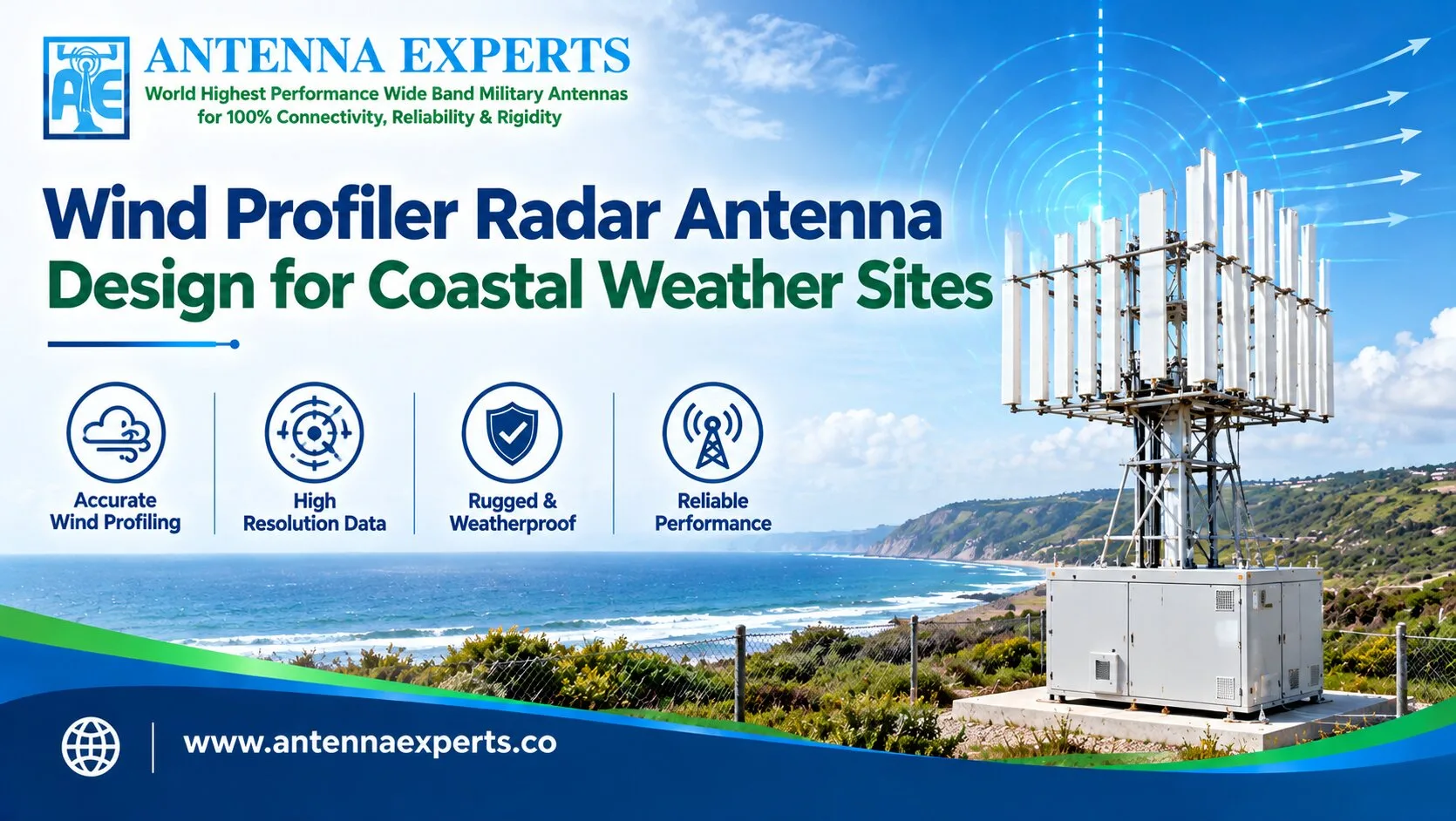
A wind profiler radar antenna faces greater environmental demands at a coastal site than at an inland site. Moisture and salt are on the hardware every day. The antenna must hold its finish and its tuning as the weather it measures changes.
This guide uses the WPRY-205 as an example of a working unit. All product facts are from the WPRY-205 information provided. There is no mention of frequency and gain. See the datasheet for these. Selecting a wind profiler radar antennafor the coast is as much an electrical question as a materials and mounting question.
Why Antenna Design Matters at Coastal Weather Sites
Frequency and signal requirements are just the start. A meteorological radar antenna on the coast is also subject to damp air, salt deposits and constant wind. Metal can corrode, and fasteners can become difficult to remove. Thus, the review is two-level. One is the radio requirement of your system. The other is the place. Ignoring the site will cost you time later with a weather radar antenna.
Yagi Design for Wind Profiler Radar Applications
The best wind profiler radar antenna is a Yagi, a directional antenna that mainly works in one direction, not all around. That is why atmospheric radar work involves Yagi designs. A wind profiler radar Yagi antenna can be positioned in the direction required for the measurement.
The WPRY-205 is a Yagi style antenna with a gamma match feed system. One way of coupling the feed line to the antenna is a gamma match. Gain, beamwidth and number of elements not specified. Here none are mentioned. If you want to compare other directional options, check out the high gain yagi antenna range.
Protection Against Coastal Corrosion
Salt in the coastal air attacks bare metal. Outdoor hardware is the first to be damaged.
The WPRY-205 is made of 6063T6 anodized aluminum. Epoxy powder coating, designed for saline coastal air. The mounting hardware is stainless steel 316. This is commonly referred to as marine grade.
These three options are the salt spray corrosion protection of the product. No service life is given and no service life is promised here. Perform routine inspections as you would for any coastal facility.
IP66 Protection for Outdoor Radar Antennas
An IP66 rating usually indicates the equipment is dust-tight and can endure strong water jets under typical test conditions. That does not mean that the antenna is fully waterproof. Neither is it suitable for all weather conditions.
WPRY-205 has an IP66 rating as declared. IP66 rating for radar antenna? Consider that a starting point. Then look at the finish and hardware.
Tower Mounting, Hardware and Wind Exposure
Coastal towers get regular wind. Before you put the antenna up, check the tower loading and wind resistance. The antenna adds both weight and surface area to the structure.
The WPRY-205 includes 316 stainless steel mounting hardware. No wind load figure or structural rating is given. If you want one, ask for documentation. Check the tower and mount against actual site conditions.
Factory Tuning and Installation
The WPRY-205 is factory tuned. It requires no field tuning. This removes one adjustment step from the commissioning process. Factory tuning does not replace proper installation. Check the mounting and cable routing. After the antenna is installed, run system checks. An N-female connector is mounted on the support boom.
Before installation, confirm that the mounting arrangement suits the tower and site conditions. The cable path should also be planned to avoid unnecessary bends or strain on the connection. These checks help ensure the antenna is installed according to the system requirements.
What to Check Before Choosing a Wind Profiler Radar Antenna
Utilize this list to compare products:
- Antenna Type: Yagi or other design. Antenna Experts also carries a range of circular polarized yagi antennas.
- System specifications: Frequency and gain from the data sheet.
- Environmental exposure: Salt, moisture and wind at your location.
- Corrosion protection: base metal, coating, and hardware grade.
- IP rating: What it does and doesn't cover.
- Mounting and tower loading: Hardware material and wind exposure
- Connector arrangement: Type and location.
- Tuning: Factory tuned or field tunable.
Documentation Datasheet and Product Page.
For a more detailed walkthrough read how to select a wind profiler radar antenna.
Why Choose Antenna Experts?
Antenna Experts provides antenna products and technical product information, including the WPRY-205. The product information documents its Yagi design, gamma match feed, IP66 rating, material selection, mounting hardware, connector arrangement and factory tuning. We demonstrate our expertise by providing clear product information and specification-based comparisons. If a figure is not documented we state so. First, compare product-level detail when comparing an Best antenna manufacturer in India. Radar Antenna Manufacturer India buyers should consider publishing features and materials for each model. And the same for any wind profiler antenna manufacturer. Then, match those details to your installation requirements.
Frequently Asked Questions
1. Why do some wind profiler radars use Yagi antennas?
A Yagi is directional. It is directional. This is OK for radar work where the antenna has to be pointed at a target area. Real performance will depend on the system and model.
2. How is a wind profiler radar antenna protected from coastal corrosion?
The WPRY-205 is made from 6063T6 anodized aluminum. It has an epoxy powder coating for salt coastal air. Mounting hardware: 316 stainless steel. It does not specify any service life or protection period.
3. Does a wind profiler radar antenna need field tuning after installation?
WPRY-205 is factory tuned and cannot be tuned in the field. Proper installation still counts. Perform system level checks after installation.
4. What makes the best wind profiler radar antenna for a tower mount?
There isn't one best model for every site. Antenna design and environmental protection comparison Inspect tower loading and mounting hardware. Add wind conditions and connector setup. Then, verify against the documented specifications.
About the Author
Gurleen Nayar is Marketing Manager at Antenna Experts. Gurleen writes content on antennas and technical products. Gurleen also helps the company with marketing. The goal is to make product information clear so buyers can compare options and ask better questions.