
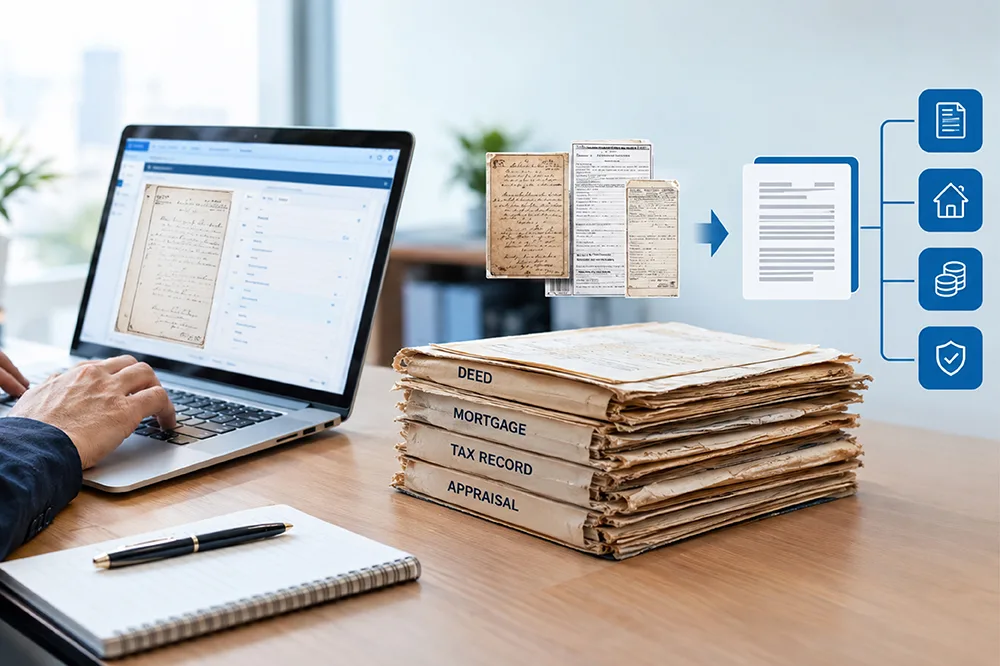
What if you invested in rebuilding your title plant, only to discover that the same data gaps, indexing errors, and workflow issues were still there?
For title companies and title plant operators, that is a real risk. Over time, property records accumulate, databases evolve, and processes that once worked well can become difficult to manage. Eventually, rebuilding the existing system may seem like the most practical way forward.
A new system does not repair the data it inherits. Whatever is wrong in the current plant migrates with it.
Before committing to a rebuild, it is worth taking a closer look at what you already have. A thorough audit of what your title plant actually contains establishes what is working, what needs attention, and what should change before migration begins.
What Is a Title Plant Audit?
A title plant audit establishes the current condition of three things: the records themselves, the technology holding them, and the processes that keep them current. It is a scoping exercise, and its output is a remediation list with owners attached.
This means checking whether property records are complete, indexes are consistent, historical documents are accessible, and the current system supports efficient title searches. It also involves reviewing how records are acquired, updated, maintained, and retrieved.
The goal is simple: identify what needs to be corrected, preserved, migrated, or replaced. With this clarity, you can make better decisions about the rebuild instead of carrying existing problems into a new environment.
What Should a Pre-Rebuild Title Plant Audit Cover?
A practical audit covers eight areas. Each produces findings that feed directly into the rebuild scope:
- Data inventory: Record counts by source, document type, geographic coverage and date range, including what exists only on microfilm or paper.
- Data quality: Duplicate rate, field-level completeness on indexed names and parcel identifiers, index consistency across eras, and metadata accuracy.
- Coverage gaps: Jurisdictions, date ranges and instrument types where the plant is incomplete, and whether those gaps are known or discovered.
- Technology: Whether the database, search layer, integrations and access controls support current volume and concurrency, measured rather than assumed.
- Workflows: How records are acquired, indexed, updated, searched and maintained, including who owns each step and where handoffs fail.
- Migration readiness: The proportion of records that migrate as-is against those requiring cleansing, conversion or manual review, with the basis for that split.
- Risk and compliance: Retention requirements, access controls, privacy handling and audit trails, tested against current practice rather than documented policy.
- Remediation planning: Issues ranked by impact, each with a named owner, a target date and a verification method.
The important part is not simply identifying issues. It is turning those findings into a prioritized action plan that guides the rebuild from planning through implementation.
Five Reasons to Audit Your Title Plant Before a Rebuild
A pre-rebuild audit does more than identify existing issues. It helps you make informed decisions about data quality, historical record preservation, operational efficiency, migration costs, and long-term system reliability. Here are five key reasons to make it a priority.
1. Catch Title Plant Data Gaps Before Migration
Duplicate entries, inconsistent property identifiers and missing fields do not announce themselves during migration. They surface later, in search results that return the wrong parcel or miss a recorded interest entirely. The new system inherits them intact.
This is why data quality is assessed before a rebuild rather than during it.
An audit measures these rather than describing them. Field-level completeness on indexed party names, the duplicate rate across the parcel index, and the share of records whose legal description cannot be matched to a current identifier are all countable, and all three predict how much remediation the rebuild will require.
The outcome is a known starting condition. You migrate records whose state you have already measured, rather than discovering it during cutover.
2. Protect Historical Records and Chain of Title
How confident are you that your title plant preserves the historical information needed to support a reliable property search?
Historical records help researchers trace ownership changes and identify relevant recorded interests, including deeds, mortgages, liens, and easements. Losing access to these records or disrupting the relationships between them can create problems long after a rebuild is complete.
An audit helps establish how far back your records extend, whether important documents are accessible, and where gaps or inconsistencies exist. It also helps determine how older documents and their associated metadata should be preserved during migration.
By addressing these questions early, you can protect historical continuity instead of discovering missing information after the new system goes live.
3. Separate Technology Problems From Data and Workflow Problems
Slow searches and heavy manual handling are usually blamed on the system. Often the system is not the cause.
Inconsistent indexing, disconnected applications, unstructured workflows and a poorly normalized database produce the same symptoms, and none of them is resolved by replacing the platform.
Rebuilding without understanding the root cause can mean spending money on a new system while retaining the same operational bottlenecks.
An audit helps separate technology limitations from process and data issues. This gives you a clearer picture of what the new system needs to deliver, whether that means faster searches, better integrations, improved automation, or more consistent indexing.
Instead of simply replacing what you have, you can focus on fixing what is holding your team back.
4. Avoid Unexpected Costs and Migration Delays
Rebuilding a plant involves more than moving data between databases. Records may need cleansing, reformatting, mapping, validation or manual review first, and indexing automation addresses only part of that.
Without an audit, this work is routinely underestimated. The proportion of a legacy backfile that can migrate without intervention depends on the condition, completeness, and structure of the source data. Discovering the extent of that work halfway through implementation can lead to budget overruns and missed cutover dates
A utility network data assessment can take 2–4 months, depending on the utility's size, the number of commodities and the scope of the assessment.
A pre-rebuild audit gives your team an earlier view of the existing data's condition and complexity. It helps identify migration risks, estimate cleanup requirements, and plan resources more realistically.
While an audit requires time and investment upfront, it can help reduce uncertainty and limit avoidable rework later.
5. Build a System That Stays Reliable Over Time
Getting a new title plant up and running is one thing. Keeping its data accurate as new records arrive is another.
If record updates, indexing practices, and quality checks are inconsistent, the new system can gradually develop the same problems as its predecessor.
According to the U.S. National Archives and Records Administration (NARA), quality management practices such as quality assurance, quality control, and validation are essential to ensuring digital records remain accurate, authentic, and usable.
An audit identifies weaknesses in data governance, including unclear ownership of index corrections, inconsistent maintenance standards between daily ingestion and backfile, and gaps in quality control. The practical output is a sampling cadence, meaning how many records are checked, how often, and against what source. These findings can inform better processes for verifying records, tracking changes, managing access, and maintaining data over time.
The benefit extends beyond the rebuild itself. You create a stronger foundation for handling growing data volumes, expanding geographic coverage, and changing business requirements.
How to Turn Audit Findings Into a Better Rebuild
Once you know where your title plant stands, the next step is to put those findings to work.
Start by addressing critical data gaps and inconsistencies that could affect record reliability. Then use the audit findings to define the new system's requirements, from search functionality and integrations to data management and security.
Before migration, establish clear rules for cleaning and mapping records. After migration, compare selected records against their original sources and test representative title searches to identify discrepancies.
Finally, put ongoing quality checks in place so that data issues do not quietly build up again. In other words, the audit should guide the entire rebuild, not just the initial planning stage.
Conclusion - What to Settle Before the Rebuild Begins
Three questions determine whether a rebuild will deliver what you expect. Whether your records are complete, whether historical information is actually reachable, and whether your current workflows are the real constraint. An audit answers all three before the budget is committed.
Answering these questions before the rebuild helps you focus on the improvements that matter most. More importantly, it ensures that data gaps, indexing issues, and operational inefficiencies are addressed rather than carried into a new system.
A successful title plant rebuild runs on accurate data and processes that keep it accurate. The audit is what tells you whether you have either and it is considerably cheaper to run before the migration than to reconstruct afterwards.