
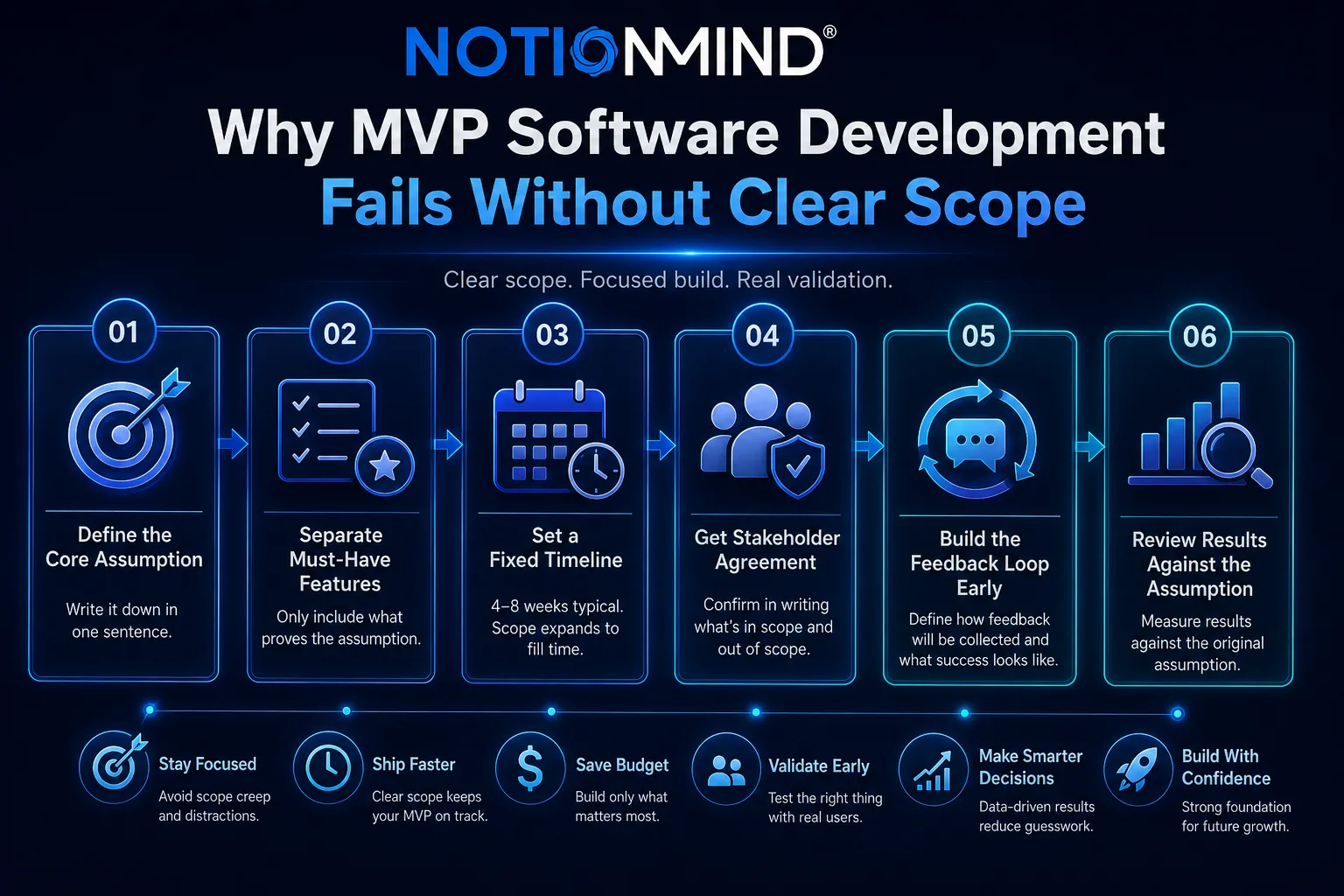
MVP software development fails most often not because of bad code or weak execution, but because scope was never properly defined before building started. Teams end up chasing a moving target, adding features mid-build, and losing sight of what the minimum viable version was actually supposed to prove in the first place. That's the core problem behind most stalled or bloated MVP projects, and it's rarely a technical problem at its root.
Getting scope right before writing a single line of code is what separates mvp software development that ships on time from projects that drag on for months without a clear finish line in sight, quietly draining budget and team morale the longer things go unresolved.
Step One in MVP Software Development: Define the Core Assumption
Every MVP exists to test one specific assumption about whether customers actually want what's being built. Skipping this step is the single biggest reason scope spirals out of control later.
Teams that skip this often end up building a small version of the entire product instead of a focused test of the one thing that actually matters most right now. That difference sounds subtle, but it usually decides whether the project stays on schedule.
The direct answer here is simple: write down the one assumption in a single sentence before any feature list gets created. If it can't fit in one sentence, the scope isn't clear enough yet to start building anything.
Step Two in MVP Software Development: Separate Must-Have Features
Once the core assumption is clear, features naturally fall into two categories, and most scope failures happen when teams blur the line between them.
Must-have features are the ones directly required to test the core assumption. Nice-to-have features are everything else that feels important but doesn't actually change whether the test succeeds or fails.
Teams that struggle here often benefit from asking one direct question about each feature: does removing this feature make the assumption impossible to test?
Step Three in MVP Software Development: Set a Fixed Timeline
Scope tends to expand to fill whatever time is available, which is exactly why setting a fixed deadline before development starts matters more than most teams initially expect.
A four to eight week timeline is typical for most MVP software development projects, though the exact number depends heavily on complexity and how much existing infrastructure the team can reuse.
Teams without a fixed deadline often find scope creeping steadily, one small addition at a time, until the "minimum" version looks nothing like what was originally planned months earlier.
Step Four in MVP Software Development: Get Stakeholder Agreement
Scope disagreements after development begins are far more expensive to resolve than disagreements caught before a single feature gets built by the team.
The clearest way to prevent this is a short, direct meeting where every stakeholder confirms in writing what's in scope and what's explicitly out of scope for this specific version being built right now.
Written agreement matters more than verbal alignment here, since memories of what was discussed tend to shift once development is already underway.
Step Five in MVP Software Development: Build the Feedback Loop Early
Many MVP software development projects treat feedback collection as something that happens after launch, when it should actually be planned before development even starts.
Deciding in advance exactly how user feedback will be collected, and what specific signals will count as validation or rejection of the core assumption, prevents ambiguous results.
Without this plan, teams often end up with vague impressions instead of clear data, making it much harder to decide whether to continue building or pivot.
Step Six in MVP Software Development: Review Results Against the Assumption
Once the MVP launches and data starts coming in, the review process should measure results against the original single assumption, not against every feature idea that came up during development.
This discipline prevents teams from declaring success or failure based on secondary metrics that were never the actual point of building the MVP in the first place.
Businesses across India, the US, and Spain that consistently ship successful MVPs describe this scope discipline as the single hardest part of the process, harder than the actual coding involved in most cases.
A common trap teams fall into is confusing enthusiasm from stakeholders with actual validation from real users. A stakeholder loving a feature idea internally says nothing about whether paying customers will actually want it once it exists in the real world.
This is why the review step matters so much. It forces a return to the original question the entire project was built to answer, rather than drifting toward whichever feature generated the most internal excitement during development.
Teams that skip this discipline often end up in a strange position: technically shipping an MVP, but with no clear answer about whether the core business idea actually works. Getting scope discipline right from the very first step tends to prevent this outcome entirely.
This same discipline, once learned on a first MVP, tends to carry forward into every future product decision the team makes, well beyond this single project alone.