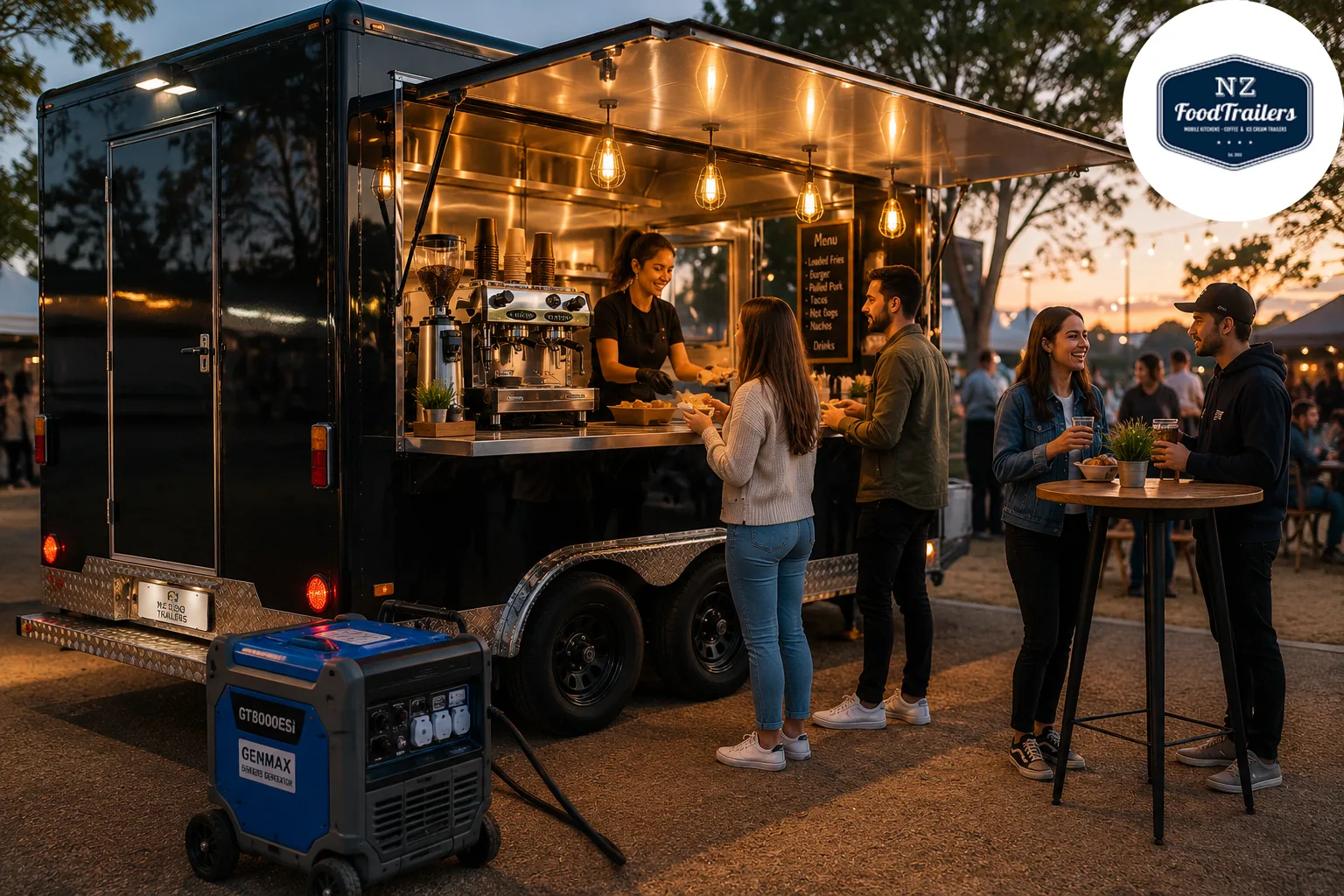
Walk through any decent-sized market or festival in New Zealand right now and count how many food trailers actually stand out. Not "have a nice sign" — stand out, the way you'd notice a building has good architecture for your airstream coffee trailer before you know what's inside it. Most operators are still competing entirely on what's on the menu and hoping the queue does the marketing for them.
That's starting to change, and it's worth understanding why, because it says something broader about how mobile commerce is evolving.
The Trailer Is the First Sale
Every purchase decision has a moment before the product even matters: the moment someone decides whether to walk over at all. In a crowded event with a dozen similar vendors, that decision gets made on appearance, not flavour.
This is why a specific category of mobile setup — the rounded, polished, Airstream-style trailer — has moved from novelty to serious business asset for coffee operators, ice cream vendors, mobile bars, and pop-up retailers. The shape itself isn't new; it's borrowed from classic American travel trailers. What's new is operators treating it as a deliberate business decision rather than an aesthetic indulgence.
The logic is simple. A customer evaluates four things before they taste anything: does this look clean, does this look professional, does this look like it'll still be running next month, and is this worth photographing. A retro-style trailer answers "yes" to all four before a single coffee is poured.
What's Actually Driving the Shift
A few forces are converging here, and none of them are unique to New Zealand.
Events have become curated experiences, not just vendor lineups. Festival and market organisers are increasingly selective about who they let in, because a market full of generic white gazebos photographs badly and undersells the event. Operators with distinctive setups get preferred placement and repeat invitations — this is now a competitive advantage in getting into events, not just performing once you're there.
Social platforms reward the photogenic. A striking trailer gets photographed and shared by customers for free, which is marketing spend most small operators can't otherwise afford. This isn't speculation — it's the same mechanic that turned specific cafes and bars into destinations purely because they were "Instagrammable" before that became a cliché.
The unit economics have improved. Five years ago, a stainless steel retro-style build was a premium import with a long wait and a painful exchange rate. Local manufacturers now build these domestically, which has narrowed the price gap between a generic box trailer and a genuinely distinctive one. The cost of standing out has dropped relative to the cost of looking identical to everyone else.
What "Customisation" Actually Means in Practice
The word gets used loosely, so it's worth being specific. For a mobile food business, customisation isn't paint colour — it's a list of operational decisions that determine whether the trailer makes money or just looks good:
- Equipment layout. A coffee trailer fitted for a two-person rush-hour workflow is a different build than one designed for a solo operator at a slow Sunday market. Grinder placement, fridge access, and POS positioning all change the speed of service.
- Power and water provisioning. Generator sizing and water tank capacity decide whether you can run a full festival day without a midday shutdown.
- Compliance from day one. In New Zealand, that means registration, warrant of fitness, electrical warrant of fitness, and food safety sign-off under the Food Act 2014 — none of which are optional, regardless of how the trailer looks.
- Branding integration. Signage and livery that's designed into the build, not bolted on afterward, ages better and photographs better.
Operators who skip straight to "make it look like an Airstream" without solving these first tend to end up with a trailer that's beautiful in photos and frustrating to actually run.
The Counter-Argument Worth Taking Seriously
It would be dishonest to present this as a universal upgrade. A distinctive, premium-finish trailer costs more upfront than a basic box build, and that premium doesn't pay for itself for every business model. A high-volume operator selling a commodity product at low margin — think basic hot dogs at a sports ground — may get a better return from a cheap, durable, easily replaceable unit than from a striking one. Appearance matters most where the purchase decision is discretionary and experience-driven: coffee, dessert, boutique retail, events. It matters far less where customers are buying out of necessity or convenience.
The honest framing is that a premium trailer is a marketing investment with a specific use case, not a default upgrade every mobile operator should chase.
Where This Goes Next
Expect the gap to widen further between operators who treat their setup as part of the product and those who treat it as a delivery mechanism. As more entry-level businesses adopt generic box trailers — because they're cheap and fast — distinctive presentation becomes a sharper differentiation for everyone else, not a less relevant one. Scarcity of a look is part of what makes it valuable.
For anyone weighing this decision, the practical test isn't "do I like how it looks." It's: does my customer's purchase decision depend on perceived experience, and would a more distinctive setup change whether they choose me over the stall next to me. If the answer is yes, the trailer's appearance isn't decoration — it's the first thing you're actually selling.
It's a calculation manufacturers are increasingly building for directly rather than leaving operators to figure out after the fact. NZ Food Trailers, a Tauranga-based builder that's been producing custom trailers and mobile kitchens since 2015, now runs a dedicated retro and Airstream-style range alongside its standard builds — a sign that the demand for distinctive presentation has become consistent enough to plan a production line around, not just an occasional custom request.