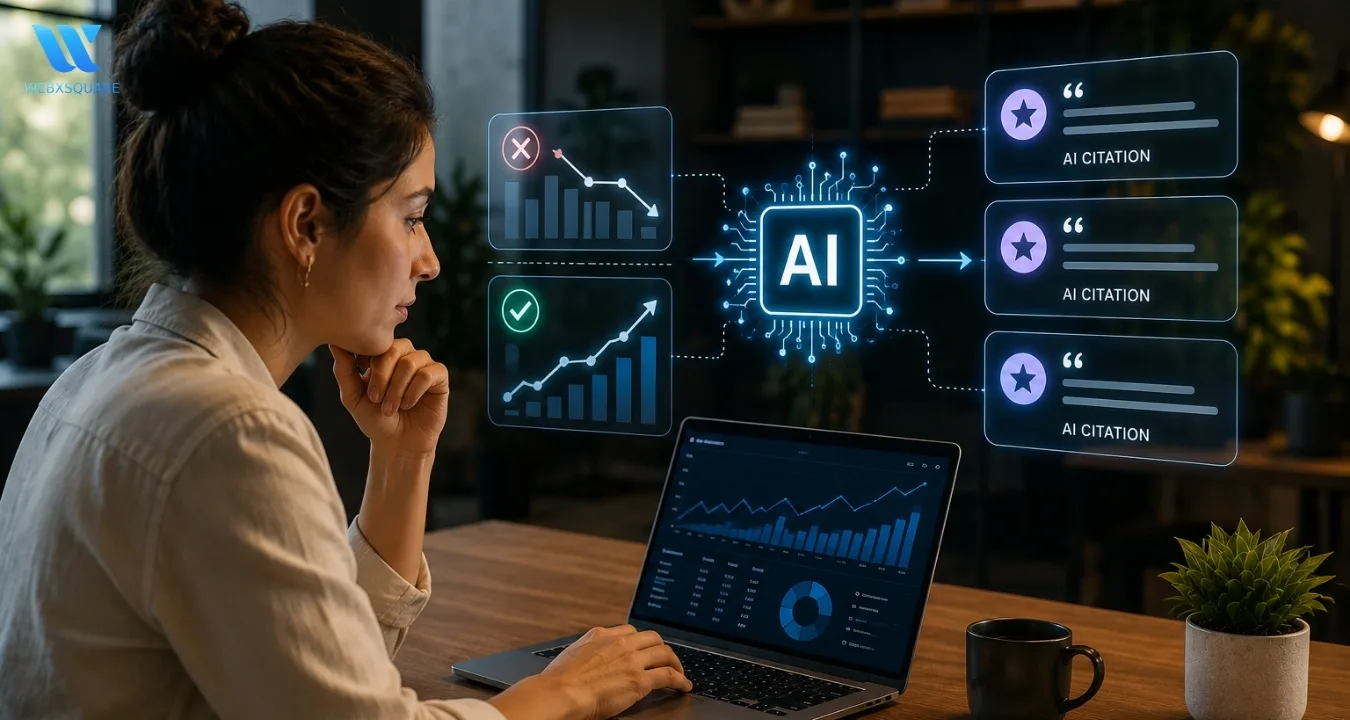
Over two decades, marketers saw keyword rankings as the end-all and be-all performance scoreboard. Position one implied traffic, leads and bragging rights in each client meeting. Nonetheless, AI created responses have shaken that cozy formula forever. Today, SEO services which are the best are those which are cited within AI answers.
Citation implies that you quote your brand as evidence in Google, ChatGPT or Perplexity. In the meantime, a ranking is becoming more and more a sitting below a response that no one scrolls through. This article discusses the reasons why the change occurred and what the statistics demonstrate. You will also get to know how to re-strategize this quarter precisely.
The Old Obsession: Why Rankings Ruled Marketing for Two Decades
Rankings were the most popular measure in the industry as they were easy and noticeable. A job might be followed on a daily basis, displayed on a monthly basis and glorified in reports. Clients insisted on position reports and the agencies provided colorful charts on a monthly basis.
There was also predictable movement of position and traffic over the course of the majority of SEO history. First, about 1/3 of all searchers visited your link. The agencies created full business to push un-rewarding keywords higher on the list.
Therefore, everywhere marketing dashboards continue to consider the first position the finish line. The latter assumption was quite logical in the case when all screens were filled with ten blue links. No one doubted that measure since it had been a reliable indicator of revenue over the years. But today, when your customers visit the results page, it looks nothing like that.
What Changed: AI Answers Took Over the Top of Search
Google AI Overviews can now be found on about a quarter of all searches. That number continues to rise when Google is broadening the feature to the query types. In addition, AI Mode had 1 billion monthly users in 2026 alone. Each day, ChatGPT, Perplexity, and Claude answer millions of purchasing questions. These engines are written first, and a few sources are cited next to the answer. There are only a limited number of citation slots (between two and seven) in each answer.
This has made the AI summary the actual first page. The box is usually read and the brands mentioned are trusted, and there is never a scroll. Customers are now requesting assistants to make suggestions rather than making ten different scans. Customers are still searching 24 hours around the clock, only the answering interface is different. Meanwhile, publishers are experiencing drastic traffic falls on informational queries in most industries.
The Data: Rankings and Citations Are Splitting Apart
The most significant change is that rankings are no longer a reliable predictor of citations. Two data points must revise the way all marketing teams spend their money.
The 76% to 38% Collapse
As of mid-2025, top-ten pages had approximately 76 percent of AI citations. As early as 2026, Ahrefs discovered that overlap had dropped to 38 percent. References have been divided into page-one references and pages ranked way down into the results. Thus, even the first place is approximately a fifty-fifty chance of citation. That crash implies that now you rank reports and cover your actual visibility issue.
Future-oriented SEO offerings view rankings as a starting point, rather than a destination. The winning pages have a similar structure and credibility, not only good position. As a result, the teams are glorifying green dashboards as their organic traffic that has qualified to be called as such, is silently reducing.
The Click Economics of Being Cited
Seer Interactive followed 5.47 million queries in dozens of large consumer brands. The average CTR of pages mentioned within an AI Overview was approximately 2.1 percent. Meanwhile, pages without citations on the same queries were only able to handle about 0.9 percent. Being quoted within the answer is approximately doubling your clicks on that query. These figures make sense of why competitors mentioned are suddenly ranking higher than you on the same keywords.
Further, overall AI Overview click-through rates recovered 85 percent early 2026. Traffic was not lost; it was simply redistributed in a sharp increase toward the mentioned sources. The brands whose traffic is decreasing are ranked high but remain unseen within the answer boxes. Citation share should thus be given the budget that is used to run after petty positions.
Why Citations Beat Rankings for Trust and Revenue
A reference, has that which a mere blue link never had, recommendation. The AI puts your brand as the demonstration of its own solution. Therefore, mentioned brands form a part of the consideration on the part of the buyer prior to any clicking. Customers do not often check the assertions when a close friend makes a direct mention of your brand. Rankings are catchy, whereas citations are believed, which is much more effective than visitors. In addition, citations compound between engines due to AI systems learning through web consensus.
A brand that is mentioned many times becomes the default solution to its category. Uncited rivals gradually fade out of discussion occurring within mainstream AI chat interfaces. Revenue becomes what the brands machines are familiar enough with to name. That borrowed authority will reduce your sales cycles and decrease your overall acquisition costs.
What a Citation-First Strategy Looks Like
Seeking citations does not imply throwing all that you know about SEO. Rather, it implies re-organizing material and cues based on the way AI engines read.
Answer-First, Extractable Content
Each significant page must respond to its main question in 100 words. Research shows 55 percent of citations come from a page's top 30 percent. As such, a capsule with a direct answer should be presented at the front of each question.
Make paragraphs brief, independent and comprehensible out of context. Your odds of extraction are also enhanced by tables, bullet lists and clear definitions. Include statistics and quotes of experts, which increase the visibility of AI by 22 and 37 percent. In the meantime, by burying answers under lengthy introductions, you can have engines jump your whole page.
E-E-A-T and Brand Consensus Signals
Approximately, 96 percent of the citation sources have high E-E-A-T signals. Connect actual authors with qualifications, original information, and personal experience everywhere. Smart SEO services review author entities prior to writing even a single new paragraph.
The optimal SEO services will create authentic trust structure, not the keyword-stuffed thin pages. Updates to Google 2026 specifically incentivize original knowledge and penalize artificial noise generated by AI. Case studies are more real world than any industry overview.
Off-Site Mentions That AI Engines Trust
AI engines authenticate brands by the mention of the brand on Reddit, YouTube, and industry publications. Moreover, Google citations coincide with those of ChatGPT only eight percent of the time. The various engines draw out varying indexes and hence the consensus needs to be cross web.
Regular communication on all channels educates engines on what your brand really does best. Citation algorithms are directly fed by digital PR, community presence, and regular brand profiles. Also, podcast appearances and roundups of experts produce mentions that are quickly indexed by engines.
The New KPIs: What to Measure Instead of Positions
New columns should be added to your dashboard, as old metrics lack the battlefield. Citing frequency in Google AI Overviews, ChatGPT, Perplexity, and Claude. Also, quantify your portion of voice across AI responses by category. Keep track of branded search volume, as mentioned brands are searched by name later. Watch referral traffic coming in through AI platforms, which converts at amazing rates.
The contemporary SEO services give out these figures on a monthly basis together with the conventional traffic and revenue. Rankings are still on the dashboard, albeit as a supportive indicator. Report citation wins next to pipeline numbers in order to have the executives easily visualize the relationship. Where we rank has been transformed into who gets quoted. This means that your budget discussions move out of the vanity positions to quantifiable revenue results.
How to Transition Without Abandoning SEO Fundamentals
Begin with an audit of what queries in your category already elicit AI responses. Next, find out whether your pages or your competitors' pages are cited today. Your commercial inquiries should be your top priority, since such citations will impact purchases directly. Re-write your most valuable pages with answer capsules and question heading formats. Then, add Article, FAQ, and Organization schema to ensure engines read everything. Make an original contribution to research, which others will refer to.
In the meantime, make your technical SEO keen, as crawlability serves as an entry gate to all. Blocked crawlers make your best content invisible to Google and AI engines. Then proceed to developing informational support on broader and more profound topical power. Allow transition a single quarter, follow up citation growth with baseline.
FAQs
Are keyword rankings completely dead?
No, rankings remain important as the nutrient the AI retrieval systems thrive on. Excellent rankings enhance citation chances although they are no longer definite.
What do I do to keep track of AI cites?
Citations are now monitored using tools such as Semrush, Ahrefs, and special AI visibility platforms. Also, manually test your queries of priority in Google, ChatGPT, and Perplexity at least once a month.
Do AI mentions increase revenue?
Yes, the cited pages receive approximately twice the CTR of competing pages that have no citations. Brand trust also develops on citation which boosts direct and branded search traffic.
What is the pace at which marketers should switch?
Begin now, since citation patterns become fixed as engines become familiar with brand associations. Early movers are the reference that becomes default prior to the slower entrants taking any attention.
Conclusion
The scoreboard is different, and marketers that are still holding on to rankings are gauging yesterday. There are now citations within AI answers that determine what brands the buyers see and trust. The playbook works: extractable responses, real expertise, and web-wide brand agreement. Those teams with citation-first thinking will have their categories to own in 2026 and beyond.
At Webxsquare, our SEO services are designed for this new citation economy. We reviewed your AI presence on Google, ChatGPT, Perplexity, and Claude today. And then we reorganize what you have, enhance E-E-A-T and create a long-lasting brand agreement.
We also monitor your citation on a monthly basis and link it to actual revenue. Clients will prefer Webxsquare due to our pursuit of the moving metrics of business. Whenever Google releases another major update in its algorithms, our strategists update all their campaigns.