
Crypto traders often spend most of their time watching price charts. Candlesticks show where the market has been, indicators help identify patterns, and volume provides clues about participation.
But a price chart does not show everything happening beneath the surface.
To understand the immediate supply and demand around a cryptocurrency, traders often turn to the exchange order book.
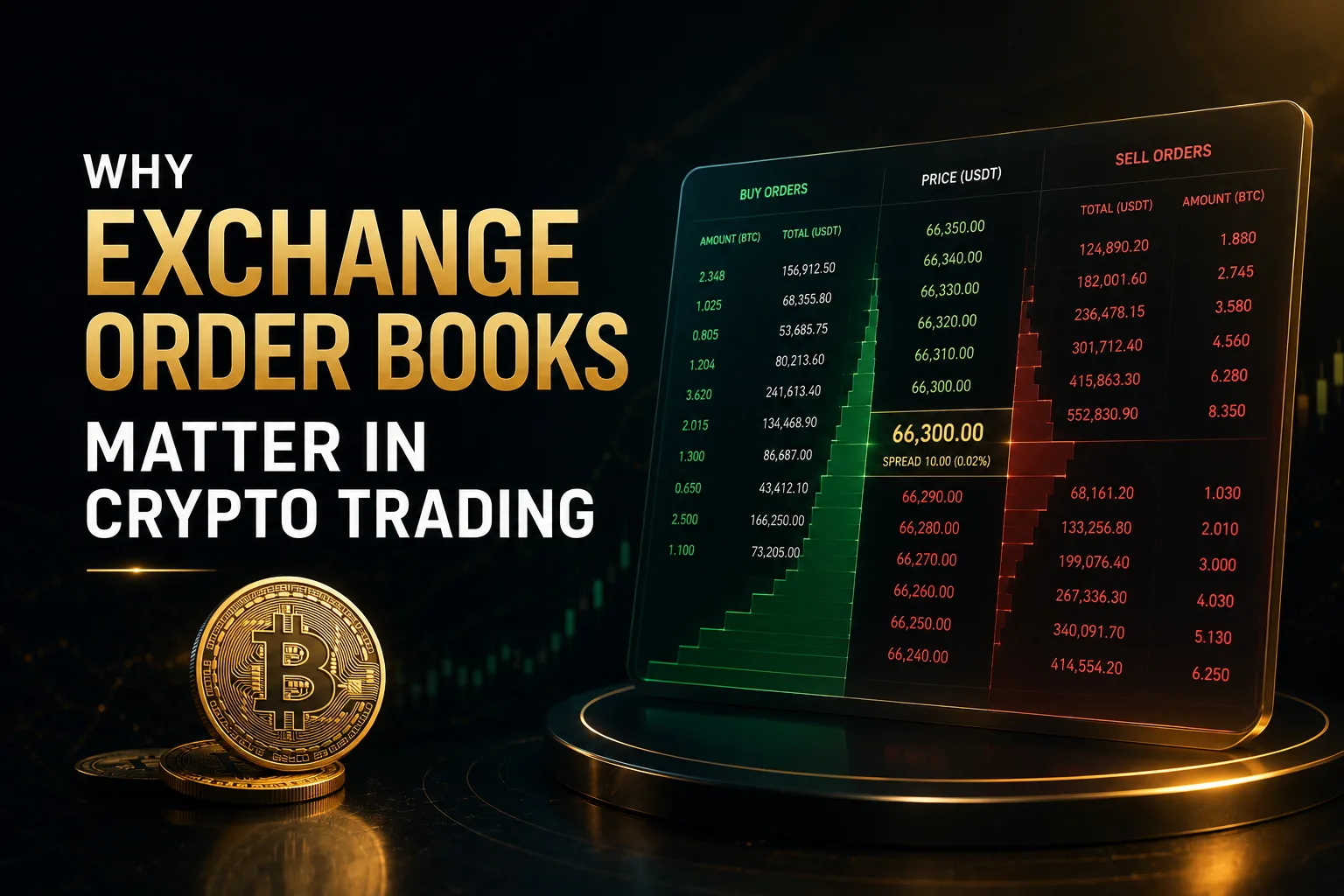
An order book provides a live view of buy and sell orders waiting to be executed. It can show where traders are willing to buy, where sellers are willing to sell, and how much liquidity exists around the current market price.
For active traders, this information can be particularly useful.
What Is a Crypto Exchange Order Book?
An exchange order book is a continuously updated list of buy and sell orders for a particular trading pair.
It is generally divided into two sides:
Bids: Buy orders placed below or around the current market price.
Asks: Sell orders placed above or around the current market price.
The highest available bid and the lowest available ask form the immediate market boundary. The difference between them is known as the bid-ask spread.
Why Order Books Matter
Markets move because buyers and sellers interact.
When aggressive buyers are willing to pay increasingly higher prices, the market can move upward. When sellers become more aggressive, prices can move lower.
The order book provides a snapshot of this interaction.
It can help traders evaluate:
- Market liquidity
- Bid-ask spreads
- Potential support and resistance areas
- Buying and selling pressure
- Slippage risk
- Large pending orders
- Short-term market structure
However, an order book should not be treated as a guaranteed prediction of where price will move next.
Orders can be cancelled, modified, or replaced at any time.
Understanding Bids and Asks
The simplest way to read an order book is to understand the difference between bids and asks.
A bid represents the price at which someone is willing to buy.
An ask represents the price at which someone is willing to sell.
Suppose Bitcoin is trading near $60,000.
If the highest bid is $59,990 and the lowest ask is $60,010, the spread is $20.
A trader placing a market order may interact with the available liquidity rather than receiving exactly the last traded price.
This distinction becomes increasingly important when trading assets with lower liquidity.
The Importance of Liquidity
Liquidity refers to how easily an asset can be bought or sold without causing a significant change in its price.
A deep order book generally contains substantial buy and sell liquidity around the current market price.
A thin order book has fewer orders available.
This difference can have a major impact on execution.
Imagine two cryptocurrencies both trading at $1.
The first has millions of dollars of orders close to the current price.
The second has only a small amount of liquidity.
A large market order may have little impact on the first asset but move the second asset considerably.
This is known as market impact.
For traders, understanding liquidity can therefore be just as important as understanding price direction.
What Is the Bid-Ask Spread?
The bid-ask spread is the difference between the highest bid and lowest ask.
A narrow spread generally indicates that buyers and sellers are relatively close in their desired prices.
A wider spread can indicate lower liquidity or greater uncertainty.
For example:
Market A
Highest bid: $100
Lowest ask: $100.05
Spread: $0.05
Market B
Highest bid: $100
Lowest ask: $100.50
Spread: $0.50
The second market has a much wider spread.
For frequent traders, spreads can become an important part of trading costs, especially when entering and exiting positions repeatedly.
Order Book Depth
Order book depth refers to the amount of buy and sell liquidity available at different price levels.
A trader might see substantial bids clustered around one price range and large asks concentrated around another.
These areas can sometimes influence short-term price behavior.
For example, if there is significant sell liquidity above the current market price, buyers may need to absorb those orders before the market can move substantially higher.
Similarly, substantial buy liquidity below the market may temporarily slow a decline.
This is one reason traders sometimes describe large concentrations of orders as potential liquidity zones.
But these zones should not automatically be interpreted as permanent support or resistance.
What Are Buy and Sell Walls?
A buy wall occurs when a relatively large amount of buy orders is concentrated around a particular price level.
A sell wall is the opposite: a large concentration of sell orders at a specific level.
These walls can affect trader psychology because market participants can see significant liquidity sitting nearby.
However, traders need to be careful.
Large orders can disappear before execution.
This means a visible wall does not necessarily represent genuine long-term buying or selling interest.
Some market participants may cancel orders as market conditions change, while others may place large orders for strategic reasons.
Therefore, the order book should be observed dynamically rather than treated as a static map.
Order Books and Market Orders
Understanding order books also helps explain how market orders work.
A market buy order generally consumes available sell orders beginning with the lowest ask.
If the order is large enough, it can continue moving through progressively higher ask levels.
The same principle applies to a large market sell order consuming bids.
This is why large market orders can experience slippage.
For example, suppose the sell side contains:
- 1 BTC at $60,000
- 2 BTC at $60,020
- 3 BTC at $60,050
A trader attempting to buy 6 BTC immediately may not receive the entire order at $60,000.
The order could execute across several price levels.
The average execution price would therefore be higher than the initial ask.
Order Books and Short-Term Trading
Order book information can be particularly useful for traders operating on short timeframes.
Scalpers and day traders may monitor changes in liquidity, spreads, and order flow to understand short-term market conditions.
They may look for:
- Rapid changes in bid or ask liquidity
- Large orders appearing or disappearing
- Increasing market-order activity
- Changes in spread
- Liquidity being consumed at important price levels
This can provide additional context alongside price and volume.
However, short-term order-book signals can change extremely quickly.
A pattern that appears meaningful one second may disappear moments later.
Order Book Imbalances
Another concept traders sometimes monitor is order book imbalance.
An imbalance occurs when there is significantly more displayed liquidity on one side of the book than the other.
For example, suppose there are substantially more bids than asks within a defined price range.
Some traders may interpret this as evidence of stronger buying interest.
But displayed liquidity is not the same thing as executed trading activity.
A large number of buy orders does not guarantee that buyers will actually transact at those prices.
For that reason, order-book imbalance is better viewed as one piece of evidence rather than a standalone trading signal.
Order Book Data vs Trading Volume
Order book data and trading volume provide different types of information.
Order book data shows what participants are currently willing to buy or sell.
Trading volume shows transactions that have already taken place.
This distinction is important.
A trader might see a large number of sell orders in the order book, but if buyers aggressively absorb those orders and price continues rising, the visible sell liquidity may not have the expected effect.
Combining order-book information with actual trading volume can therefore provide a more complete picture of market activity.
Why Order Books Can Be Misleading
One of the biggest mistakes beginners make is assuming that every visible order represents genuine market conviction.
That assumption can be dangerous.
Orders can be cancelled before execution. Large displayed orders can also create an impression of supply or demand without necessarily resulting in actual trades.
This is why experienced traders often pay attention to executed orders and changes in liquidity, rather than simply looking at the largest number on the screen.
The order book is a live environment, not a fixed prediction of future prices.
How Traders Can Use Order Books More Effectively
The best approach is to use order-book information as part of a broader decision-making process.
A trader might begin by examining the overall market structure.
Then they can look at:
- Current price and trend
- Trading volume
- Bid-ask spread
- Order book depth
- Liquidity concentrations
- Recent market-order activity
- Volatility
- Relevant news or market events
This creates a more balanced view.
For example, a trader may notice that price is approaching a major resistance level while the order book shows increasing sell liquidity. That does not guarantee a reversal, but it may encourage the trader to wait for additional confirmation rather than entering immediately.
Order Books Are About Context, Not Certainty
The biggest value of an order book is not that it predicts the future.
It is that it provides market context.
Price tells you what the market has done.
Volume tells you how much trading activity occurred.
The order book shows where liquidity is currently positioned.
On-chain data can reveal blockchain activity.
Derivatives data can provide insight into leverage and positioning.
Each layer answers a different question.
When these sources are considered together, traders can develop a much more informed understanding of market conditions.
Final Thoughts
Exchange order books are one of the most useful tools for understanding the mechanics of crypto markets.
They reveal bids, asks, liquidity, spreads, and the orders waiting to be executed. For active traders, this information can help with assessing execution costs, market depth, potential liquidity zones, and short-term trading conditions.
But an order book should never be treated as a crystal ball.
Liquidity can change quickly. Orders can disappear. Market participants can behave differently from what their displayed orders initially suggest.
The strongest trading decisions usually come from combining order-book information with price action, volume, market structure, derivatives data, and broader market context.
In crypto trading, knowing where orders are sitting can be useful. Understanding why the market is moving is even more valuable.