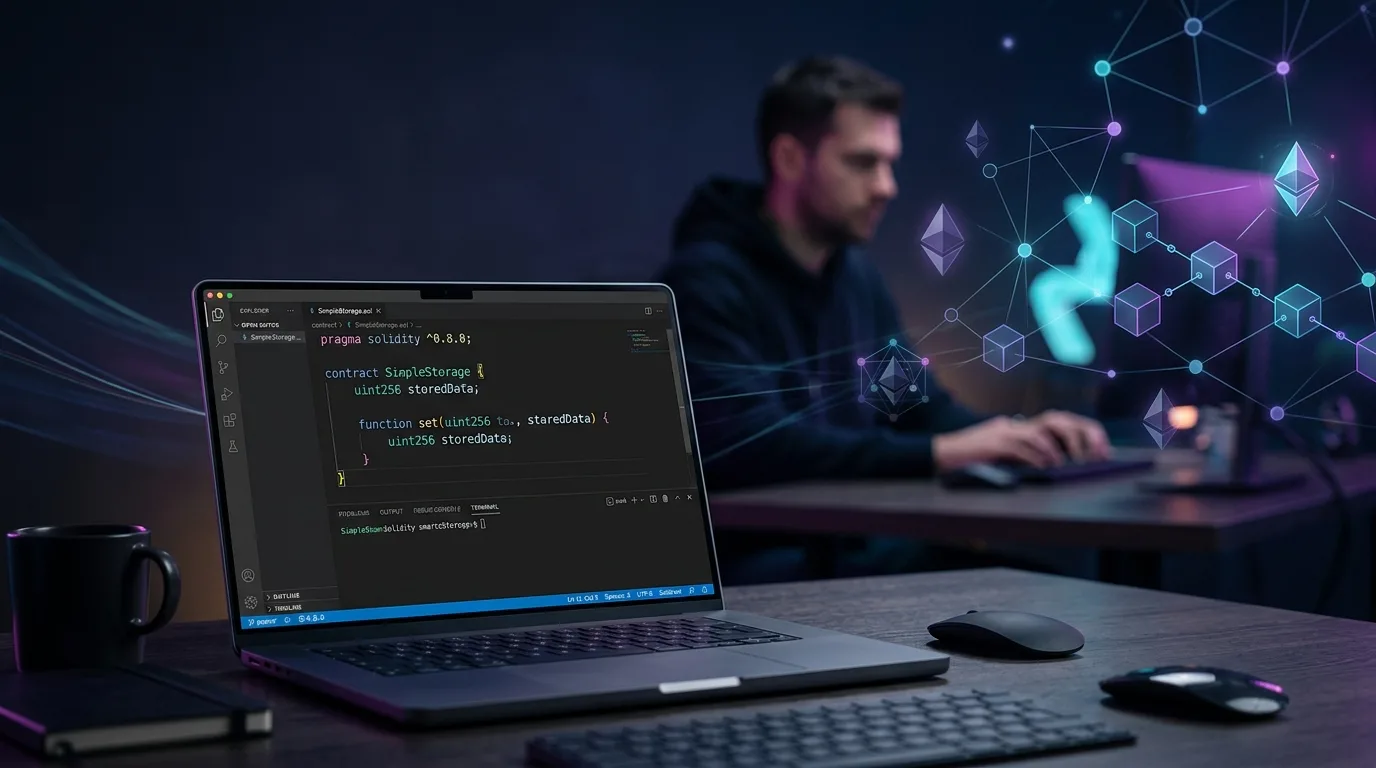
Blockchain technology has created new opportunities for developers who want to build decentralized applications, digital assets, and smart contracts. One of the most popular programming languages in this space is Solidity.
If you are new to blockchain development, learning Solidity may seem difficult at first. However, with the right learning path and regular practice, you can gradually develop the skills needed to create smart contracts and decentralized applications.
In this guide, we will explain how to learn Solidity for blockchain development in simple steps.
What Is Solidity?
Solidity is a programming language mainly used to create smart contracts for Ethereum and other blockchain networks that support the Ethereum Virtual Machine (EVM).
A smart contract is a program stored on a blockchain. It can automatically perform actions when specific conditions are met.
For example, a smart contract can be used to:
- Create tokens
- Build decentralized applications
- Manage NFTs
- Create voting systems
- Develop DeFi applications
- Handle digital payments
- Build blockchain games
Solidity has become an important skill for people interested in Web3 and blockchain development.
Do You Need Programming Experience?
You do not need to be an expert programmer to start learning Solidity.
However, knowing basic programming concepts can make the process much easier.
Before starting Solidity, it helps to understand:
- Variables
- Functions
- Data types
- Conditional statements
- Loops
- Arrays
- Basic programming logic
If you are completely new to programming, consider learning basic JavaScript or Python first. You do not need advanced knowledge. A basic understanding of programming is enough to begin.
How to Learn Solidity Step by Step
1. Learn Blockchain Basics
Before writing Solidity code, learn how blockchain technology works.
You should understand basic concepts such as:
- Blockchain
- Ethereum
- Smart contracts
- Wallets
- Transactions
- Gas fees
- Blocks
- EVM
- Public and private keys
You do not need to become a blockchain expert before learning Solidity. The goal is simply to understand where your smart contracts will run and how users interact with them.
2. Understand Smart Contracts
The next step is learning how smart contracts work.
A smart contract contains rules written in code. Once deployed to a blockchain, users can interact with those rules through transactions.
For example, you could create a simple contract that stores a message.
// SPDX-License-Identifier: MIT pragma solidity ^0.8.20; contract MessageStore { string public message; constructor(string memory initialMessage) { message = initialMessage; } function setMessage(string memory newMessage) public { message = newMessage; } }
This simple example teaches several important Solidity concepts, including variables, functions, constructors, and state changes.
The most important thing at this stage is not writing complicated code. Focus on understanding what each line does.
3. Learn Solidity Fundamentals
After understanding smart contracts, start learning Solidity syntax.
Focus on the following topics:
- Variables
- Data types
- Functions
- Arrays
- Mappings
- Structs
- Enums
- Constructors
- Modifiers
- Events
- Errors
- Inheritance
- Interfaces
You should also learn about storage, memory, and calldata because they are important when developing Solidity contracts.
Do not try to learn everything in one day. Study one concept and then create a small example using it.
4. Practice With Remix
One of the easiest ways for beginners to start writing Solidity is Remix IDE.
Remix is a browser-based development environment that allows you to write and compile Solidity contracts without setting up a complicated development environment.
You can:
- Create a Solidity file.
- Write your contract.
- Select a compiler version.
- Compile the contract.
- Deploy it in a test environment.
- Interact with its functions.
- Test how the contract changes state.
This hands-on practice can help you understand Solidity much faster than simply watching tutorials.
5. Learn Solidity Development Tools
Once you become comfortable with basic Solidity, you can start using professional development tools.
Some popular tools include:
Remix
Good for beginners and quick experiments.
Foundry
Foundry is a powerful toolkit for Solidity development, testing, debugging, and deployment.
Hardhat
Hardhat is another popular Ethereum development environment and is useful for developers who work with JavaScript or TypeScript.
You do not need to learn all these tools immediately.
A simple path is:
Remix → Foundry or Hardhat → Advanced development workflow
6. Learn How to Test Smart Contracts
Testing is extremely important in blockchain development.
A small mistake in a smart contract can cause serious problems, especially when the contract handles digital assets.
When testing a contract, consider different situations.
For example, if you create a withdrawal function, test:
- A successful withdrawal
- An unauthorized withdrawal
- A withdrawal with insufficient funds
- Multiple withdrawals
- Invalid inputs
Do not only test when everything works correctly. Try to find situations where the contract could fail.
7. Learn Smart Contract Security
Security should be an important part of your Solidity education.
Some common smart contract security topics include:
- Reentrancy
- Access control
- Unauthorized transactions
- External contract calls
- Oracle manipulation
- Signature verification
- Denial-of-service attacks
You should never assume that a contract is secure simply because it compiles successfully.
Before deploying a contract, test it carefully and understand how its functions can be used or misused.
8. Understand Gas Fees
When using Ethereum, transactions and smart contract operations require gas.
Gas represents the computational work required to execute operations on the network.
As a Solidity developer, you should understand:
- What gas is
- Why transactions require gas
- Why some operations cost more than others
- How contract storage affects costs
- How to write reasonably efficient code
You do not need to become a gas optimization expert when you are just starting. First focus on writing correct and secure code.
9. Build Small Solidity Projects
The best way to improve your Solidity skills is to build projects.
Start with simple ideas before attempting complex DeFi applications.
Beginner Projects
You could build:
- Message storage contract
- Voting contract
- Todo list
- Simple crowdfunding contract
- Basic escrow contract
Intermediate Projects
After gaining experience, try:
- ERC-20 token
- NFT contract
- NFT marketplace
- Auction contract
- Staking application
- Multisignature wallet
Building projects gives you practical experience and can also help you create a blockchain developer portfolio.
10. Learn Token Standards
Once you understand Solidity basics, learn about common Ethereum token standards.
Some important examples include:
ERC-20: Used for fungible tokens.
ERC-721: Commonly used for NFTs.
ERC-1155: Supports multiple types of tokens within one contract.
Learning these standards can help you understand how many existing blockchain applications are designed.
11. Learn How DApps Work
Solidity is only one part of many blockchain applications.
A typical decentralized application can include:
Frontend → Wallet → Web3 library → Blockchain → Smart Contract
After learning Solidity, consider learning JavaScript or TypeScript so you can connect your smart contracts to a website.
You can eventually learn tools and libraries such as:
- ethers.js
- viem
- React
- wagmi
This combination can help you move from simply writing smart contracts to building complete Web3 applications.
12. Read Other Smart Contracts
Another useful way to improve is by reading code written by experienced developers.
When looking at an existing contract, ask yourself:
- What does this contract do?
- What information does it store?
- Who can call each function?
- Which functions change the blockchain state?
- Where can funds enter or leave?
- Does the contract interact with other contracts?
- What security risks could exist?
You may not understand complex contracts immediately. That is normal.
Start with simple contracts and gradually move to more advanced projects.
How Long Does It Take to Learn Solidity?
The answer depends on your programming experience and how much time you spend practicing.
A beginner might follow a learning path like this:
TimeWhat to LearnWeek 1–2Programming and blockchain basicsWeek 3–4Solidity fundamentalsMonth 2Smart contracts and testingMonth 3Security and development toolsMonth 4+DApps and advanced projects
These are only general estimates.
If you already know programming, you may progress faster. If you are completely new to coding, give yourself more time.
The goal should not be to learn Solidity as quickly as possible. The goal should be to understand it well enough to build and test your own projects.
Common Mistakes New Solidity Developers Make
Trying to Learn Everything at Once
Blockchain development includes many areas, including Solidity, cryptography, frontend development, DeFi, NFTs, and security.
Start with the basics and gradually expand your knowledge.
Copying Code Without Understanding It
Tutorials are useful, but copying code does not mean you understand it.
After following an example, try changing it or rebuilding it without looking at the original.
Ignoring Security
Security should not be treated as something you learn only after becoming an advanced developer.
Start learning secure coding practices from your first projects.
Following Outdated Tutorials
Blockchain technology changes quickly.
Always check the Solidity version and make sure the tutorial uses modern tools and practices.
Building Only Tutorial Projects
Tutorial projects are a good starting point, but you should eventually build something yourself.
Even a small original project can teach you more than simply following another person's code.
Best Way to Practice Solidity
A simple learning cycle is:
Learn → Code → Test → Make Mistakes → Debug → Improve → Build
For example, if you learn Solidity mappings, create a small project that uses mappings.
Then change the code and see what happens.
Try to break it.
Fix the problem.
Write tests.
This process helps you develop real programming skills instead of simply memorizing syntax.
Can You Use AI to Learn Solidity?
Yes. AI tools can be useful when learning Solidity.
You can use AI to:
- Explain difficult code
- Explain compiler errors
- Generate practice exercises
- Create test ideas
- Explain programming concepts
- Review simple code
- Suggest project ideas
However, you should never blindly deploy AI-generated smart contracts.
Smart contracts can handle valuable assets, so developers need to understand and test the code themselves.
Use AI as a learning assistant, not as a replacement for learning Solidity.
Final Thoughts
Learning Solidity for blockchain development does not have to be overwhelming.
Start with programming and blockchain basics. Then learn Solidity fundamentals, create simple smart contracts, practice with Remix, and gradually move into testing, security, development frameworks, and DApp development.
Most importantly, keep building projects.
Your first project may be nothing more than a simple storage contract. Later, you can move toward tokens, NFTs, marketplaces, and complete decentralized applications.
If you stay consistent and focus on understanding rather than simply copying code, Solidity can become a valuable skill for your blockchain development journey.