Introduction
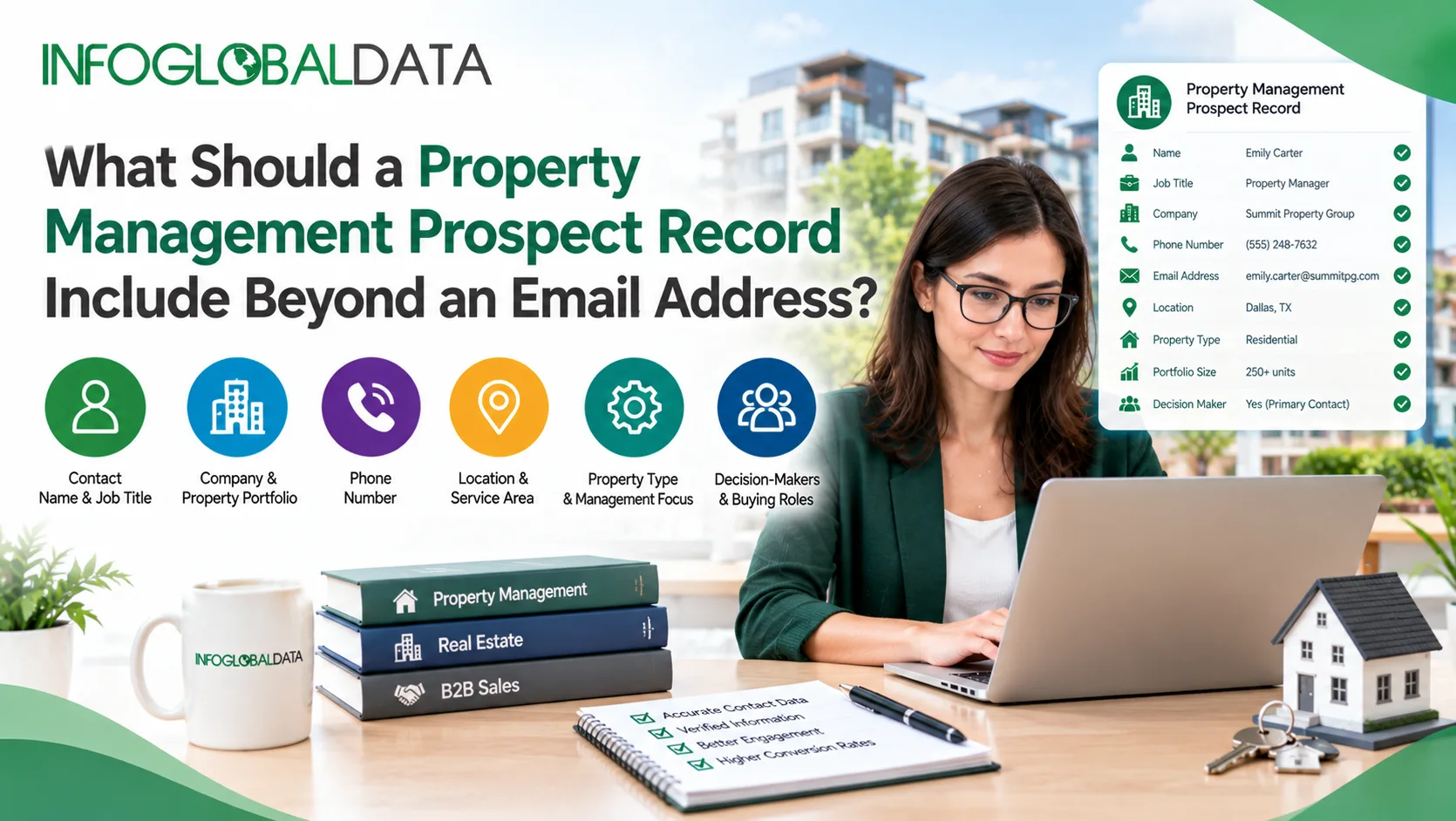
A property management prospect record should do more than identify someone’s email address. It should help sales and marketing teams understand which company the person represents, what types of properties it manages, how large its portfolio is, and whether the contact has influence over purchasing decisions. Without these details, outreach can reach the wrong employee, overlook a valuable account, or promote services that do not fit the business.
Property management is also evolving rapidly. Buildium’s 2026 State of the Property Management Industry Report found that AI adoption among surveyed property management companies increased from 20% in 2024 to 58% in 2025, although only 8% had fully automated any processes.
As businesses adopt more technology, structured prospect data becomes increasingly valuable for segmentation, research, and sales automation.
For marketers building a Property Management Email List, the objective is to create accurate, useful records that support relevant outreach—not simply collect more email addresses.
1. Company Identity and Business Structure
The first step is to establish exactly which property management business a prospect belongs to. A company may manage residential rentals, commercial buildings, multifamily communities, homeowners associations, or mixed-use properties. These distinctions affect the services it may need and the people involved in buying decisions.
Buildium’s 2026 industry report covers multiple property management segments and identifies operational efficiency, maintenance, and business growth as important industry themes. Its findings reinforce the importance of understanding a prospect’s business context rather than treating all property managers as one audience.
Include these fields where available:
- Official company name and website.
- Business email domain.
- Property management business type.
- Headquarters and operating locations.
- Parent company, subsidiary, or franchise relationship.
- Business status and last-verified date.
These fields help distinguish similarly named companies and connect individual contacts to the correct organization. If a property management firm operates under a parent company, record both the local business and parent relationship rather than replacing one with the other.
2. Contact Role and Purchasing Authority
A contact’s job title helps determine whether the person is likely to evaluate, recommend, approve, or purchase a product or service. An owner or managing director may influence software investment, while a regional manager may oversee property operations and a maintenance director may evaluate contractors or maintenance technology.
Buildium’s 2026 report found that 56% of rental property owners said maintenance support was the main reason they hired a property manager.
For businesses selling maintenance platforms, inspection services, or property operations software, this finding highlights the importance of identifying contacts connected to maintenance responsibilities. It does not mean every maintenance-related purchase is controlled by one role.
Useful contact fields include:
- Full name and current job title.
- Department or functional responsibility.
- Seniority and likely purchasing influence.
- Business email and professional profile, where available.
- Associated company, region, or portfolio.
- Date the role was last verified.
Avoid assuming that a senior title automatically means purchasing authority. Where possible, identify the likely decision-maker, operational user, and technical evaluator separately.
3. Property Types, Portfolio Size, and Geographic Coverage
A prospect’s property portfolio can help marketers assess whether their offer is relevant. A vendor selling multifamily access-control systems may prioritize large apartment operators, while a landscaping company may focus on firms managing properties within its service area.
A Property Management Mailing List should therefore include segmentation fields that distinguish the scale and nature of each business. Buildium’s 2026 report found that 75% of surveyed property managers planned to grow in 2026, while 55% reported expanding in 2025.
Although these figures do not describe every property management company, they make growth plans a potentially useful qualification topic for sales teams.
Consider capturing:
- Property types managed: residential, multifamily, commercial, HOA, or mixed-use.
- Estimated number of units, buildings, or managed properties.
- Geographic service area and operating markets.
- Number of offices or regional teams.
- Client and portfolio segments, where publicly documented.
- Expansion plans or acquisitions, if confirmed through a reliable source.
Do not treat portfolio size as a perfect proxy for budget. A smaller specialist operator may have a strong need for a particular service, while a large company may already have a long-term supplier or centralized purchasing agreement.
4. Technology Environment and Business Priorities
Knowing a prospect’s business priorities can help marketers explain why a product may be relevant. A company experiencing maintenance coordination challenges may value workflow automation, while another may prioritize owner reporting, tenant communications, accounting, or portfolio growth.
Buildium’s 2026 report found that AI adoption rose from 20% in 2024 to 58% in 2025, but only 8% of companies had fully automated any processes.
This gap between adoption and full automation suggests that technology use alone is not enough to establish a company’s needs. Marketers should investigate the specific processes a prospect uses and the problems it is trying to solve.
Useful fields include:
- Property management software, if reliably known.
- Relevant technology or service category.
- Publicly announced operational initiatives.
- Known business challenges or stated priorities.
- Procurement or contract-renewal timing, when verified.
- Lead qualification status and next action.
Record the source and date for any buying signal. A company that mentioned automation in an old announcement may have already completed its project or selected a provider.
5. Data Freshness, Verification, and Source History
Property management contacts and company details change over time. Employees move between firms, responsibilities shift, companies acquire portfolios, and email accounts become inactive. An email address that once worked may no longer reach the intended person.
ZeroBounce’s 2026 Email List Decay Report analyzed more than 11 billion addresses processed during 2025. It found that 62% were valid and 23% were invalid; more than 9% were classified as catch-all addresses. These figures reflect ZeroBounce’s cross-industry dataset, not property management contacts specifically.
A Property Management Email Database should track not only the contact details but also when and how they were checked. Useful fields include:
- Email verification status and date.
- Contact and job-title verification date.
- Company website and source of the record.
- Last-updated date and record owner.
- Confidence or review status for uncertain information.
- Duplicate and suppression status.
Email verification cannot confirm every aspect of a record. It may assess whether an address is likely to accept messages, but it does not necessarily confirm a person’s current role, company affiliation, or purchasing influence. Those details need separate checks.
6. Duplicate Control and CRM Compatibility
A database can contain accurate individual records and still be difficult to use if the same company or contact appears multiple times. Duplicates can inflate prospect counts, cause repeated outreach, and create confusion when different systems hold conflicting information.
Validity’s State of CRM Data Management in 2025, based on 602 CRM users and stakeholders, found that 76% said less than half of their organization’s CRM data was accurate and complete. In the same survey, 37% reported revenue loss associated with poor data quality. These are cross-industry findings, not property management-specific estimates, but they highlight the importance of systematic data governance.
Before importing a list, check for:
- Duplicate email addresses and contact records.
- Multiple records for the same company under different names.
- Conflicting job titles, domains, or locations.
- Missing required fields and inconsistent formats.
- CRM field mapping and account ownership.
- Unsubscribe and do-not-contact status.
Use more than company name alone when matching records. Two offices within the same management group may have separate operating responsibilities, and multiple contacts at one firm may be legitimate prospects for different services.
7. Compliance and Responsible Outreach
A complete prospect record should help the marketing team determine whether contact is appropriate. That means preserving source information, honoring opt-outs, and checking the requirements that apply to the recipient’s location.
The U.S. Federal Trade Commission states that the CAN-SPAM Act applies to commercial email, including business-to-business messages. Requirements include accurate sender information, non-deceptive subject lines, a valid physical postal address, a clear opt-out mechanism, and honoring opt-out requests within 10 business days.
Maintain fields or linked controls for:
- Data source and collection date.
- Relevant consent or lawful-basis information, where required.
- Unsubscribe and suppression status.
- Applicable country or jurisdiction.
- Last suppression-list check.
- Data-retention and access controls, where appropriate.
Requirements vary by jurisdiction, so CAN-SPAM should not be treated as a universal standard for campaigns in the UK, EU, or other markets. Collect only the professional information needed for legitimate outreach and apply appropriate access and retention practices.
Practical Takeaways for Marketing and Sales Teams
Before launching a campaign using a Property Management Email List, follow these five steps:
- Standardize prospect records. Make company name, contact name, job title, business email, property type, location, source, and verification date core fields.
- Segment by commercial fit. Group prospects by property portfolio, geography, company type, and relevant business responsibilities.
- Verify important details. Check email validity and confirm current employment and company information before outreach.
- Preserve data history. Record source information, last-updated dates, and suppression status so teams can distinguish current facts from outdated records.
- Measure quality and outcomes. Monitor hard bounces, duplicate rates, qualified replies, meetings, and conversions—not just the number of contacts in the database.
Teams can create a simple internal scorecard by tracking the percentage of records with verified email addresses, current job titles, complete company details, and documented sources. Set targets after measuring the current baseline; no universal data-quality score guarantees campaign success.
How InfoGlobalData Fits Into the Process
For businesses selling software, maintenance services, technology, or other B2B solutions to property management companies, InfoGlobalData can be a resource for exploring business contact data. Before using a Property Management Email Database, assess its coverage, field completeness, freshness, verification practices, source transparency, and suitability for your target audience.
The goal is to combine relevant contacts with reliable company information and clear qualification criteria. This gives sales teams a better foundation for prioritizing accounts and personalizing outreach without assuming that a contact record alone proves buying intent.
Conclusion
An effective property management prospect record should contain much more than an email address. Company identity, contact responsibilities, property types, portfolio size, geographic coverage, technology needs, verification history, CRM quality controls, and compliance information all contribute to a more useful record.
Recent research from Buildium, Validity, and ZeroBounce illustrates why these details matter: property management businesses are adopting new technologies, while data-quality problems remain a challenge across industries. However, cross-industry email and CRM benchmarks should not be mistaken for property management-specific performance guarantees.
As property management companies expand portfolios and modernize operations, accurate prospect records can help marketers identify relevant opportunities and communicate more effectively. The best approach is to maintain data continuously, verify important details before outreach, and measure success through qualified engagement rather than database size alone.
Frequently Asked Questions
1. What should a Property Management Email List include?
It should include contact names, current job titles, business email addresses, company names, property types, locations, and relevant portfolio details. Source information, verification dates, and suppression status also help teams assess data quality.
2. Why is portfolio size important in property management prospecting?
Portfolio size can help indicate whether a company is a suitable prospect for services designed for particular numbers of units, buildings, or locations. However, it should be considered alongside business needs, purchasing authority, geography, and existing supplier relationships.
3. How often should a Property Management Email Database be updated?
Review records before campaigns and whenever bounces, company changes, or outdated contact details are detected. The appropriate schedule depends on the age of the data, its source, the rate of organizational change, and campaign frequency.
4. What is the difference between a Property Management Mailing List and a Property Management Email Database?
The terms are often used interchangeably. A mailing list generally emphasizes contacts for outreach, while a database may include structured information about companies, roles, portfolios, verification, and sources. Quality depends on the accuracy and relevance of the actual records.
5. Which job titles should B2B marketers target at property management companies?
Depending on the offer, relevant contacts may include owners, managing directors, regional property managers, operations directors, maintenance managers, IT leaders, and procurement professionals. The best target is the person whose responsibilities align with the product or service being promoted.
6. Does email verification guarantee accurate property management prospect data?
No. Email verification can assess whether an address appears likely to accept messages, but it does not necessarily confirm current employment, company affiliation, portfolio responsibility, or purchasing authority. Those fields require separate verification.
7. How can marketers improve the quality of property management prospect records?
Standardize fields, verify email addresses, confirm company and role information, remove duplicates carefully, record data sources, and maintain suppression lists. Review campaign results to identify which records and segments generate qualified engagement.