
Moving industrial machinery is a job where small oversights can create surprisingly large problems. This is especially true when the equipment belongs to the oil and gas industry. A pump, compressor, drilling component, generator, processing unit, or large mechanical assembly may be too heavy for ordinary handling and too valuable to risk with improvised packing.
That makes oil and gas machinery shipping a planning exercise as much as a transportation task. The equipment needs to be prepared for movement, protected against the conditions it may encounter, loaded appropriately, and delivered to a location where it can be unloaded safely.
The process becomes easier when every stage is considered before the machinery starts its journey. Instead of asking only, "How will we get this there?" businesses need to consider a bigger question: "How can we get it there in the same usable condition in which it left?"
Why Moving Energy Equipment Is a Different Challenge
Oil and gas machinery is built for demanding working environments. That does not mean it should be treated roughly during transportation.
Industrial equipment can contain delicate instruments, electrical connections, moving mechanisms, control components, seals, fittings, and other parts that may be affected by impact or exposure. The main frame might be incredibly strong while one small attached component is relatively fragile.
There is also a major difference between shipping a machine and shipping a household item.
A household appliance might be lifted by a few people and placed into a vehicle. Large industrial machinery may require lifting equipment, specialized trailers, careful positioning, and a detailed plan for securing the load.
The size of the equipment can create another layer of difficulty. A machine that fits comfortably inside a factory may become much harder to transport once its complete dimensions, protective packaging, and loading requirements are considered.
Start With the Machinery, Not the Truck
One of the smartest ways to organize a machinery shipment is to understand the item first.
Before transportation arrangements are finalized, the equipment should be examined for its:
- Overall dimensions
- Weight
- Shape
- Lifting points
- Fragile attachments
- Removable components
- Electrical parts
- Exposed openings
- Moving sections
- Protection requirements
These details influence nearly every later decision.
For instance, knowing the weight helps determine how the machinery can be lifted and transported. Knowing its height can help identify potential clearance issues. Knowing where the strongest lifting points are can help prevent unsafe handling.
It is much like moving a large refrigerator. Before carrying it through a doorway, you would measure both the appliance and the opening. With industrial machinery, the same principle applies on a much larger scale.
The Journey Begins Before the Machine Leaves
A common misconception is that shipping starts when a carrier arrives.
In reality, preparation starts much earlier.
Machinery may need to be cleaned, disconnected, inspected, drained where appropriate, and prepared for transportation. Loose components should not be left free to move around. Parts that extend from the main body may need additional protection.
Some equipment may have fluids, oils, fuels, or other substances associated with its operation. The appropriate preparation depends on the specific machine, its condition, and applicable transportation requirements.
An inspection before packing is also useful. Photographs can document the machinery's condition before it leaves the facility, while a written checklist can help confirm that preparation has been completed.
This approach reduces the chance that an important detail will be forgotten simply because several people are involved in the shipment.
Packaging Should Match the Equipment
There is no single box or wrapping method that works for every industrial machine.
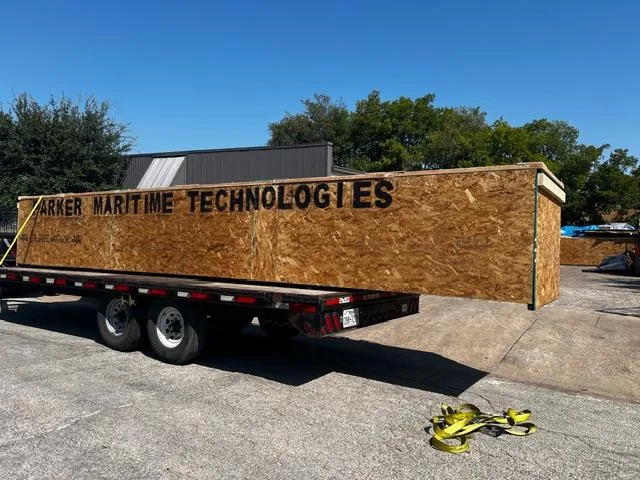
A relatively small component may require a compact protective container. A large compressor or pump may need a heavy-duty wooden crate with a reinforced base and internal supports.
The packaging should be designed around the machinery rather than forcing the machinery into an unsuitable container.
Custom packaging can account for unusual shapes, weight distribution, delicate sections, and areas that need extra clearance. It can also provide a more stable foundation for equipment that would otherwise be difficult to handle.
Think of custom packaging as a fitted suit. A suit designed specifically for one person generally provides a better fit than one chosen randomly from a shelf. Industrial crates work on a similar principle: the closer the packaging matches the shipment, the easier it can be to protect the contents.
What Makes a Strong Industrial Crate?
A crate used for heavy machinery needs to do more than surround the equipment.
Its construction should support the weight of the contents and provide adequate protection during handling and transportation. Depending on the shipment, the design may include reinforced framing, strong flooring, blocking, bracing, cushioning, or other protective features.
Internal support is particularly important.
If machinery has space to move inside the crate, repeated movement during transportation can cause unnecessary stress. A properly planned package helps keep the equipment in a controlled position.
The base also matters. Heavy machinery places substantial pressure on the surface supporting it. A packaging design that is appropriate for a lightweight item may be completely unsuitable for a machine weighing thousands of pounds.
This is one reason professional assessment is valuable for industrial shipments.
Don't Forget the Smaller Components
Large machinery often gets most of the attention, but smaller parts can be just as important.
A control unit, gauge, fitting, cable, sensor, valve, or removable attachment could be vulnerable during handling. If such components are damaged or lost, the main machine may arrive at its destination but still be unable to operate properly.
Where appropriate, removable parts can be separately protected and clearly identified.
This also makes receiving easier. Workers at the destination can determine what belongs with the primary machine rather than spending time searching through a large crate.
Good packaging should therefore protect the complete shipment, not just the largest object inside it.
Weather Can Change the Shipping Equation
Machinery may spend hours or days exposed to changing conditions while it is being transported or temporarily stored.
Rain is an obvious concern, but moisture is not the only environmental factor worth considering. Humidity, dust, temperature changes, and condensation can also affect certain equipment.
Metal surfaces may be vulnerable to corrosion under unsuitable conditions. Electrical components may require protection from moisture. Openings may need to be covered so that dirt and water do not enter sensitive areas.
The appropriate protection depends on the equipment and the anticipated journey.
For some shipments, protective wrapping may be sufficient. Other situations may call for stronger moisture-control measures.
The important point is to consider environmental exposure before transportation begins rather than discovering the problem after delivery.
Getting Heavy Machinery Onto the Trailer
Loading is one of the most important stages of oil and gas machinery shipping.
Heavy machinery must be moved onto the transportation equipment without creating unnecessary risk to people, the machine, or the packaging.
Depending on the size and design of the equipment, cranes, forklifts, or other lifting machinery may be required. The available lifting points should be identified beforehand.
Weight distribution also deserves attention. A heavy object cannot simply be placed wherever there happens to be room. Its position can affect how the transportation unit carries the load.
Once loaded, the machinery must be secured so that it remains stable during movement.
Imagine carrying a full bucket of water in a vehicle. Even though the bucket is heavy, sudden braking and turning can cause the water to move dramatically. A heavy machine behaves differently, but the basic idea is similar: movement creates forces that need to be controlled.
Route Planning Can Prevent Unpleasant Surprises
The destination is only half of the transportation equation. The route between the origin and destination matters too.
Large machinery may face restrictions that ordinary passenger vehicles never encounter. Depending on the shipment, factors such as vehicle height, width, length, and weight can influence route planning.
Road construction, narrow passages, bridges, clearance limitations, and local requirements may need to be considered.
A route that appears shortest on a map may not be the most practical choice for an oversized industrial load.
Advance planning allows transportation professionals to identify potential obstacles before the machinery is already on the road.
Where Custom Packaging and Shipping Services Fit In
Businesses shipping industrial machinery may have the equipment and destination figured out but still face an important question: who will handle the packaging and transportation details?
This is where custom packaging and shipping services can provide practical value.
Rather than treating the crate, loading process, and transportation arrangement as unrelated tasks, an experienced provider can look at the shipment as a complete project.
For example, the final dimensions of the packaging can influence the transportation arrangement. The weight of the packaged machinery can affect loading requirements. The method used to secure the equipment can influence how it is positioned.
When these factors are considered together, there is less room for one part of the plan to conflict with another.
AA&D Crating can help businesses address specialized industrial packaging needs while coordinating the practical considerations associated with moving large equipment.
Shipping Documents Should Be Easy to Understand
Industrial shipments can involve several people and organizations.
The equipment owner may be different from the company arranging transportation. A packaging provider may prepare the crate, while another company handles the actual freight movement. The receiving facility may have its own unloading team.
Clear documentation helps keep everyone working from the same information.
Depending on the shipment, useful records may include:
- Equipment description
- Dimensions
- Weight
- Handling instructions
- Packaging details
- Photographs
- Pickup information
- Delivery information
- Special unloading requirements
Labels and instructions should also be easy to identify.
A well-organized shipment reduces the possibility of confusion when the machinery reaches its destination.
What Happens at the Receiving Site?
Successful delivery does not necessarily mean the job is finished.
Before shipment, businesses should consider how the equipment will be unloaded once it arrives. Does the destination have sufficient space? Is suitable lifting equipment available? Is there a clear path from the delivery point to the final installation area?
These questions can prevent an awkward situation in which a massive machine arrives safely but cannot be moved into the building.
Receiving personnel should also know what equipment is arriving and whether there are special handling instructions.
The final few feet of a shipment can sometimes be just as important as the hundreds of miles before it.
Common Mistakes Are Often Avoidable
Many shipping problems begin with assumptions.
One assumption is that a strong-looking machine does not need much protection. Another is that any heavy-duty crate will work. A third is that transportation can be arranged after everything else has been completed.
These approaches can create unnecessary complications.
Other mistakes include:
- Failing to confirm exact measurements
- Ignoring the completed package size
- Forgetting about removable components
- Leaving vulnerable connections exposed
- Underestimating unloading requirements
- Not planning for environmental exposure
- Waiting too long to arrange specialized transportation
- Failing to document the machinery before shipment
None of these problems has to become part of the shipping process. Careful planning can address them before they interfere with delivery.
Why Proper Preparation Is Worth the Effort
Industrial machinery represents a significant investment. It may also be tied directly to a construction project, maintenance schedule, production operation, or field installation.
If equipment arrives damaged, the consequences can extend beyond the cost of repairing the machine. Workers may have to wait, installation schedules can shift, replacement parts may need to be ordered, and transportation may have to be arranged again.
Good preparation helps reduce these avoidable disruptions.
The purpose of professional packaging is not to make a shipment unnecessarily elaborate. It is to match the level of protection to the value, size, weight, and sensitivity of the equipment.
In other words, the packaging should make sense for what it is protecting.
A Better Way to Think About Machinery Shipping
The safest approach is to view the shipment as a chain.
Preparation affects packaging. Packaging affects dimensions and weight. Those factors affect transportation. Transportation affects loading and route planning. Delivery affects unloading.
If one link is overlooked, it can create difficulties elsewhere.
A coordinated approach brings these pieces together before the machinery starts moving.
For companies involved in oil production, natural gas operations, processing, drilling, maintenance, and related industrial work, this approach can make complicated transportation projects considerably easier to manage.
Conclusion
Oil and gas machinery shipping requires more thought than simply selecting a vehicle and scheduling a pickup. Large industrial equipment must be evaluated, prepared, protected, secured, transported, and unloaded with its specific characteristics in mind.
The right packaging can help protect machinery from impact, movement, moisture, and handling-related risks. Careful loading and securing can help keep heavy equipment stable during transportation, while route and delivery planning can reduce unexpected obstacles.
For businesses that regularly move pumps, compressors, generators, drilling machinery, processing equipment, and other energy-related assets, custom packaging and shipping services can bring these individual tasks together into a more organized process.
AA&D Crating offers a practical option for companies that need specialized crating and packaging support for demanding industrial shipments.
Ultimately, the goal is straightforward: move valuable machinery from one location to another without compromising the equipment's condition or creating unnecessary delays. When the shipment is planned around the machinery itself, every stage of the journey becomes easier to manage.