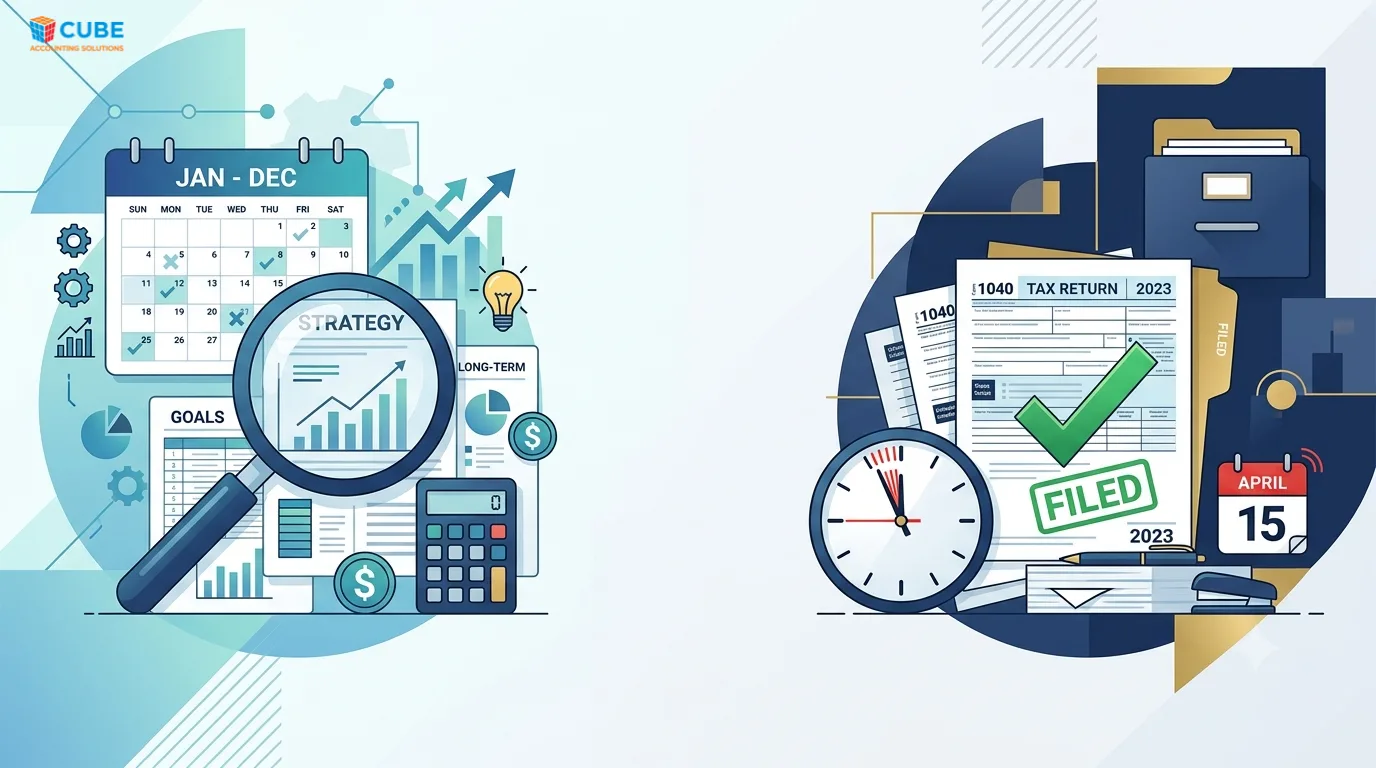
Most business owners only think about taxes once a year, usually sometime between January and April, when it's time to gather documents and file a return. That's tax preparation. It's necessary, it's deadline-driven, and by the time it happens, most of the decisions that determined the tax bill have already been made.
Tax planning is a different activity entirely. It happens throughout the year, before the numbers are locked in, while there's still room to make choices that actually change the outcome. Understanding the difference between the two isn't just a matter of definitions — it affects how much a business ends up owing and how many surprises show up at filing time.
Tax Preparation: Reporting What Already Happened
Tax preparation is the process of taking a year's worth of financial activity and turning it into an accurate return. For an individual, that might mean Form 1040 preparation and e-filing. For a business, it depends heavily on entity type — an S-corp return looks different from a partnership return, which looks different from a sole proprietor filing a Schedule C.
A firm handling individual tax return preparation and S-corp tax return preparation is working with numbers that are essentially fixed. Revenue was what it was. Expenses were what they were. Payroll decisions, retirement contributions, and equipment purchases already happened. The preparer's job is to apply the tax code correctly to those facts, claim every deduction and credit the business is entitled to, and file an accurate return by the deadline.
This is precise, technical work, and it matters. An incomplete or inaccurate return can trigger an IRS notice, an audit, or a missed deduction that costs real money. But by definition, tax preparation is retrospective. It reports on decisions that can no longer be changed.
Tax Planning: Shaping the Outcome Before It's Fixed
Tax planning happens earlier, when decisions are still adjustable. It's the process of looking at a business's financial picture during the year — not just at year-end — and making choices deliberately with tax consequences in mind.
That can include things like reviewing quarterly estimated tax calculations so a business isn't blindsided by penalties, or checking whether reasonable compensation for an S-corp officer is properly structured before payroll runs for the year are finalized. It can mean deciding when to make a major purchase, how to time a bonus, or how to structure a distribution — all before those events happen rather than after.
The distinction matters because most small business tax reduction strategies only work if they're implemented before the tax year closes. A deduction someone forgot to plan for in June generally can't be recreated in April.
Why the Timing Difference Matters So Much
Think of tax preparation as taking a photograph and tax planning as directing the scene before the photo is taken. A skilled preparer can make sure the photograph is accurate and nothing is missed. But no amount of preparation skill can change what's already in the frame.
This is the core reason proactive tax planning vs. tax preparation isn't really an either-or choice — a business needs both, but they solve different problems. Preparation ensures compliance and accuracy for the year that already happened. Planning influences what next year's return will actually look like.
Who Tends to Notice the Gap
The businesses that feel this distinction most acutely tend to be the ones with more complexity: multiple entities, S-corp status, growth from one year to the next, or income that fluctuates seasonally.
Tax planning for S-corp owners often centers on getting the balance right between salary and distributions, since that balance affects both payroll tax exposure and overall tax liability — and it's a decision that has to be made through the year, not after it ends.
Owners running more than one business face a related but bigger version of the same problem. Tax strategy for multi-entity business owners has to account for how income, expenses, and elections in one entity affect the others. Without coordinated multi-entity tax planning, it's easy for entities to be filed correctly on paper while still missing opportunities that only become visible when someone looks at the full picture together.
What Year-Round Tax Strategy Actually Looks Like
In practice, year-round tax strategy for business owners doesn't mean constant meetings about taxes. It usually means a few defined check-in points during the year — sometimes structured as quarterly tax strategy sessions — where a business reviews year-to-date performance, revisits estimated payments, and identifies any decisions coming up that carry tax implications.
This is different from a service built purely around filing. A firm that only offers tax return preparation services and packages is set up to produce accurate returns for work that's already been done. A firm offering ongoing tax planning services for small business is set up to influence what those returns will contain before the year closes.
Neither replaces the other. A business still needs its returns filed correctly and on time, whether that's an individual return, an S-corporation tax preparation service, or C-corporation tax return preparation. But relying on preparation alone means only ever reacting to a tax bill that's already been determined by decisions made without a tax lens applied to them.
The Cost Question
One reason some businesses stick with preparation-only relationships is cost — business tax return preparation cost is a known, bounded expense, while ongoing planning can feel like an open-ended add-on. In practice, the calculation usually runs the other way. A single missed opportunity — an improperly structured distribution, a deduction that expired unused, an estimated payment that wasn't adjusted when income changed — often costs more than a planning engagement would have.
That's the practical argument for treating tax planning as a tax strategy consultation for business owners rather than a luxury reserved for larger companies. The businesses with the most to gain from planning are often the ones assuming they're too small to need it.
Bringing the Two Together
The healthiest approach treats preparation and planning as two parts of the same relationship rather than two separate services. Planning identifies the moves that make sense during the year. Preparation makes sure those moves are documented and filed correctly when the year is over.
Businesses looking to actually reduce their tax burden — not just report it accurately — eventually run into the same conclusion: filing an accurate return is necessary, but it isn't a strategy. Knowing how to reduce business taxes legally requires decisions made before the numbers are final, not explanations written after they are.