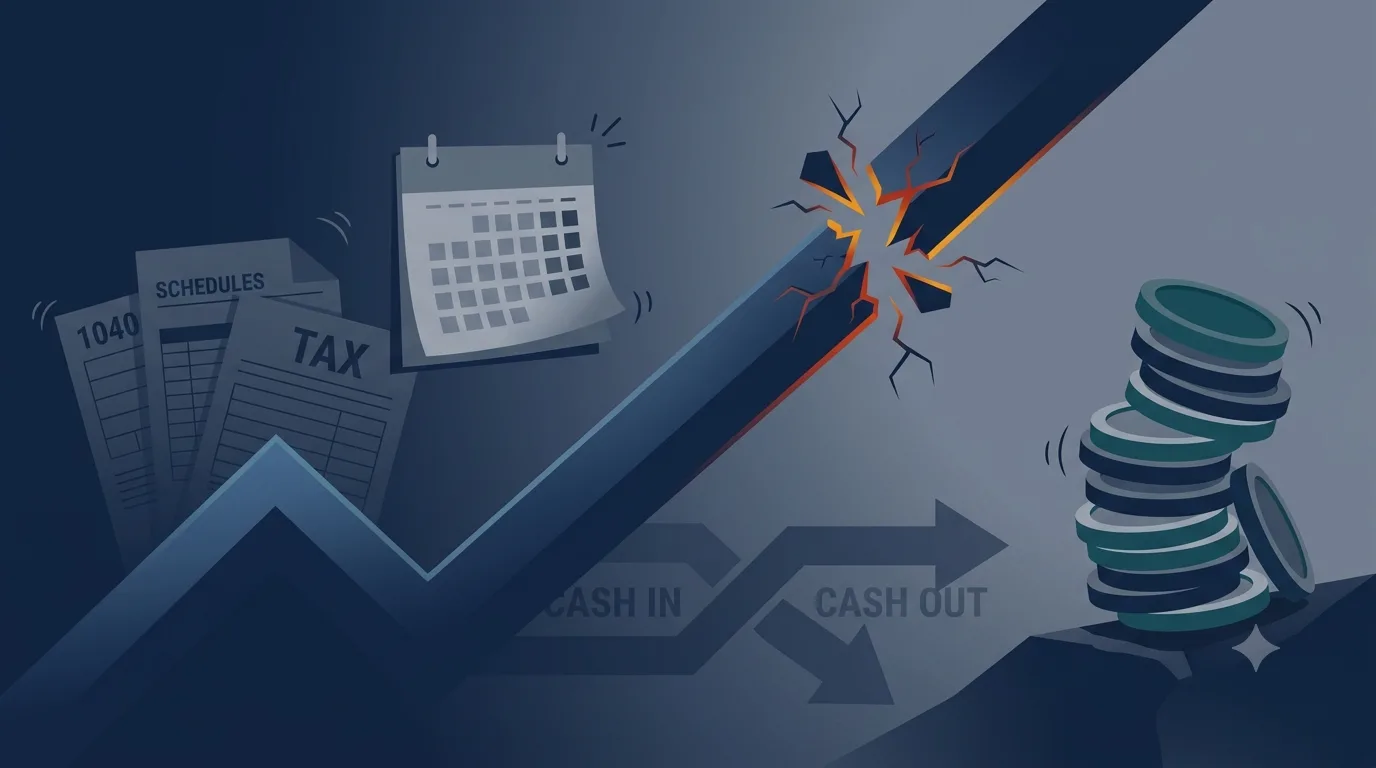
There's a particular kind of failure that doesn't look like failure at all while it's happening. Revenue is climbing. New clients are signing. The phone doesn't stop ringing. By every outward measure, the business is winning.
And yet, somewhere between the second big year and the third, the wheels come off — not because the business stopped growing, but because it grew faster than the systems underneath it could support.
This is one of the most common and least discussed failure patterns in small and mid-sized business. It isn't caused by a bad product or a shrinking market. It's caused by success arriving before the financial infrastructure was ready to handle it.
Growth Doesn't Fail Quietly — It Fails Financially
When a business scales quickly, almost everything about its financial picture changes at once: payroll headcount, inventory or job costs, tax exposure, entity structure, cash conversion cycles.
A bookkeeping setup that worked fine at $800,000 in revenue can become dangerously inadequate at $4 million, not because anyone did anything wrong, but because the volume and complexity outpaced the tools tracking it.
The owners who get blindsided almost always describe the same experience afterward: the business felt healthy right up until a tax bill, a cash crunch, or a lender's question revealed that the numbers they'd been making decisions on weren't telling the full story. Growth had outrun visibility.
The First Crack: Tax Exposure Nobody Modeled
Fast growth almost always changes a business's tax position, often faster than the owner realizes. A jump in profit means a jump in tax liability, and if nobody is running quarterly estimated tax calculations against updated projections, the business can end up significantly underpaid come filing season — sometimes by a number large enough to strain cash reserves that were earmarked for payroll or inventory.
This is where the gap between tax preparation and tax planning becomes very real, very fast.
Tax preparation looks backward: it reports what already happened. Tax planning looks forward and asks what the business should be doing differently right now, this quarter, based on where the year is actually heading.
A business that's only ever had its taxes prepared — never planned — has no early warning system. The first sign of a problem is often the bill itself.
For businesses structured as S-corporations, growth adds another layer: reasonable compensation S-corp officer payroll requirements don't stay static as profit climbs.
An officer salary that was defensible at a smaller profit level can become a liability if it isn't revisited as the business scales, and it's a detail that's easy to overlook when everyone's attention is on sales, not payroll structure.
The Second Crack: Entity Structure That No Longer Fits
Many fast-growing businesses start simple — a single LLC or S-corp — because simple was all they needed at the time.
Growth changes that calculus. A business that's expanded into new states, added a second location, spun up a related entity, or brought on partners often needs a fundamentally different structure than the one it started with.
Without multi-entity tax planning services, it's easy for a growing business to end up with a structure that made sense at launch but now creates unnecessary tax exposure, liability risk, or reporting complexity.
Owners running multiple entities need tax strategy for multi-entity business owners that actively coordinates across the whole structure — not separate, disconnected filings that miss opportunities to plan holistically across the entities as a group.
The Third Crack: Multi-State Exposure Nobody Tracked
Growth frequently means new geography — a new hire working remotely in another state, a new customer base that crosses state lines, a physical expansion into a new market. Each of those can quietly create tax nexus in a state the business has never filed in.
Multi-state tax filing obligations don't announce themselves. They show up later, often as a notice, once a state has determined the business had a filing responsibility it wasn't meeting.
By the time that happens, the business may be facing prior-year tax catch-up filing across multiple periods and jurisdictions, along with the administrative weight of IRS notice response support or the state-level equivalent.
A proactive nexus study for multi-state business — done at the point of expansion, not years afterward — is far cheaper than the alternative.
The Fourth Crack: Cash Flow That Doesn't Match the P&L
This is the crack that catches the most owners off guard, because it's the most counterintuitive: a business can be profitable on paper and still run out of cash.
Fast growth typically means the business is spending money — on payroll, inventory, materials, new hires — well before it collects the revenue tied to that spending. The P&L says the business is thriving.
The bank account tells a different, more urgent story.
Without disciplined, real-time financial reporting, owners often don't see the gap forming until it's already a crisis — a payroll that almost doesn't clear, a vendor payment pushed a week too many times, a line of credit tapped out faster than expected.
This is precisely the kind of blind spot that CFO-level oversight is built to catch: someone watching cash conversion timing, not just top-line growth, and flagging the mismatch months before it becomes an emergency.
Why "We'll Fix It Later" Doesn't Work
The instinct in a fast-growing business is almost always to keep pushing forward and deal with the financial infrastructure once things "settle down." The problem is that fast-growing businesses rarely settle down on a convenient schedule, and the cost of catching up later is almost always higher than the cost of building it in real time.
Prior-year tax catch-up filing, retroactive nexus registrations, and reconstructed financials for a lender or investor are all more expensive, more stressful, and more error-prone than the ongoing version of the same work.
A business that waits until it needs a clean set of financials for a bank loan or acquisition conversation is often surprised by how long it takes to produce one — and how much that delay can cost in lost opportunity.
What Actually Prevents This Failure Pattern
The businesses that grow through this stage instead of stalling out at it generally share a few habits:
- Year-round tax strategy for business owners, not a single meeting in December. Tax planning that happens continuously catches problems while there's still time to act on them.
- Quarterly tax strategy sessions that revisit projections as the year's actual numbers come in, rather than assuming January's plan still holds in September.
- Entity and multi-state structure reviewed proactively as the business expands — not reconstructed after a notice arrives.
- Real cash flow forecasting that sits alongside the P&L, not a substitute for it.
- A clear answer, at any point in the year, to "what will we owe, and do we have the cash to cover it."
This is the core difference between proactive tax planning vs. tax preparation, and it's the difference that determines whether rapid growth becomes a business's best year or its most dangerous one. Tax preparation tells you what happened. Tax planning — paired with real financial visibility — tells you what's about to happen, while there's still time to do something about it.
The Bottom Line
Fast growth doesn't kill businesses on its own. It kills the businesses that scaled their revenue without scaling the financial systems watching over it. The tax bill that seemed to come out of nowhere, the cash crunch in the middle of the best sales quarter ever, the multi-state notice for a market the business barely realized it had entered — none of these are random.
They're what happens when growth outpaces oversight.
Firms like Cube Accounting Solutions work with growing businesses specifically at this inflection point — building out tax strategy consultation for business owners, multi-entity planning, and quarterly forecasting so that growth stays a strength instead of becoming the very thing that exposes a business's weakest financial link. The businesses that make it through this stage aren't the ones that grew the fastest. They're the ones that grew with someone watching the numbers as closely as they were watching the sales pipeline.