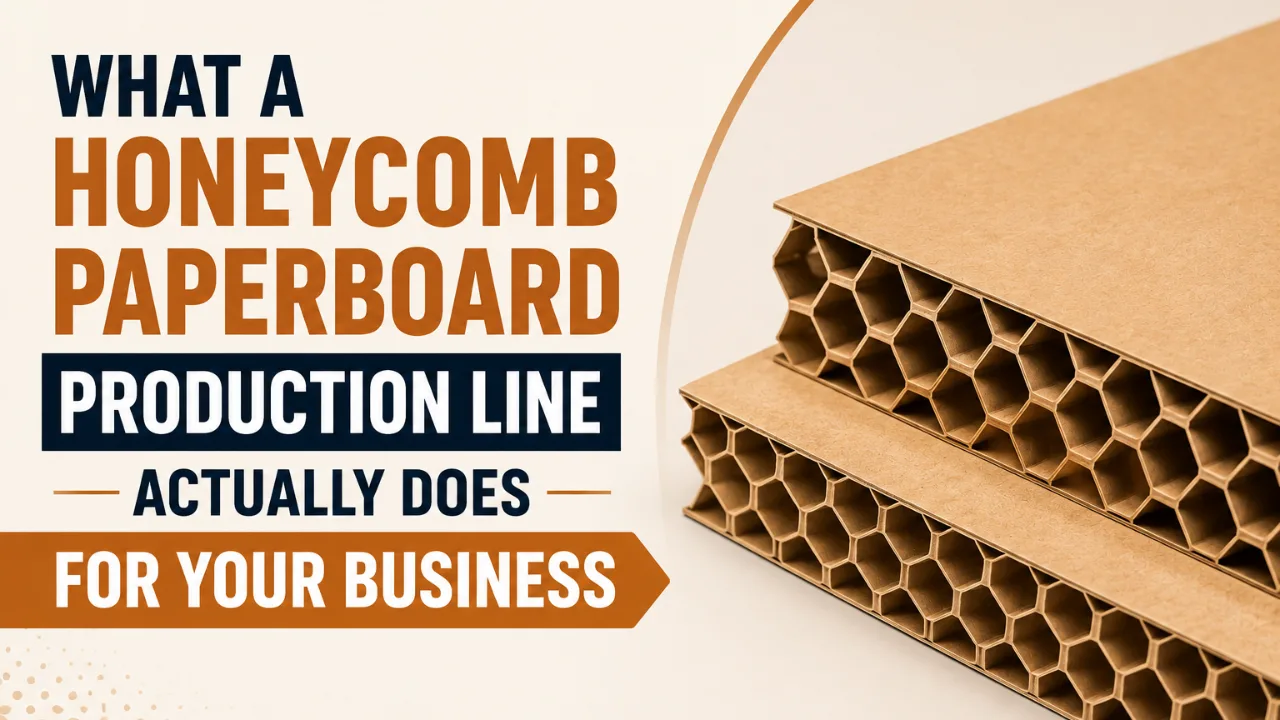
Most people who look into a Honeycomb Paperboard Production Line focus on one thing.
The product.
They read about the hexagonal cell structure. They learn it is lightweight and strong. They understand it is eco friendly. And then they stop there.
What they miss is the business impact. What actually changes in your operation when you add this capability. How it affects your clients, your margins, your competitive position, and your long-term growth.
This article covers all of that. Here is what a Honeycomb Paperboard Production Line actually does for your business. In plain, honest terms.
It Puts You in a Market That Is Actively Growing
Why the Timing Is Right
The packaging industry is in the middle of a significant shift.
Governments across India and globally are tightening regulations on plastic and foam packaging. Brands are under consumer pressure to switch to sustainable alternatives. And the economics of lightweight packaging are becoming more attractive as freight costs rise.
Honeycomb paperboard sits at the intersection of all three of these trends. It is made from recycled paper. It is fully recyclable. It is significantly lighter than foam, wood, and solid fibreboard at equivalent strength levels. And it costs less per unit of protective performance than most alternatives it replaces.
The Markets Actively Looking for Honeycomb Paperboard Suppliers
Setting up a Honeycomb Paperboard Production Line gives your business direct access to clients who are actively looking for suppliers right now:
- Furniture manufacturers using honeycomb paperboard as a lightweight core material in flat-pack doors, table tops, and shelving panels
- Electronics and appliance companies replacing foam inserts with honeycomb protective packaging
- Automotive parts manufacturers using honeycomb pallet boards and protective packaging for parts handling and shipment
- E-commerce brands switching from foam void fill to honeycomb corner guards and edge protectors
- Industrial goods manufacturers replacing wooden pallets with lighter, recyclable honeycomb pallet boards
- Export-focused businesses needing packaging that meets international sustainability standards
These are not niche markets. These are large, active industries with consistent packaging demand. And they are all moving toward honeycomb paperboard faster in 2026 than they were two years ago.
It Opens a Product Category Most Competitors Cannot Offer
The Competitive Gap in the Market
Most packaging businesses in India produce corrugated boxes. 3 ply, 5 ply, printed, plain. The market is competitive. Many plants offer similar products at similar prices.
A Honeycomb Paperboard Production Line takes you out of that crowded market and into a category where far fewer businesses are operating.
Honeycomb paperboard is a specialist product. Not every packaging plant produces it. Not every region has a reliable local supplier. When you set up this capability you become one of a smaller number of businesses that can serve the growing demand in your area.
What This Means for Your Client Relationships
Clients who use honeycomb paperboard are harder to lose than clients who use standard corrugated boxes.
Corrugated box clients can switch suppliers relatively easily. One call to a competitor, similar product, similar price. Done.
Honeycomb paperboard clients are stickier. Finding a new reliable supplier means qualifying their production, testing their panel quality, and risking supply disruption during the switch. Most clients would rather stay with a supplier who performs well than take that risk.
This client loyalty translates directly into more stable, predictable revenue for your business.
It Changes Your Raw Material Economics
What Honeycomb Paperboard Is Made From
A Honeycomb Paperboard Production Line runs on recycled kraft paper. This is one of the most widely available and cost-effective raw materials in the Indian packaging industry.
The production process uses paper efficiently. The hexagonal cell structure is created by bonding strips of paper in an offset pattern and expanding them. This means a relatively small amount of paper creates a large volume of honeycomb core structure. Less raw material per unit of finished product is the fundamental economic advantage of honeycomb paperboard production.
The Material Cost Advantage Over Alternatives
Packaging MaterialWeight Per UnitMaterial CostRecyclableFoam ReplacementFoam (EPS)HeavyMediumNoReference pointSolid FibreboardVery HeavyHighPartiallyPossibleWooden Pallet BoardHeaviestHighPartiallyPossibleHoneycomb PaperboardLightestLowerYesDirect replacementLess material per unit of protective performance. Lower raw material cost per square metre of finished panel. And because the material is recycled paper rather than petroleum-based foam or timber, the input cost is more stable and predictable.
It Reduces Packaging Weight for Your Clients
Why Lighter Packaging Matters More Than Ever
Freight costs in India and globally are tied to weight. Every kilogram of packaging that can be eliminated from a shipment is a direct saving for your client.
Honeycomb paperboard delivers equivalent or better protective performance compared to foam, solid fibreboard, and wooden pallet boards at a fraction of the weight.
When you supply honeycomb paperboard to a client replacing foam or wood, you are not just selling them packaging. You are reducing their freight bill. That is a business benefit they feel every time they ship.
Clients who experience this benefit are loyal. They do not look for cheaper alternatives because the total cost of ownership of honeycomb packaging, including the freight saving, is already lower than what they were using before.
It Improves Your Business Margins
Where the Margin Improvement Comes From
The margin profile of a Honeycomb Paperboard Production Line is different from a standard corrugated box plant.
Corrugated box margins are compressed by competition. Many plants. Similar products. Price pressure from clients who know they have alternatives. Margin per box is thin and getting thinner in the most competitive segments.
Honeycomb paperboard margins are better for two reasons.
First: Fewer competitors means less price pressure. You are not fighting ten other plants for the same order.
Second: Honeycomb paperboard delivers a clearly demonstrable value to clients. It is lighter. It is stronger per unit of weight. It is eco-friendly. It reduces their freight cost. These are measurable benefits that justify a better price per square metre than commodity corrugated boxes command.
It Gives Your Business a Sustainability Story
Why This Matters for Client Acquisition in 2026
Brand sustainability commitments are no longer marketing language. They are procurement requirements.
Large FMCG companies, electronics manufacturers, automotive brands, and e-commerce platforms have internal sustainability targets. They are under pressure from their own clients and investors to reduce plastic and non-recyclable materials from their packaging and supply chains.
When you supply honeycomb paperboard, you are helping your clients meet their sustainability goals. This is a genuine business benefit that goes beyond the product itself.
The Sustainability Credentials of Honeycomb Paperboard
- Made from recycled kraft paper
- Fully recyclable at end of life
- No petroleum-based materials
- Replaces foam which is neither biodegradable nor easily recyclable
- Replaces wood which requires logging and is heavy to transport
- Lower carbon footprint per unit of protective performance than most alternatives
When your clients can tell their own customers and investors that they have switched to honeycomb paperboard packaging, that is a story worth paying for. And they will pay a supplier who helps them tell it.
It Fits Into an Existing Packaging Business
Adding Honeycomb Capability to What You Already Do
A Honeycomb Paperboard Production Line does not have to be a standalone business. It fits naturally alongside an existing corrugated box plant.
Many corrugated box plant owners add honeycomb paperboard production as a second capability. Their existing clients start asking about protective packaging inserts, corner guards, and pallet boards. Rather than sending those clients to a competitor, they add a honeycomb line and supply the full packaging requirement themselves.
This expands revenue per client. It strengthens client relationships. And it uses the existing factory infrastructure, sales relationships, and operational experience the business has already built.
The Machinery Relationship
A Honeycomb Paperboard Production Line uses different corrugated box making machinery from a standard corrugated board line. But the operational principles are similar. Paper rolls as raw material. Continuous production process. Precision controls. After-sales support from the manufacturer.
Plant owners who already understand how to run corrugated box making machinery adapt to honeycomb production relatively quickly with proper operator training. The learning curve is shorter than starting an entirely new manufacturing category from scratch.
What to Look for When Choosing a Manufacturer
Choosing the right manufacturer for your Honeycomb Paperboard Production Line matters as much as choosing the right line.
Here is what to check:
Manufacturer Evaluation Checklist
FactorWhat to AskWhy It MattersISO CertificationRequest the certificateConfirms quality management systemIn-House DesignDo you design your own machinesDetermines technical support qualityAfter-Sales SupportCan engineers reach my locationAffects breakdown response timeSpare Parts SupplyAre parts stocked locallyDetermines plant downtime riskOperator TrainingIs training includedAffects startup production qualityComplete Line SupplyCan you supply the full lineEnsures compatibility across machinesTrack RecordHow many plants have you equippedConfirms real world experienceWarranty TermsWhat does warranty coverPost purchase protectionNatraj Machines: A Trusted Partner for Honeycomb Paperboard Production
Natraj Machines, headquartered in Palwal, Haryana, is one of India's leading corrugated box making machine manufacturers and packaging machinery brands. ISO 9001:2008 certified, the company manufactures over 100 types of corrugating and packaging machines including complete Honeycomb Paperboard Production Lines.
Their team provides complete turnkey support including:
- Machinery consultation and customised plant planning
- Full installation and commissioning at your facility
- Operator training for your production team
- Preventive maintenance programmes
- Fast spare parts supply
- Comprehensive after-sales technical support
Whether you are setting up a standalone honeycomb paperboard business or adding this capability to an existing corrugated box plant, Natraj Machines has the experience and product range to support your business from day one.
Is a Honeycomb Paperboard Production Line Right for Your Business
Signs This Investment Makes Sense for You
Your business is a strong candidate for a Honeycomb Paperboard Production Line if any of these apply:
- You run a corrugated box plant and clients are asking about protective packaging, corner guards, or pallet boards
- You are looking to enter a packaging market with less competition and better margins than standard corrugated boxes
- Your region has furniture manufacturers, electronics assemblers, auto parts companies, or industrial goods manufacturers who currently use foam or wooden pallet packaging
- You want a business with a genuine sustainability story that resonates with modern brands
- You are looking for a manufacturing investment with a growing market and stable long-term demand
Questions to Ask Before You Invest
- What daily output volume do I need to produce to serve my target client base
- What panel thickness and cell size ranges do my target clients need
- Is my factory space sufficient for the production line, raw material storage, and finished panel storage
- What paper grades are available from suppliers in my region
- What training and after-sales support does the manufacturer provide
Final Thoughts
A Honeycomb Paperboard Production Line does more than produce a packaging material.
It puts your business in a growing market. It gives you a product that clients are actively looking for and switching to. It delivers better margins than commodity corrugated box production. It builds more loyal client relationships. And it gives your business a sustainability story that opens doors with modern brands who care where their packaging comes from.
The businesses that set up honeycomb paperboard production capability in 2026 are positioning themselves at the centre of one of the fastest-growing segments in Indian packaging. That positioning will pay dividends for years to come.