Businesses often reach a point where a standard website no longer meets their needs. Perhaps customers want to book services online, employees need a centralized dashboard, or the business needs to automate operations. That is when the question arises: should you improve your website or invest in a web application?
Understanding the difference between a website and a web application helps you choose the right solution without overspending on unnecessary features.
Both can support business growth, but they serve different purposes. Your decision should depend on your goals, users, workflows, and budget.
Website vs. Web Application: What's the Difference?
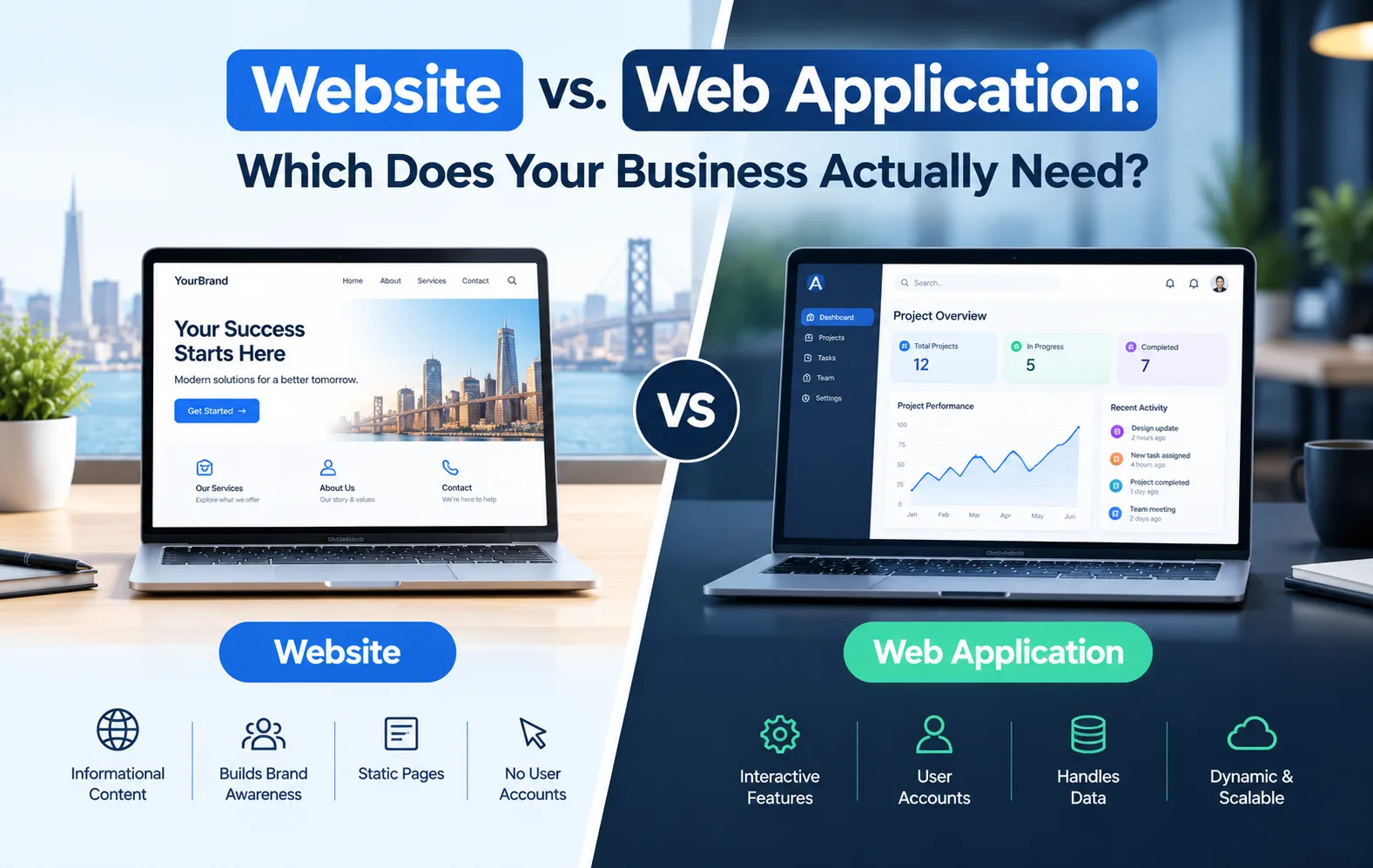
A website primarily shares information with visitors. It may include service pages, blogs, product catalogs, contact forms, and company information. Its main purpose is to inform, attract visitors, and generate leads.
A web application allows users to perform tasks and interact with data through a browser. Examples include online booking platforms, customer portals, project management tools, and inventory management systems.
For example, a restaurant website might display its menu and location, while a web application could let customers customize orders, make payments, and track deliveries.
The key difference is functionality: websites focus primarily on presenting information, while web applications enable interactive tasks and workflows.
When Does Your Business Need a Website?
A traditional website is often the right choice when your primary objective is to establish an online presence and communicate with potential customers.
Consider a website if you need to:
- Showcase products, services, and company information.
- Improve search visibility and attract organic traffic.
- Publish blogs, resources, and industry insights.
- Generate leads through contact forms and consultation requests.
- Build brand credibility and make it easier for customers to find you.
For many small businesses and startups, a well-designed website provides a practical starting point. You can expand its functionality as customer expectations and operational needs evolve.
When Should You Invest in Web Application Development?
Web application development becomes valuable when your business needs more than static information and basic forms.
A custom web application may be appropriate if you want to:
Automate business processes: Replace repetitive manual tasks with structured digital workflows.
Manage customer accounts: Allow users to access profiles, order histories, subscriptions, or personalized dashboards.
Integrate business systems: Connect payments, CRM software, inventory tools, and other platforms.
Support multiple user roles: Provide different permissions and features for customers, employees, managers, and administrators.
Scale digital services: Introduce new functionality without rebuilding the entire business system.
When comparing web app development services, focus on the business problem each feature solves rather than choosing technology simply because it sounds advanced.
Website vs. Web Application: What About Cost?
Costs depend on design, functionality, integrations, security, and ongoing maintenance. The following are illustrative estimates in USD, not fixed market prices.
- Business website: $2,000–$10,000 for a typical small-business website with standard pages and lead-generation features.
- Advanced website: $10,000–$25,000+ for custom design, content management, and more complex functionality.
- Custom web application: $15,000–$50,000+ for an initial application with user accounts, dashboards, and core workflows.
- Complex web application: $50,000–$150,000+ for advanced integrations, multiple user roles, automation, or enterprise requirements.
Actual quotations can fall outside these ranges. Hosting, third-party services, security updates, and ongoing development may add recurring expenses.
To manage costs, define your essential requirements first. A minimum viable product (MVP) can help you validate demand before investing in advanced features.
How to Choose the Right Development Partner
If your business needs custom functionality, selecting a reliable web application development company is an important decision.
Look for a team that understands your business objectives, user experience, security requirements, integrations, and long-term maintenance needs.
Before hiring a provider, ask about:
- Relevant projects and technical expertise.
- Project scope, milestones, and delivery timelines.
- Data security and access management.
- Integration with existing systems.
- Source-code ownership and documentation.
- Post-launch support and future enhancements.
Companies such as Apptunix can be included in your research when evaluating application development options. Compare providers based on their relevant experience, proposed approach, and suitability for your specific requirements.
Also consider web mobile application development if customers and employees need to access your platform across smartphones, tablets, and desktop browsers. Responsive design and mobile usability should be part of the planning process from the beginning.
Frequently Asked Questions
1. Can a website become a web application?
Yes. A website can evolve to include interactive features such as user accounts, booking systems, payments, and dashboards. The complexity depends on the existing architecture and required functionality.
2. Is a web application better than a website?
Neither is universally better. A website is suitable for information and lead generation, while a web application is useful when users need to complete tasks, manage data, or interact with business systems.
3. How long does web application development take?
A relatively simple application may take a few months, while complex platforms can require six months or longer. The timeline depends on features, integrations, testing, and project scope.
4. Does a web application work on mobile devices?
Yes. A properly designed web application can run in mobile browsers and adapt to different screen sizes. Some projects may also benefit from a dedicated mobile app.
Final Thoughts
Choosing between a website and a web application starts with understanding what your business and customers actually need. If your goal is to establish an online presence and generate leads, a website may be sufficient. If you need automation, interactive features, personalized experiences, or connected business workflows, a web application may offer greater value.
Before contacting a development partner, list your essential features, expected users, budget, and future goals. Then compare suitable solutions and request a detailed project estimate.
Planning your next digital project? Start by identifying the problem you want to solve, then speak with an experienced development team to determine the most practical and cost-effective approach.