IMARC Group has recently released a new research study titled “United States Railroad Market Report by Type (Rail Freight, Passenger Rail), Distance (Long Distance, Short Distance), End Use (Mining, Construction, Agriculture, and Others), and Region, 2026-2034,” offers a detailed analysis of the market drivers, segmentation, growth opportunities, trends and competitive landscape to understand the current and future market scenarios.
United States Railroad Market Size, Growth, and Forecast (2026-2034)
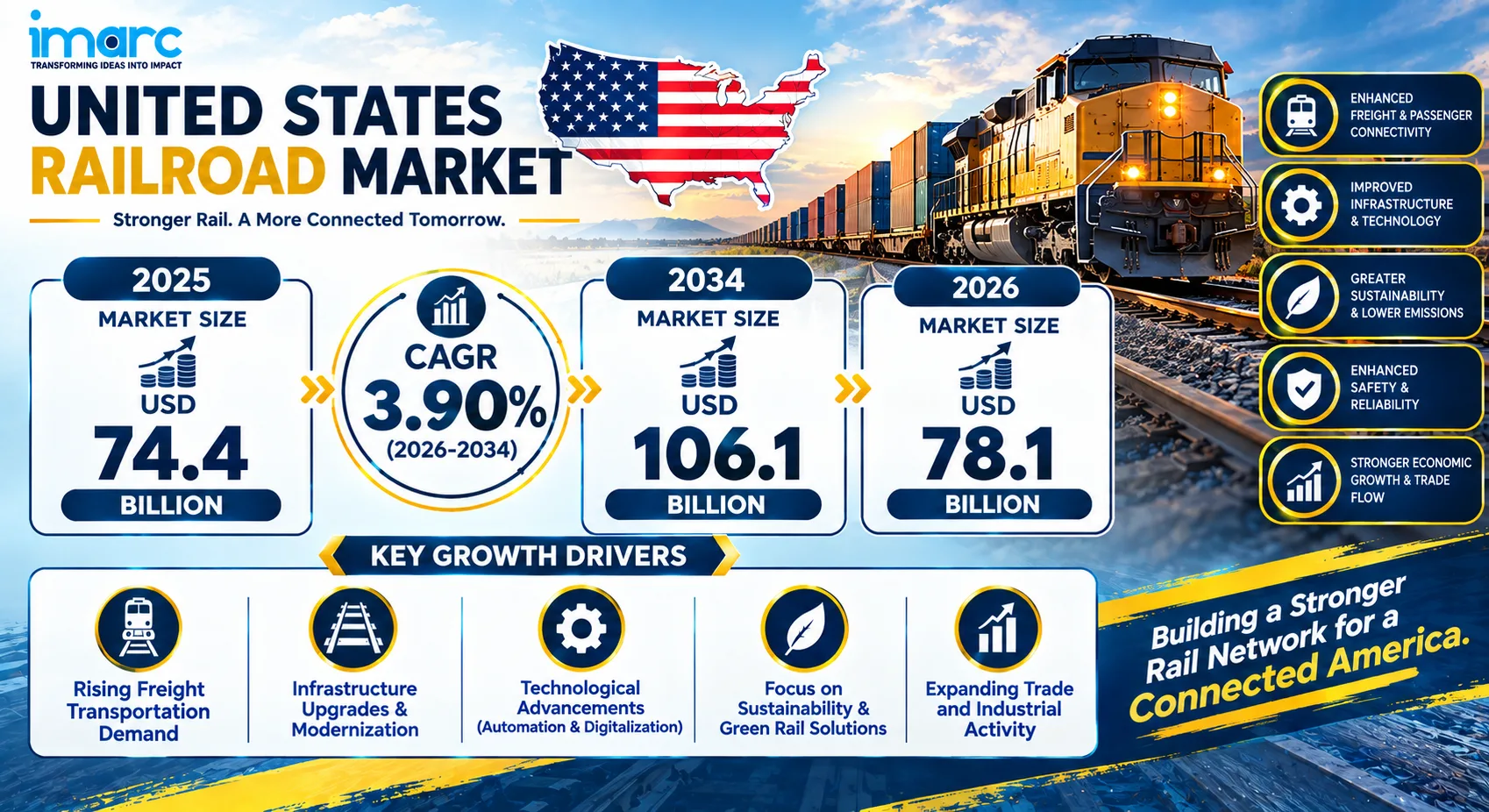
The united states railroad market increased from USD 74.4 Billion in 2025 to USD 78.1 Billion in 2026 and is projected to reach USD 106.1 Billion by 2034, exhibiting a CAGR of 3.90% during 2026-2034. Substantial government investment in rail infrastructure, environmental sustainability initiatives, rapid urbanization, and rising technological advancements are the primary factors driving the united states railroad market.
The railroad market encompasses the infrastructure, rolling stock, and services used to move freight and passengers across the country, spanning rail freight, passenger rail, and the long- and short-distance networks that connect industries, cities, and ports. Investments in Positive Train Control (PTC), Internet of Things (IoT) integration, and autonomous train technologies are revolutionizing rail operations, reducing human error, and improving overall efficiency.
Federal transportation legislation, including the Infrastructure Investment and Jobs Act (IIJA), has directed significant funding toward modernizing rail infrastructure, extending networks, and supporting high-speed rail projects. At the same time, growing public-private partnerships are pooling government and private-sector resources to deliver more comprehensive and efficient rail projects, further strengthening the united states railroad market outlook.
Explore Growth Opportunities in the United States Railroad Market - Grab Your Sample Report for Evaluation: https://www.imarcgroup.com/united-states-railroad-market/requestsample
Key Trends Driving the United States Railroad Market
- Rising government investments and policies: The Infrastructure Investment and Jobs Act has contributed around $1.2 trillion for infrastructure and transportation spending, with $550 billion allocated to new projects, including the modernization of rail infrastructure and expansion of high-speed rail systems.
- Urbanization and population growth: The U.S. urban population rose 6.4% between 2010 and 2020, increasing demand for commuter trains, light rail, and metro systems that ease congestion and connect residential areas with commercial and industrial hubs.
- Growing focus on environmental sustainability: Rail remains one of the most energy-efficient transport modes, carrying a significant share of freight and passenger volumes while accounting for only a small fraction of total transport energy demand, encouraging a shift toward electrification and alternative fuels such as hydrogen.
United States Railroad Market Report Segmentation:
The United States Railroad Market report provides a detailed segmentation analysis to help businesses identify key growth segments and evolving industry dynamics. The market is categorized based on type, distance, and end use, offering comprehensive insights across the united states railroad market.
Type Insights:
- Rail Freight: This segment facilitates the efficient, cost-effective movement of bulk goods, raw materials, and finished products across vast distances, serving manufacturing, agriculture, mining, and energy industries.
- Passenger Rail: This segment covers commuter trains, intercity rail, and high-speed rail systems that reduce traffic congestion, lower travel times, and offer a sustainable alternative to car travel.
Distance Insights:
- Long Distance: Long-distance rail connects major cities, states, and international borders, with freight trains moving bulk commodities and passenger trains offering long-haul travel options.
- Short Distance: Short-distance rail supports urban transit systems such as subways, light rail, and commuter trains, along with short-haul freight services that serve local industries and distribution networks.
End Use Insights:
- Mining: Rail transport is essential for moving extracted minerals and ores such as coal and iron ore efficiently and cost-effectively over long distances to processing facilities and ports.
- Construction: Railroads move cement, steel, lumber, and aggregates needed for building infrastructure projects, offering an efficient solution for heavy and bulky materials.
- Agriculture: Rail transport provides a reliable, cost-efficient means of moving grains, fruits, vegetables, and livestock from farms to processing plants, distribution centers, and export terminals.
Regional Insights:
The Northeast region relies heavily on passenger and freight rail services, supported by increasing investments in track upgrades, signal improvements, and station enhancements. The Midwest serves as a hub for agricultural and industrial activity, with an extensive rail network moving grains, livestock, and manufacturing goods. The South is a rapidly growing region leveraging rail networks and strategic ports to support energy, manufacturing, and agriculture, while the West benefits from a well-developed rail infrastructure connecting agricultural products, technology goods, and natural resources to domestic and international markets through its major ports.
United States Railroad Market: Recent News and Developments
- December 15, 2025: Amtrak unveiled its new Airo trainsets, manufactured by Siemens Mobility, as part of a $7.3 billion investment covering 83 trainsets with options for 130 more, supported by Infrastructure Investment and Jobs Act funding. The trains operate at speeds up to 125 mph and will enter service first on the Cascades route before expanding across the Northeast.
- May 28, 2026: The U.S. Surface Transportation Board accepted for substantive review the merger application filed by Union Pacific and Norfolk Southern, allowing the proposed roughly $85 billion combination to advance. The merged network would span more than 50,000 route miles across 43 states and connect about 100 ports in North America.
Challenges Impacting the United States Railroad Market
Large portions of U.S. rail infrastructure remain outdated, requiring significant investment for upgrades and ongoing maintenance to ensure safety and operational efficiency.
Large-scale consolidation activity, such as the proposed Union Pacific-Norfolk Southern merger, is drawing regulatory scrutiny over competition concerns, which could affect freight rates, service options, and the pace of network integration.
Investment Opportunities in the United States Railroad Market
The united states railroad market presents compelling investment opportunities supported by its projected growth from USD 78.1 Billion in 2026 to USD 106.1 Billion by 2034. Expansion in freight and passenger rail through public-private partnerships represents a high-value opportunity for improving capacity, efficiency, and sustainability.
Continued investment in Positive Train Control, IoT-enabled monitoring, and electrification presents a growing frontier for technology providers and rail operators seeking to modernize aging infrastructure.
Outlook of the United States Railroad Market (2026-2034)
The outlook for the united states railroad market is positive, supported by sustained government investment, urbanization, and continued technological innovation. The market is projected to grow from USD 78.1 Billion in 2026 to USD 106.1 Billion by 2034 at a CAGR of 3.90%.
Continued rail network modernization, expansion of high-speed and urban rail systems, and consolidation among major freight operators will be the defining trends shaping the united states railroad market through 2034.
Key Players in the United States Railroad Market
Union Pacific Corporation: One of the largest Class I freight railroads in the United States, Union Pacific has proposed acquiring Norfolk Southern in a deal valued at approximately $85 billion, aiming to create a single network linking the West Coast and East Coast and diverting an estimated 2.1 million truck movements to rail annually.
Norfolk Southern Corporation: A major eastern U.S. Class I freight railroad, Norfolk Southern is the proposed merger partner in the Union Pacific transaction now under review by the Surface Transportation Board, reflecting continued consolidation and investment activity in the market's competitive landscape.
Frequently Asked Questions (FAQs): United States Railroad Market
1. What is the current United States railroad market size?
The United States railroad market size increased from USD 74.4 Billion in 2025 to USD 78.1 Billion in 2026, and is projected to reach USD 106.1 Billion by 2034, growing at a CAGR of 3.90% during 2026-2034.
2. What does the United States railroad market cover?
The market covers rail freight and passenger rail services across long- and short-distance networks, serving end uses such as mining, construction, and agriculture across the Northeast, Midwest, South, and West regions.
3. What are the key drivers of the united states railroad market?
Key drivers include substantial government investment in rail infrastructure, environmental sustainability initiatives, rapid urbanization and population growth, and rising technological advancements such as Positive Train Control and IoT integration.
4. Which region leads the United States railroad market?
The Northeast leads due to its dense population, extensive urbanization, and historical reliance on passenger and freight rail, supported by ongoing infrastructure modernization investments.
5. Who are the key players in the United States railroad market?
Key players include Union Pacific Corporation and Norfolk Southern Corporation, alongside other major freight and passenger rail operators such as Amtrak, BNSF Railway, CSX Corporation, and Kansas City Southern.
Author IMARC Group
IMARC Group is a global management consulting firm that helps the world's most ambitious changemakers to create a lasting impact. The company provide a comprehensive suite of market entry and expansion services. IMARC offerings include thorough market assessment, feasibility studies, company incorporation assistance, factory setup support, regulatory approvals and licensing navigation, branding, marketing and sales strategies, competitive landscape and benchmarking analyses, pricing and cost research, and procurement research.
Contact Us
IMARC Group,
134 N 4th St. Brooklyn, NY 11249, USA,
Email: [email protected],
United States: +1-201971-6302